

On this page
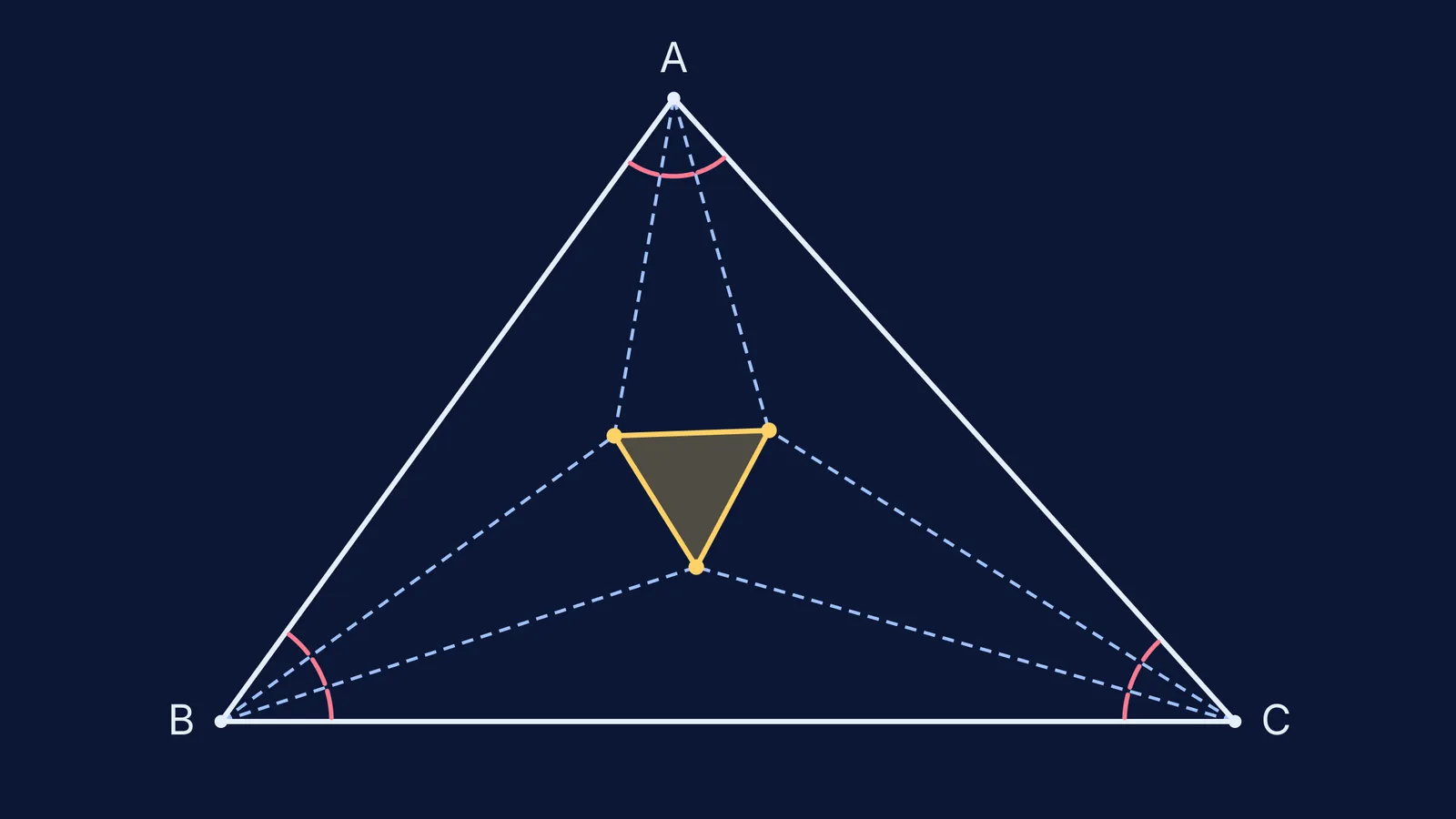
Draw any triangle and split each angle into three equal parts. Each side now has two trisectors next to it, one from each end, and they meet at a point. Join the three points and you get an equilateral triangle, whatever triangle you started with.
What does Morley's trisector theorem say?
Morley's trisector theorem states that in any triangle, the three points of intersection of the adjacent angle trisectors form an equilateral triangle, called the first Morley triangle (Wikipedia: Morley's trisector theorem).
The key word is adjacent: at side BC, pair the trisector from B nearest BC with the trisector from C nearest BC.
The same source gives the size: each side of the Morley triangle is 8R sin(A/3) sin(B/3) sin(C/3), where R is the circumradius and A, B, C are the angles of the original triangle. The expression is symmetric in A, B and C, a quick hint that the three sides come out equal.
Frank Morley, an English-born mathematician, taught at Haverford College in Pennsylvania until 1900, then moved to Johns Hopkins University (Wikipedia: Frank Morley). He found the theorem in 1899, while he was a professor at Haverford (cut-the-knot: Morley's Miracle).
How does the backward proof work?
Several early proofs relied on delicate trigonometric calculations (Wikipedia: Morley's trisector theorem). John Conway posted a different kind of proof to the geometry.puzzles newsgroup in 1995 (cut-the-knot: Conway's proof), and he later published a short note on the theorem in The Mathematical Intelligencer in 2014. His proof starts from the equilateral triangle and builds outwards.
Call the triangle's angles 3a, 3b and 3c. They add to 180°, so a + b + c = 60°.
Write x* for x + 60°. Take an equilateral triangle with side 1.
Make six more triangles from angle recipes: (a, b*, c*), (a*, b, c*), (a*, b*, c), and (a, b, c), (a, b, c), (a, b, c**). Each recipe adds up to 180°, so each triangle exists. Conway fixes the scale of each so that the edges facing the equilateral triangle have length 1.
Fit the seven pieces together. At every inside point the angles add up to 360°, and every pair of edges that meet either were both given length 1 or are a shared edge, so the pieces close up into one big triangle.
The big triangle is similar to your original triangle with its angles trisected. Its middle piece is the Morley triangle, and you built it equilateral at the start.
Why did the theorem surprise mathematicians?
The cut-the-knot page linked above describes the result as so surprising that it entered mathematical folklore as "Morley's Miracle". Triangles had been studied since antiquity, yet this simple equilateral triangle was only discovered in 1899.
Our guess, not documented history, is the tool kit. Angle trisection with straightedge and compass is a classical problem of ancient Greek mathematics, and Pierre Wantzel proved in 1837 that it cannot be done for an arbitrary angle (Wikipedia: Angle trisection). Geometers who built figures with those tools had little reason to draw trisectors at all.
It keeps attracting new proofs. Cletus Oakley and Justine Baker wrote about it in The American Mathematical Monthly in 1978, and Alain Connes published an algebraic proof in 1998 that extends the theorem to general fields other than characteristic three (Wikipedia: Morley's trisector theorem). It is a fact about flat geometry: the same Wikipedia article notes that it does not hold in spherical and hyperbolic geometry.
Worked example: how long is the Morley triangle's side?
Take the triangle in the picture above: angles A = 78°, B = 54°, C = 48°, with BC = 10 cm.
Find R from the sine rule, BC = 2R sin A: R = 10 / (2 × 0.9781) = 5.112 cm.
Take the thirds: 26°, 18° and 16°. Their sines are 0.4384, 0.3090 and 0.2756.
Multiply: 8 × 5.112 × 0.4384 × 0.3090 × 0.2756 = 1.527 cm.
We checked this with coordinates: all three sides came out at 1.527 cm.
Now try it yourself. For an equilateral triangle with side s, use R = s/√3 and angles of 60°. You should get a Morley side of about 0.185s. For guided sine-rule practice, the Fermi Problem Library has worked problems with a step-by-step solver that explains the reasoning rather than just giving the answer.
How can you see it with a ruler and protractor?
Draw a scalene triangle at least 12 cm across, so the Morley triangle is big enough to measure.
Measure each angle and mark its thirds lightly. Draw only the two trisectors next to each side.
Mark where each adjacent pair meets and join the three points.
Measure the three sides. They should agree to about a millimetre; a bigger gap usually means a trisector is off by a degree.
Next, try Viviani's theorem, another surprise inside an equilateral triangle, the complex-number condition for an equilateral triangle or Stewart's theorem for the length of a cevian. To revise the sine rule and circumradius, the Fermi Concept Library has a lesson for every concept in mathematics.


