On this page
Complex numbers are on the official JEE Main mathematics syllabus: Unit 2 of the NTA syllabus for JEE (Main) 2027 lists the Argand diagram and the modulus and argument of a complex number. The equilateral-triangle condition is where those ideas meet. Below, we derive it, then use it to find a missing vertex.
Why does a 60° rotation give the equilateral condition?
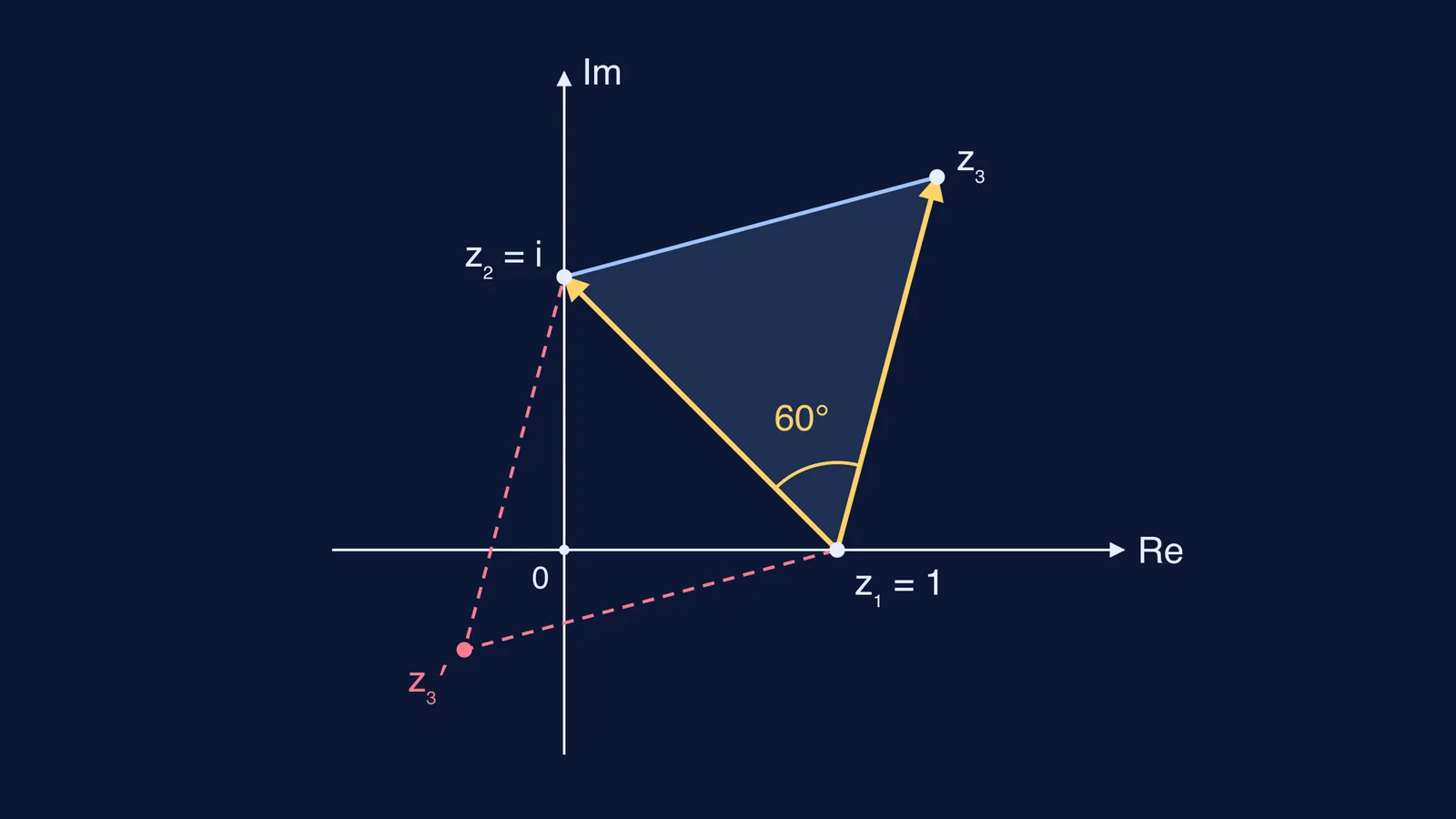
Multiplying a complex number by e^(iθ) turns it through the angle θ without changing its length, the idea behind using the Argand plane as a geometry tool. In an equilateral triangle, each side vector is another side vector turned through 60°.
Label the vertices anticlockwise. At z₁, turning the side towards z₂ by 60° gives the side towards z₃. At z₂, turning the side towards z₃ by 60° gives the side towards z₁:
z₃ − z₁ = (z₂ − z₁)e^(iπ/3)
z₁ − z₂ = (z₃ − z₂)e^(iπ/3)
Both right-hand sides carry the same factor, so divide one equation by the other and it cancels:
(z₃ − z₁)/(z₂ − z₁) = (z₁ − z₂)/(z₃ − z₂)
Cross-multiply to get (z₃ − z₁)(z₃ − z₂) = −(z₁ − z₂)², expand, and collect terms:
z₁² + z₂² + z₃² = z₁z₂ + z₂z₃ + z₃z₁
If the vertices run clockwise, both factors become e^(−iπ/3) and cancel the same way, so orientation does not matter. ProofWiki proves the same theorem with the same rotation idea. A note by Maria Gillespie writes it in an equivalent form, (z₁ − z₂)² + (z₂ − z₃)² + (z₃ − z₁)² = 0, and points out that shifting all three points by the same amount does not change it.
Does the converse hold?
Yes, for three distinct points. Using ω = e^(2πi/3), a cube root of unity, the difference of the two sides factorises:
z₁² + z₂² + z₃² − z₁z₂ − z₂z₃ − z₃z₁ = (z₁ + ωz₂ + ω²z₃)(z₁ + ω²z₂ + ωz₃)
Expand the right side and use ω + ω² = −1 to check it; our post on cube roots of unity and the JEE problem types covers the properties you need. If the first bracket is zero, subtract z₁(1 + ω + ω²) = 0 from it to get z₃ − z₁ = −ω²(z₂ − z₁) = e^(iπ/3)(z₂ − z₁), which is the rotation we started from. The second bracket gives the clockwise version.
One trap: z₁ = z₂ = z₃ also satisfies the equation, so the points must be distinct.
How do you find the third vertex in a JEE-style problem?
Problem. Two vertices of an equilateral triangle are z₁ = 1 and z₂ = i. Find the third vertex z₃.
Read the condition as a quadratic in z₃: z₃² − (z₁ + z₂)z₃ + (z₁² + z₂² − z₁z₂) = 0.
Substitute: z₁ + z₂ = 1 + i and z₁² + z₂² − z₁z₂ = 1 − 1 − i = −i, so z₃² − (1 + i)z₃ − i = 0.
Discriminant: (1 + i)² + 4i = 2i + 4i = 6i. Since (√3(1 + i))² = 3 × 2i = 6i, the square root is √3(1 + i).
So z₃ = (1 + i)(1 ± √3)/2, roughly 1.366 + 1.366i or −0.366 − 0.366i.
There are two answers, one on each side of the line joining 1 and i.
Check by distance. |z₁ − z₂| = √2. Write the first answer as z₃ = k(1 + i) with k = (1 + √3)/2, so k satisfies 2k² − 2k − 1 = 0. Then |z₃ − z₁|² = (k − 1)² + k² = 2k² − 2k + 1 = 2, so |z₃ − z₁| = √2 as well.
Check by the identity. The left side is 1 + (−1) + z₃² = 2ik². The right side is i + i·k(1 + i) + k(1 + i) = i + 2ik. They match because 2k² = 1 + 2k.
A triangle that fails. Take 0, 1 and i, a right isosceles triangle. The left side is 0 + 1 + i² = 0; the right side is 0 + i + 0 = i. They differ, so it is not equilateral, even though two sides are equal.
Which mistakes cost marks on this question?
Giving one third vertex when the question allows two.
Dropping the minus sign in (z₃ − z₁)(z₃ − z₂) = −(z₁ − z₂)².
Forgetting that the points must be distinct.
Using e^(iπ/3) for a clockwise triangle when you use complex rotation directly to find vertices. The identity ignores orientation; a rotation equation does not.
If you get stuck at the cross-multiplication or the discriminant, the Fermi Problem Library has worked problems with a step-by-step solver that explains the reasoning rather than printing an answer. If rotation by multiplication itself feels shaky, the Fermi Concept Library gives each mathematics concept its own lesson and shows where it sits in the map.
Next step: redo the worked problem with z₁ = 0 and z₂ = 2, and check that you get 1 ± i√3.