On this page
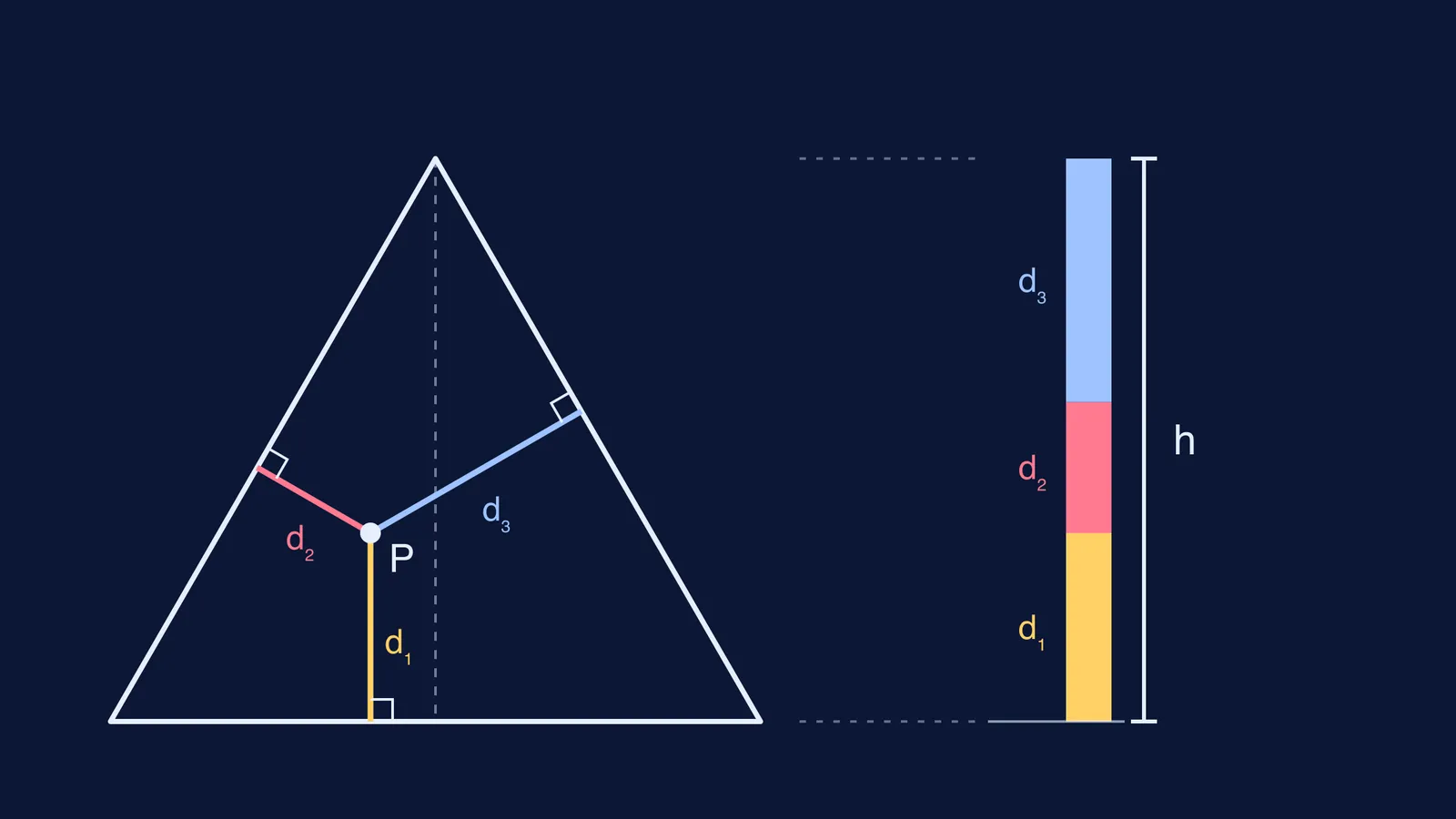
Draw an equilateral triangle, put a dot anywhere inside it, and drop a perpendicular from the dot to each side. Measure the three lengths and add them. Move the dot and do it again. The three numbers change, but the total does not.
What does Viviani's theorem say?
Viviani's theorem states that the sum of the perpendicular distances from any point inside an equilateral triangle to its three sides equals the triangle's altitude (Wikipedia, Wolfram MathWorld). It also holds when the point sits on a side (cut-the-knot).
The theorem is named after Vincenzo Viviani (1622-1703), a Florentine mathematician who lived with Galileo as his student and collaborator from 1639 until Galileo's death in 1642 (MacTutor History of Mathematics).
Why is the sum of distances constant in an equilateral triangle?
The shortest proof uses only area, as set out on Wikipedia and cut-the-knot. Call the side a, the altitude h, and the distances d1, d2 and d3.
Join P to the three corners. This cuts the big triangle into three smaller ones.
Each small triangle has a side of the big triangle as its base, length a, and its height is the distance from P to that side.
Their areas are a·d1/2, a·d2/2 and a·d3/2.
Together they fill the big triangle exactly, whose area is a·h/2.
So a(d1 + d2 + d3)/2 = a·h/2. Divide by a/2: d1 + d2 + d3 = h.
Step 5 is where equal sides matter: you can cancel a only because all three bases are the same length. To revisit where a·h/2 and h = (√3/2)a come from, see our derivation of the area of an equilateral triangle.
A worked example you can check with a ruler
Take an equilateral triangle with side 6 cm. Its altitude is (√3/2) × 6 = 3√3, about 5.20 cm.
At the centre, the three distances are equal: each is 5.20 ÷ 3, about 1.73 cm (exactly √3).
Slide P down until it is 1 cm above the base. The other two distances must now add up to 4.20 cm. If one is 1.5 cm, the other is 2.70 cm.
Push P into a corner. Two distances become 0 and the third is the whole altitude, 5.20 cm.
What breaks in other triangles?
Run the same area proof in a triangle with sides a, b and c and you get a·d_a + b·d_b + c·d_c = 2 × area. That weighted sum is fixed, but the plain sum is not, because the bases no longer cancel.
Try a right triangle with sides 3, 4 and 5 cm. Its area is 6 cm², so 3·d_a + 4·d_b + 5·d_c = 12.
At the right-angle corner, the distances to both legs are 0 and the distance to the hypotenuse is 12 ÷ 5 = 2.4 cm. Sum: 2.4 cm.
At the corner where the 4 cm leg meets the hypotenuse, the distance to the 3 cm leg is 4 cm and the other two are 0. Sum: 4 cm.
At the third corner, the sum is 3 cm.
Each distance changes at a steady rate as P moves along a straight line, so the sum is smallest and largest at the corners. In any triangle, the sum lies between the shortest and the longest altitude: here, 2.4 cm and 4 cm. Only when all three altitudes are equal, meaning the triangle is equilateral, does that range shrink to one number. Wikipedia states this converse: if the sum is the same for every interior point, the triangle is equilateral. The same source notes that the sum is also constant in any parallelogram.
How can you investigate it yourself?
A 10-minute plan for a student, or a parent and student together:
Predict first: in a 3-4-5 triangle, at which corner will the sum be largest? Write the guess down.
Measure three points in a 6 cm equilateral triangle with a set square and add the distances.
Measure the 3-4-5 triangle at its corners and at one point inside.
Explain in one sentence why the first totals agree and the second do not.
Bonus: find the point whose distances are in the ratio 1:2:3. (Answer: h/6, h/3 and h/2.)
Dragging a point by hand is slow. The Fermi Simulation Lab has interactive simulations for ideas that are easier to see than to read. If the 3-4-5 version trips you up, the Fermi Problem Library has worked problems with a step-by-step solver that explains the reasoning rather than printing an answer.
To compute each perpendicular from coordinates, see perpendicular distance from a point to a line. For another surprise hiding in equilateral triangles, read about Napoleon's theorem.