

On this page
What is the mystery of the three centres?
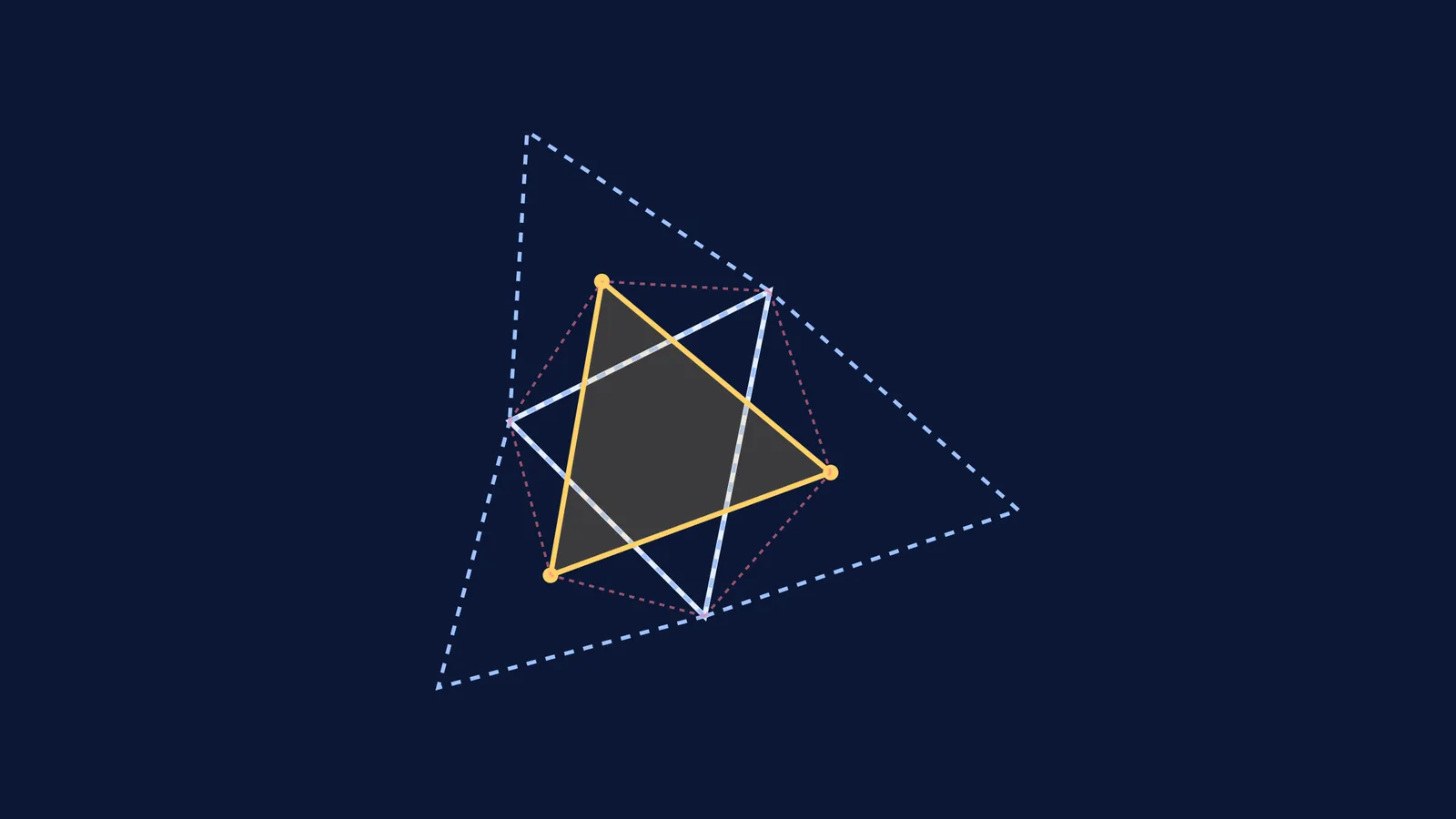
Start with an ordinary piece of paper and draw any triangle you like. It could be acute, obtuse, right-angled, or entirely uneven. Now, construct a perfect equilateral triangle on each of its three sides. You now have a central, random triangle surrounded by three outward-pointing, equilateral ones.
Finally, find the exact geometric centre—or centroid—of each of those three outer triangles. Connect those three newly found centres with straight lines. What shape have you just drawn?
According to Napoleon's theorem, those three centres will always form a perfect equilateral triangle, no matter what shape you started with (Wolfram MathWorld). Even if you stretch, squash or pull the original central triangle into a strange, needle-like sliver, the new triangle connecting the centres stubbornly scales and rotates but remains undeniably equilateral.
Does dynamic geometry help you learn?
Reading a geometric rule in a textbook is one thing; truly believing it and building intuition is another. Instead of accepting a theorem on trust, you can test it by dragging points in an interactive geometry tool.
When you use a dynamic tool, you manipulate the triangle's corners in real time and watch the centres update instantly. A major meta-analysis published in the *Journal of Educational Computing Research* found that learning with dynamic geometry software leads to a large positive effect size (d = 1.02) on student achievement (Chan & Leung, 2014). This means students who use these tools significantly outperform those taught with traditional paper-and-pencil methods, as the software provides immediate visual feedback.
Students who drag and test shapes build a much deeper conceptual understanding because they see the rule holding true under every possible condition. The software takes away the slow, error-prone burden of redrawing shapes with a compass and protractor, freeing up your brain to look for the underlying patterns.
How can you predict and test it yourself?
You can predict the outcome of geometric transformations and test them interactively in the Fermi Simulation Lab. If you do not know where to start, Fermi's AI tutor works out what you already know and builds a plan for the session, guiding you to discover the rule rather than just giving you the final answer.
To explore this theorem dynamically, follow these steps:
Draw a random base: Plot three points randomly on the canvas to form an uneven triangle.
Predict the shape: Before proceeding, try to guess how the outer shapes will interact.
Build the outer triangles: Instruct the tool to construct equilateral triangles on each side of your starting shape.
Find the centres: Mark the centroid (where the medians intersect) of each outer triangle.
Connect the dots: Draw lines between the three outer centroids to reveal the inner shape.
Drag and break it: Grab any point of your original triangle and drag it wildly across the screen.
As you move the points, you will watch the centre triangle stretch, shrink, and rotate. Yet, its three angles will never deviate from 60 degrees. This active cycle—predict, manipulate, observe—is how mathematicians build real intuition. If you are ever unsure about a geometric property, such as why the angle sum of a triangle is always 180 degrees, exploring it dynamically turns an abstract rule into a visible, undeniable fact.
Wait, did Napoleon Bonaparte discover it?
The theorem carries the name of Napoleon Bonaparte (1769–1821). However, mathematicians and historians have found no solid evidence that the French Emperor actually discovered the theorem himself.
Instead, its published appearance in geometric literature has been traced back to 1825, a few years after his death (Wolfram MathWorld). Because of his well-known interest in mathematics, the attribution has persisted in modern geometry textbooks.
Regardless of who first discovered it, the theorem remains a classic, beautiful piece of geometry. When you are studying the properties of shapes, such as types of triangles by sides and angles, the best way to master them is to play with the rules. The next time you face a new geometry theorem, do not just memorise the textbook statement. Draw it, stretch it, and prove it to yourself.


