

On this page
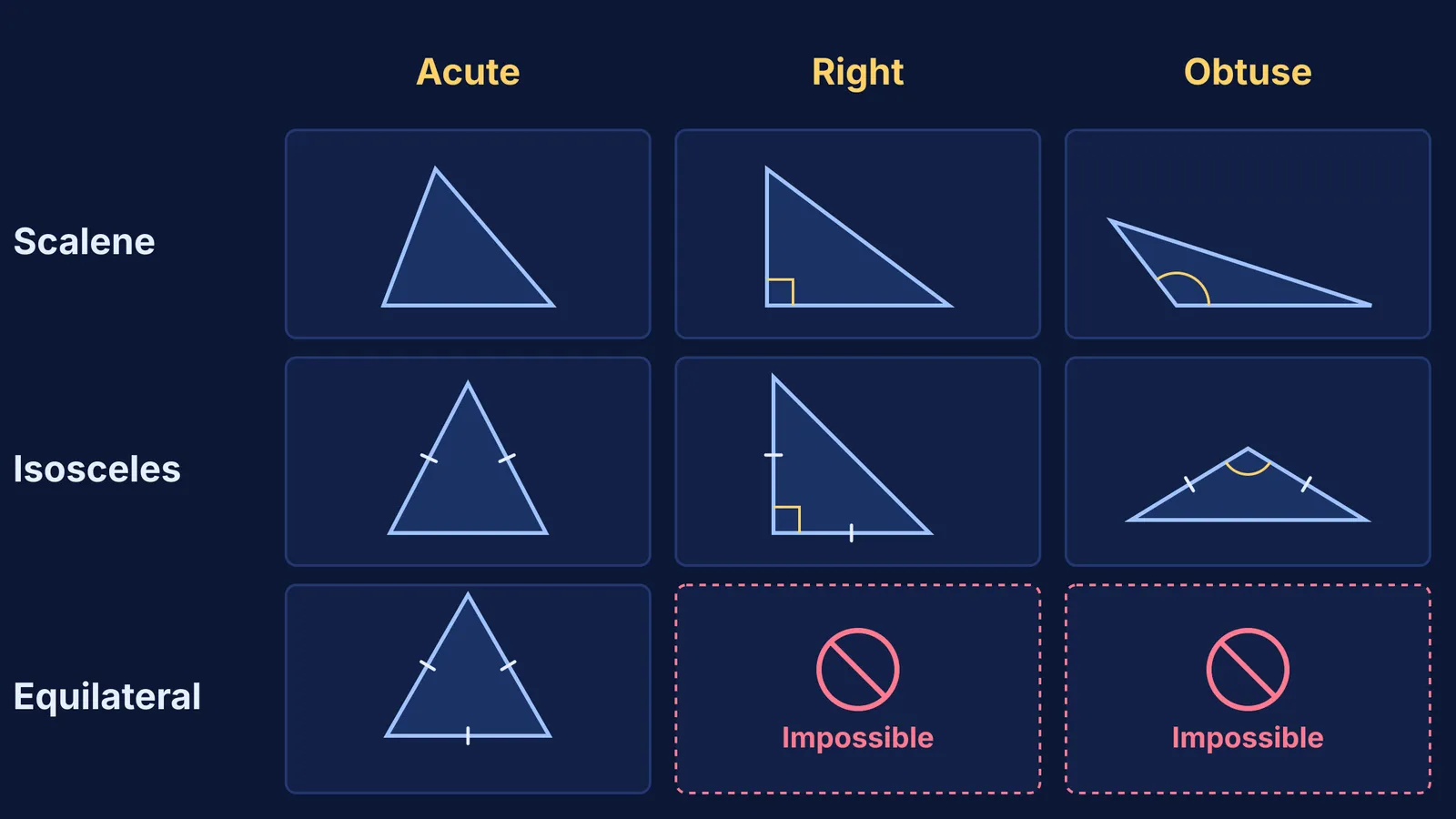
Every triangle is classified using two independent criteria: the relative lengths of its three sides and the size of its three internal angles. As established in Euclid's Elements, Book I, Definitions 20 and 21, classifying by sides yields three categories:
Scalene: all three side lengths are unequal, so all three interior angles are distinct.
Isosceles: at least two sides are equal in length, and the angles opposite them are congruent.
Equilateral: all three sides are equal in length, and all three interior angles measure 60°.
Classification by internal angles yields three categories, as catalogued on Wolfram MathWorld:
Acute: all three interior angles measure strictly less than 90°.
Right: exactly one interior angle measures 90°. The opposite side is the hypotenuse, and the adjacent sides are legs.
Obtuse: exactly one interior angle measures greater than 90° and less than 180°.
In a 1999 article in Teaching Children Mathematics, Pierre M. van Hiele showed that students often treat geometric shapes as mutually exclusive categories instead of hierarchical sets. Under standard definitions, an equilateral triangle is a special isosceles triangle where all three sides happen to be equal.
Which combinations of sides and angles are impossible?
Pairing three side categories with three angle categories suggests nine theoretical combinations. However, two of these pairings cannot exist in a plane.
The reason lies in the angle sum property proven in Euclid's Elements, Book I, Proposition 32: the three interior angles of any planar triangle sum to 180°. Because an equilateral triangle has three equal side lengths, its three interior angles must also be equal. Dividing 180° by 3 yields exactly 60° per angle.
This requirement immediately eliminates two combinations:
Equilateral right triangle: impossible. A right angle is 90°. If an equilateral triangle had one 90° angle, all three equal angles would need to be 90°, producing an impossible sum of 270°.
Equilateral obtuse triangle: impossible. An obtuse angle exceeds 90°. If an equilateral triangle had an obtuse angle, the three equal angles would sum to more than 270°, violating the 180° rule.
Because an equilateral triangle can only have 60° angles, it is always acute. Only seven of the nine theoretical combinations exist.
What are the seven real triangle combinations?
The seven valid pairings cover every planar triangle in Euclidean geometry, as outlined on Wolfram MathWorld:
Acute scalene: three unequal sides with all angles under 90° (such as sides 5, 6, and 7).
Right scalene: three unequal sides with one 90° angle (the standard 3-4-5 triangle).
Obtuse scalene: three unequal sides with one angle over 90° (such as sides 4, 6, and 9).
Acute isosceles: two equal sides with all angles under 90° (such as angles of 70°, 70°, and 40°).
Right isosceles: two equal sides with one 90° angle (the 45°-45°-90° triangle).
Obtuse isosceles: two equal sides with one angle over 90° (such as angles of 120°, 30°, and 30°).
Equilateral acute: all three sides equal and all three angles measuring 60°.
While an equilateral triangle can only be acute, scalene and isosceles triangles can each take any of the three angle forms.
How do you classify a triangle from three side lengths?
When a problem provides three side lengths without angles, you can classify the shape using a three-step method:
Check existence: ensure the sum of the two shorter sides exceeds the longest side (a + b > c). If a + b ≤ c, no triangle can close.
Classify by sides: count equal sides. Three equal sides make it equilateral; two make it isosceles; three distinct sides make it scalene.
Classify by angles: order side lengths so that a ≤ b ≤ c, and compare c² to a² + b² using the Pythagorean criterion from Wolfram MathWorld.
The square comparison indicates the angle type:
If c² < a² + b², the triangle is acute.
If c² = a² + b², the triangle is right-angled.
If c² > a² + b², the triangle is obtuse.
Take side lengths 4, 6, and 9: first, 4 + 6 = 10 > 9, confirming a valid triangle. Second, all sides differ, so it is scalene. Third, 4² + 6² = 16 + 36 = 52, while 9² = 81. Because 81 > 52 (c² > a² + b²), the triangle is obtuse scalene.
How can students master geometry without memorising?
School curricula connect triangle properties and constructions in Class 7 to formal proofs using Class 9 triangle congruence criteria and area calculations with Heron's formula from three side lengths. Rote learning falters when diagrams are rotated or lack explicit angle markers.
Mastering geometry requires understanding how side constraints determine angles. The Fermi Concept Library maps every concept in physics, chemistry, biology, mathematics and computing, each with its own lesson and its place in the map. For practice with proofs and coordinate geometry, the Fermi Problem Library has worked problems with a step-by-step solver that explains the reasoning rather than printing an answer.
If you want structured guidance on geometric properties, Fermi's AI tutor can work out what you already know and build a plan for the session, drawing the figure and checking understanding as it goes.


