

On this page
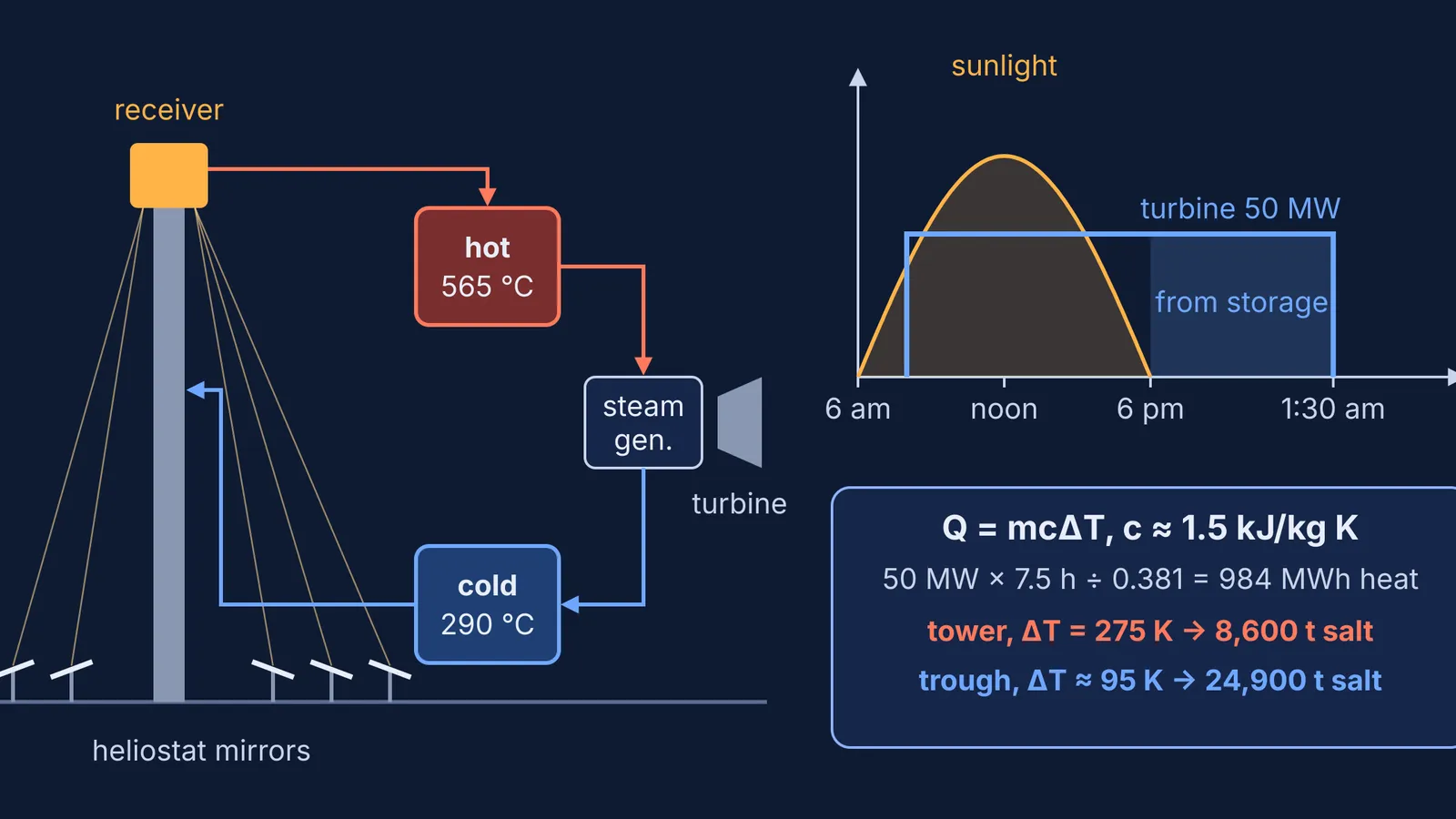
Solar panels stop making power when the Sun sets. Some solar power stations do not. A concentrating solar plant uses mirrors to heat a molten salt during the day, keeps the hot salt in a large insulated tank, and runs a steam turbine from it through the evening. The storage is nothing more exotic than Q = mcΔT, and that one equation explains why the hottest plants need far less salt.
How does a molten-salt solar plant keep working after sunset?
There are two common designs. In a power tower, a field of flat mirrors called heliostats tracks the Sun and reflects its light onto a receiver at the top of a tower. In a parabolic trough plant, long curved mirrors focus sunlight onto a pipe that runs along each trough. How mirrors concentrate sunlight is the same idea as in how a solar cooker uses physics to cook food, scaled up to a few square kilometres.
A two-tank store works like this.
Salt is pumped from the cold tank to the receiver, where concentrated sunlight heats it.
The hot salt goes into the hot tank and waits there.
Whenever power is needed, by day or night, hot salt flows through a steam generator. It boils water, and the steam drives a turbine.
The cooled salt returns to the cold tank.
Because the turbine draws from the hot tank, not straight from the sunlight, the plant can keep generating for hours after sunset. The steam cycle itself, boiler to turbine to condenser, is the subject of William Rankine's cycle.
What is solar salt, and why use a molten salt at all?
The usual storage salt, often called "solar salt", is 60% sodium nitrate and 40% potassium nitrate by mass. Sandia National Laboratories' design basis document for molten-salt power towers gives its properties:
It starts to crystallise at 238 °C and is solid at 221 °C.
It can be used as a liquid from about 260 °C to about 621 °C.
Density: ρ = 2090 − 0.636T kg/m³ (T in °C), about 1,906 kg/m³ at 290 °C and 1,731 kg/m³ at 565 °C.
Specific heat: c = 1443 + 0.172T J/kg K, between 1.49 and 1.54 kJ/kg K over 290 to 565 °C. We use 1.5 kJ/kg K below.
It has a low vapour pressure, so the tanks do not need to hold high pressure.
Why not water? Water has a larger specific heat, about 4.2 kJ/kg K, but it cannot stay liquid above its critical temperature of about 374 °C at any pressure, and even below that a hot-water tank must be a pressure vessel. A molten salt stays liquid over a wide range at ordinary pressure, which is what makes a big, cheap tank possible.
The catch is at the bottom end. Since the salt freezes around 220 °C, the "cold" tank is still very hot, about 290 °C in the Sandia design, and pipes need heating so that salt never solidifies in them.
Worked example: how much salt for 7.5 hours of power?
Take a plant with a 50 MW turbine that must run for 7.5 hours after sunset. NREL's project database lists Andasol 1 in Spain with exactly these numbers, a 50 MW turbine with 7.5 hours of storage and a turbine efficiency of 38.1%, so we use them.
Electrical energy needed. 50 MW × 7.5 h = 375 MWh.
Heat needed. The 38.1% is heat into electricity at the turbine, so heat = 375 ÷ 0.381 = 984 MWh = 984 × 3.6 × 10⁹ J = 3.54 × 10¹² J.
Tower plant. The salt cycles between 290 °C and 565 °C, as in the Sandia design, so ΔT = 275 K. m = Q ÷ (cΔT) = 3.54 × 10¹² ÷ (1,500 × 275) = 8.59 × 10⁶ kg, about 8,600 tonnes.
Volume of that salt. At 1,906 kg/m³ (cold) it fills about 4,500 m³; hot, at 1,731 kg/m³, it swells to about 5,000 m³.
Trough plant. Here the mirrors heat an oil, and the oil heats the salt. NREL lists Andasol 1's oil leaving the solar field at 393 °C, so the salt can only be heated to a little below that. Take an illustrative salt range of about 290 °C to 385 °C, ΔT ≈ 95 K. m = 3.54 × 10¹² ÷ (1,500 × 95) = 2.49 × 10⁷ kg, about 24,900 tonnes.
Check against the real plant: NREL lists Andasol 1's store as 28,500 tons of solar salt holding 1,010 MWh. Working backwards, 1,010 × 3.6 × 10⁹ ÷ (2.85 × 10⁷ × 1,500) gives an effective ΔT of about 85 K, close to our estimate. So the sum is the right size.
Why does a hotter tank need about a third of the salt?
For the same heat, m ∝ 1/ΔT. Per tonne of salt:
Tower, ΔT = 275 K: 1,000 × 1,500 × 275 = 0.41 GJ per tonne.
Trough, ΔT ≈ 95 K: 1,000 × 1,500 × 95 = 0.14 GJ per tonne.
The tower stores about 2.9 times as much heat in each tonne, so it needs about a third of the salt and smaller tanks for the same evening of power.
There is a second gain. A hotter source raises the ceiling on turbine efficiency. With the condenser at an illustrative 40 °C (313 K), the Carnot limit is 1 − 313/838 = 63% for steam from 565 °C salt and 1 − 313/658 = 52% for 385 °C. Real turbines get well under these limits, but the hotter plant starts from a higher one. Both gains point the same way.
How is this different from a solar pond?
A salt-gradient solar pond also stores solar heat in salt water, but only at about 80 °C. That is fine for process heat, but too cool to make high-pressure steam for a turbine. Molten-salt storage works at 290 to 565 °C, which is why it can drive a power station.
If you want to see how ΔT, mass and specific heat trade off before solving, the Simulation Lab has interactive simulations for ideas that are easier to see than read.
Quick checklist
Two tanks: cold (about 290 °C) and hot (565 °C in a tower); the turbine runs from the hot tank.
Solar salt: 60% NaNO₃, 40% KNO₃, c ≈ 1.5 kJ/kg K, freezes near 220 °C.
Heat needed = electrical energy ÷ turbine efficiency.
Mass of salt m = Q ÷ (cΔT); bigger ΔT means less salt.
Tower ΔT of 275 K needs about a third of the salt of a trough's ΔT of about 95 K.
A hotter hot tank also raises the Carnot limit of the turbine.


