On this page
The NEET (UG) 2026 syllabus lists Molecular Basis of Inheritance under Unit 7, Genetics and Evolution; NCERT covers it in Class 12 Biology, Chapter 5. Many slips here come from a slogan applied to the wrong strand, subunit or count.
Below are eight frequent slips, each with its cause, what the NCERT chapter (Reprint 2026-27) says by section, a quick check and a habit. For the previous chapter's crosses, use our step-by-step method for NEET genetics problems.
Which strand, and which stretch of RNA?
"The template running 5'→3' is the one copied without breaks."
Why it happens: "polymerase works 5'→3'" gets pinned on the template instead of the new strand.
What NCERT says (5.4.2): DNA polymerases add on only in the 5'→3' direction, so at the fork the template with polarity 3'→5' is copied continuously, the template with polarity 5'→3' is copied in pieces, and DNA ligase joins those pieces.
Check: a fork opens rightwards. The top template reads 3'→5' left to right; the bottom reads 5'→3'. Which gets one unbroken new strand? (The top: its new strand runs 5'→3' left to right, the way the fork moves.)
Habit: write each template's polarity in the direction the fork moves, then apply the rule: 3'→5' means continuous.
"Untranslated regions are just introns by another name."
Why it happens: both get filed under "non-coding" in quick notes.
What NCERT says (5.5.2, 5.5.3, 5.7): introns sit in the primary transcript and are gone from mature RNA after splicing, while UTRs remain in the mRNA, at the 5' end before the start codon and at the 3' end after the stop codon, and are needed for efficient translation.
Check: a ribosome is reading a finished eukaryotic mRNA. Can it still meet UTRs, introns or both? (Only the UTRs.)
Habit: for any non-coding stretch, ask whether it is still there at the ribosome.
Which part does which job?
"DNA polymerase can start a new strand on its own, wherever the helix opens."
Why it happens: the polymerase gets credit for all of replication.
What NCERT says (5.4.2): DNA polymerases cannot begin replication by themselves, and replication does not begin at random places; in E. coli it starts from a definite region, the origin of replication.
Check: true or false? (a) The polymerase alone can begin a brand-new strand. (b) Copying of the E. coli chromosome may begin at any point. (Both false.)
Habit: whenever replication starts in a question, point to the origin.
"Translation starts on the large subunit, since that is where amino acids bind."
Why it happens: the two subunits blur into one "ribosome".
What NCERT says (5.7): translation begins when the small subunit meets an mRNA; the two sites where successive amino acids sit close enough to be joined are on the large subunit.
Check: mark each S or L: first contact with the mRNA; the pair of amino-acid sites. (S, then L.)
Habit: small subunit meets the message, large subunit links the amino acids.
Which ideas get stretched too far?
"DNA was the first genetic material, and RNA came later as its messenger."
Why it happens: the central dogma arrow, DNA to RNA to protein, gets read as a timeline.
What NCERT says (5.3): RNA was the first genetic material and also acted as a catalyst; being reactive it was unstable, so DNA evolved from RNA with chemical changes that made it more stable.
Check: does DNA → RNA → protein say which molecule came first? (No. It shows today's information flow.)
Habit: keep "information flow today" and "order of evolution" apart.
"Every new mutation counts as a DNA polymorphism."
Why it happens: polymorphism arises from mutation, so the two words merge.
What NCERT says (5.10): new mutations can arise in somatic cells or in germ cells, and a polymorphism is an inheritable variation seen often in a population: more than one allele at a locus, at a frequency above 0.01.
Check: a fresh change appears in one person's skin cells and nowhere else. Is it a DNA polymorphism? (No. It is not inherited and is not common in the population.)
Habit: call it a polymorphism only if it is inherited and frequent.
Which counts and mutations get mixed up?
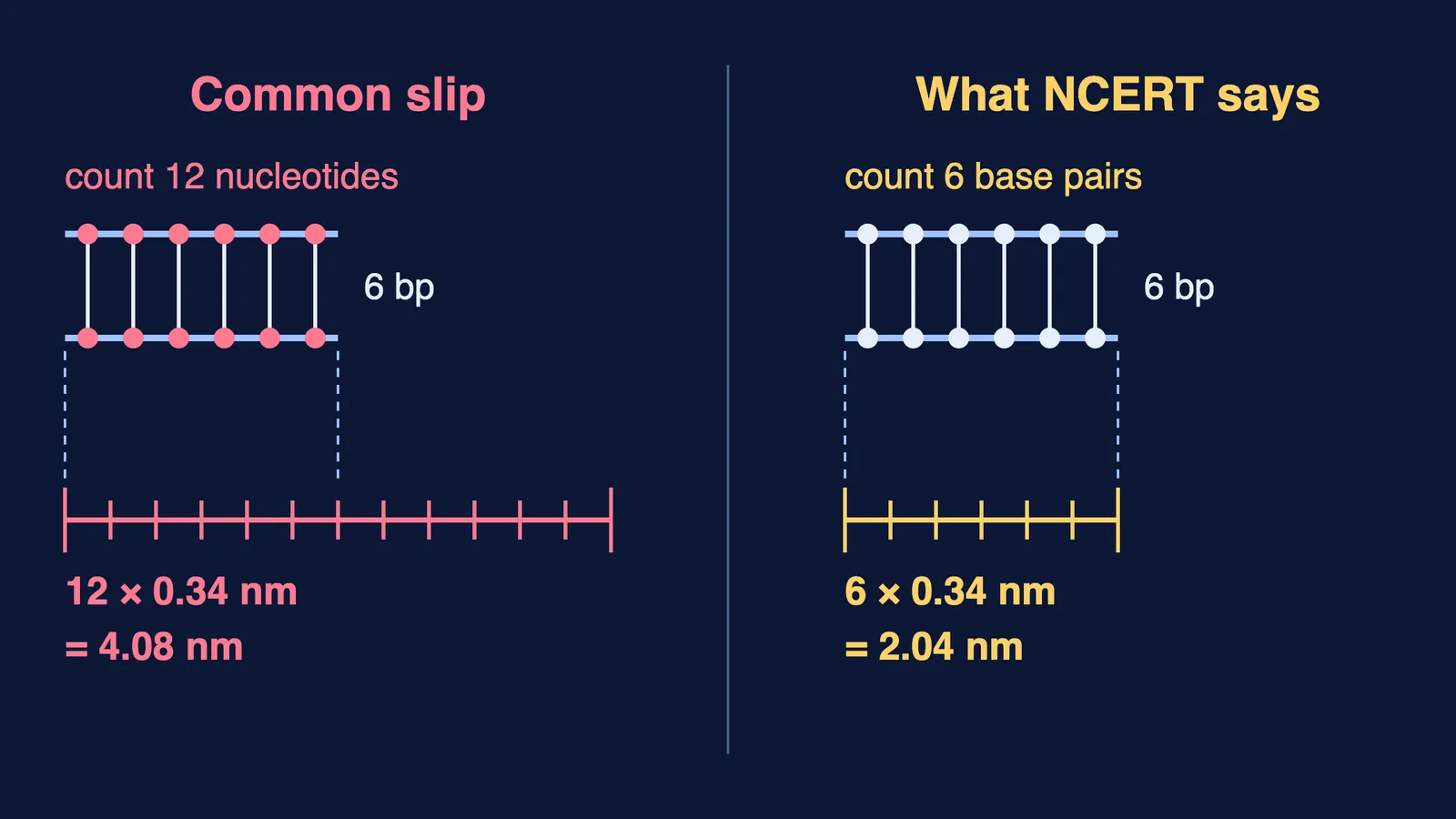
"DNA length is the number of nucleotides times 0.34 nm."
Why it happens: NCERT's opening lines give lengths in both nucleotides and base pairs.
What NCERT says (5.1, 5.1.2): 0.34 nm is the gap between two consecutive base pairs, so length is base pairs times 0.34 nm, as in its figure of about 2.2 metres for 6.6 × 10⁹ bp.
Check: a double-stranded DNA holds 24,000 nucleotides across both strands. How long is it? (12,000 bp × 0.34 nm = 4,080 nm, about 4.08 µm; using 24,000 gives 8.16 µm, double the real length.)
Habit: for double-stranded DNA, halve the nucleotide count to get base pairs before you multiply.
"Any change of a single base shifts the reading frame."
Why it happens: point mutation and frameshift share a page, so they blur.
What NCERT says (5.6.1): in sickle cell anaemia, one base pair changes in the beta globin gene and one amino acid changes, glutamate to valine. Inserting or deleting one or two bases shifts the reading frame from that point; inserting or deleting three, or a multiple of three, adds or removes whole codons and leaves the frame intact after it.
Check: after one change, a 15-base coding stretch still has 15 bases and only its third codon reads differently. A swapped base or a lost base? (A swapped base, a point mutation: losing a base would leave 14 and shift every codon after it.)
Habit: ask "swapped, added or lost, and how many?" first.
This is a study summary, not medical advice.
A 60-second self-check before you mark
When a check trips you, note the wrong belief beside NCERT's section and redo it two days later. For mixed chapter questions, try our molecular basis of inheritance practice questions with solutions.
Not sure which of these slips are yours? Fermi's AI tutor works out what you already know and builds a plan for the session.