

On this page
NCERT's Class 12 chapter on electrostatic potential ends with a short sum that most students solve in three lines and few really understand. A substance whose molecules have a permanent dipole moment of 10⁻²⁹ C m is fully polarised at low temperature by a field of 10⁶ V/m. The field direction is suddenly turned through 60°. How much heat does one mole release as its dipoles line up with the new field? The answer is about 3 J. Getting there needs the right energy formula, the right angle, and a reason why the question insists on "low temperature".
What happens to the dipoles when the field turns?
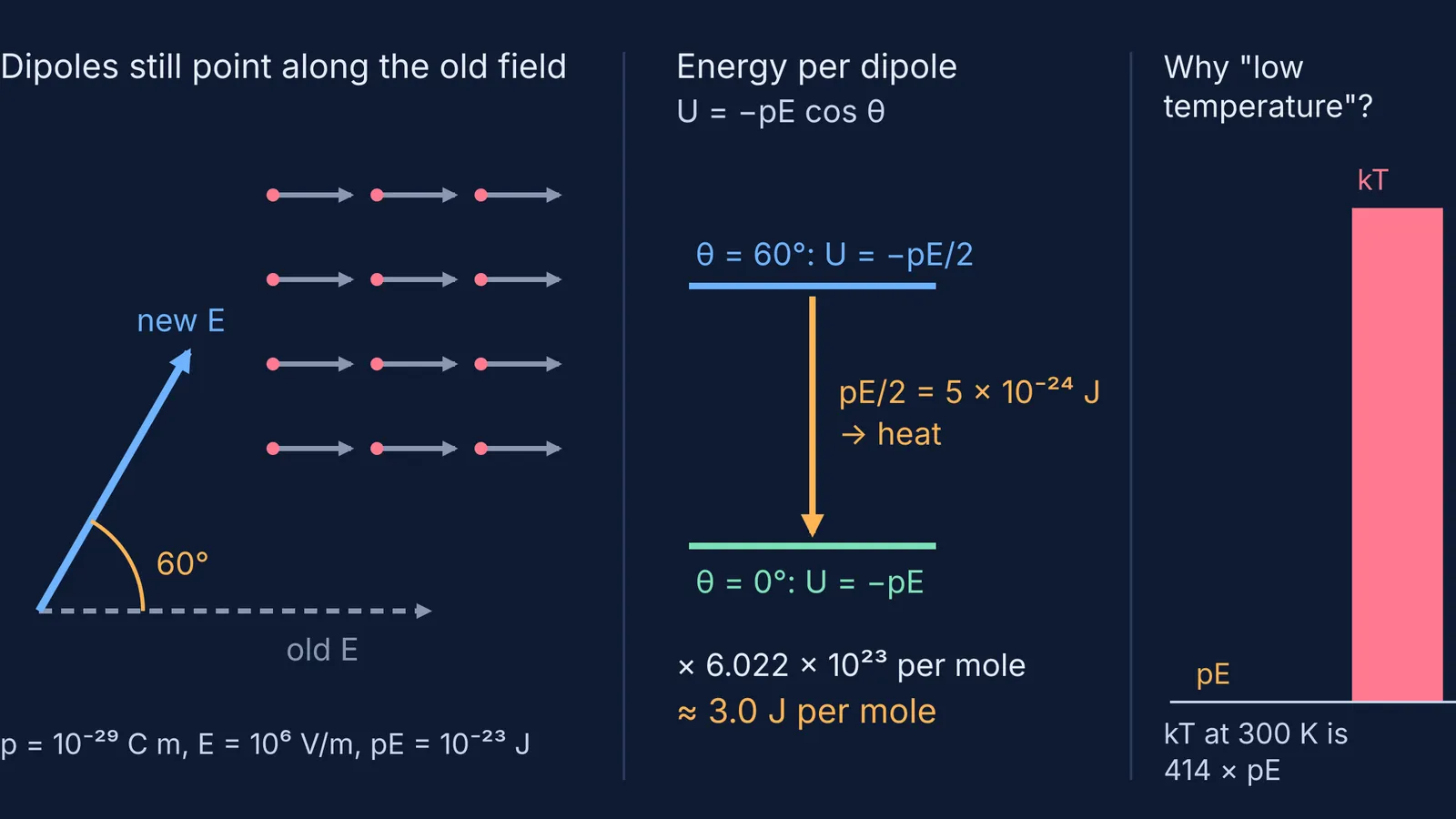
Before the change, every dipole points along the field, so it sits at θ = 0° in the position of lowest energy. The field then swings by 60° faster than the molecules can follow. For an instant the dipoles have not moved, so measured from the new field each one now sits at θ = 60°.
A dipole at an angle to a uniform field feels a torque of magnitude pE sin θ that turns it towards the field. The torque and the stable and unstable equilibrium positions are covered in torque and equilibrium of an electric dipole in a uniform field. The single-dipole energy curve, and why 0° is stable while 180° is not, is in electric dipole potential energy and stable orientations. This post scales that picture up to a mole and follows the energy.
An isolated dipole would overshoot and swing back and forth about the new direction. In a real substance each molecule keeps bumping into its neighbours. Those collisions damp the swing, and the energy the dipole loses goes into random motion of the surrounding molecules. That is heat. It is not radiated away as light.
How do you calculate the heat released per dipole?
Use the potential energy of a dipole in a uniform field:
U = −pE cos θ
At the start (θ = 60° from the new field): U₁ = −pE cos 60° = −pE/2.
At the end (θ = 0°): U₂ = −pE cos 0° = −pE.
The heat released is the drop in potential energy:
Q = U₁ − U₂ = −pE/2 − (−pE) = pE(1 − cos 60°) = pE/2
You can check this a second way. The field's torque pE sin θ does work as the dipole turns from 60° to 0°. Adding up torque × small angle over that turn gives pE(cos 0° − cos 60°) = pE(1 − cos 60°), the same result. For any turn angle α the general answer is pE(1 − cos α) per dipole.
Worked example: how do you get 3 J per mole?
Data: p = 10⁻²⁹ C m, E = 10⁶ V/m, field turned by 60°, N_A = 6.022 × 10²³ mol⁻¹, 100% alignment assumed.
Find pE. pE = 10⁻²⁹ C m × 10⁶ V/m = 10⁻²³ J. Units check: C m × V/m = C × V = J.
Energy released per dipole. pE(1 − cos 60°) = 10⁻²³ × (1 − 0.5) = 5 × 10⁻²⁴ J. That is about 3 × 10⁻⁵ eV, a very small amount per molecule.
Scale to one mole. 5 × 10⁻²⁴ J × 6.022 × 10²³ = 3.01 J.
Round sensibly. The data have one significant figure, so the answer is about 3 J per mole, which is NCERT's answer.
For scale, 3 J would warm one gram of liquid water by about 0.7 °C. It is a real, measurable amount of heat, but only because every one of the 6 × 10²³ dipoles contributes.
Why does the question say "at low temperature"?
The whole calculation assumes every dipole starts perfectly aligned. Compare the aligning energy with the thermal energy at room temperature.
pE = 10⁻²³ J.
kT at 300 K = 1.381 × 10⁻²³ J/K × 300 K = 4.14 × 10⁻²¹ J.
pE/kT ≈ 0.0024.
Thermal energy is about 400 times larger than the energy the field can offer, so collisions keep knocking the dipoles in random directions. For pE much smaller than kT, statistical physics (the Langevin result) gives the average alignment as ⟨cos θ⟩ ≈ pE/3kT ≈ 8 × 10⁻⁴. Only about 0.08% net alignment survives.
The heat released then scales down by the same factor: roughly 3 J × 8 × 10⁻⁴, a few millijoules per mole. That is about a thousand times smaller than the textbook answer.
To get 90% average alignment you need pE/kT ≈ 10, which for these numbers means T ≈ 0.07 K. So "100% polarisation" is an idealisation that needs temperatures well below 1 K. At such temperatures many real molecules are locked in a solid and cannot rotate freely at all, so treat the sum as an order-of-magnitude estimate, not a lab prediction. How polar molecules in a dielectric line up partially in a field, and why that creates bound charge, is covered in how a dielectric gets polarised.
Is a dipole moment of 10⁻²⁹ C m realistic?
Yes. Molecular dipole moments are usually quoted in debye, where 1 D ≈ 3.336 × 10⁻³⁰ C m. So 10⁻²⁹ C m is about 3.0 D. Water's dipole moment is about 1.85 D, or 6.2 × 10⁻³⁰ C m, so the NCERT value is the size of a fairly polar molecule.
The field is also sensible. 10⁶ V/m is 10 kV per centimetre: strong, but still below the field at which dry air breaks down, roughly 3 × 10⁶ V/m.
If you find it hard to picture a dipole being twisted by a field and settling into line, the Simulation Lab has interactive simulations for ideas that are easier to see than read.
What mistakes cost marks in this question?
Using pE cos 60° or pE sin 60° instead of the change in U.
Measuring θ from the old field. The final energy is set by the new field, so measure both angles from it.
Forgetting to multiply by Avogadro's number and reporting 5 × 10⁻²⁴ J as the answer.
Writing the answer as negative. "Heat released" is a positive quantity: the potential energy falls by 3 J and 3 J of heat comes out.
Saying the energy is radiated. It goes into the lattice through collisions.
Quick checklist
U = −pE cos θ, with θ measured from the field the dipole ends up in.
Heat released per dipole for a turn α: pE(1 − cos α); for 60°, pE/2 = 5 × 10⁻²⁴ J.
Per mole: × 6.022 × 10²³ gives about 3 J.
The answer needs full alignment, which needs pE much larger than kT; at 300 K, pE/kT is only 0.0024.
At room temperature the heat would be a few millijoules per mole, not 3 J.


