

On this page
Placing an insulator, or dielectric, between the plates of a capacitor does not just take up space—it changes the electrical properties of the system. By responding to the external electric field, the material reduces the voltage required to hold a given amount of charge, thereby increasing the capacitance.
How does a dielectric get polarised in an electric field?
At the molecular level, insulators respond to an electric field through polarization. According to OpenStax University Physics, polarization is the process where an external electric field causes a separation of positive and negative charges within the material.
This happens in two ways, depending on the molecules involved. In materials with non-polar molecules, like oxygen, the external field exerts forces in opposite directions on the nucleus and the electron cloud, stretching them apart to create an induced dipole. In contrast, polar molecules like water already have a permanent dipole moment. When the external field is applied, it exerts a torque that forces these randomly oriented molecules to align with the field.
Where does the bound surface charge come from?
As millions of microscopic dipoles align within the dielectric, an interesting macroscopic effect emerges. Inside the bulk of the material, the positive end of one dipole sits right next to the negative end of its neighbour. These adjacent charges effectively cancel each other out, leaving the interior electrically neutral.
However, at the very edges of the dielectric, there are no neighbouring molecules to provide a cancelling charge. This results in a persistent layer of charge on the outer faces. These charges are called bound surface charges because they belong to the stationary molecules of the dielectric and cannot flow like the free charges on the capacitor plates.
Why does the net electric field decrease?
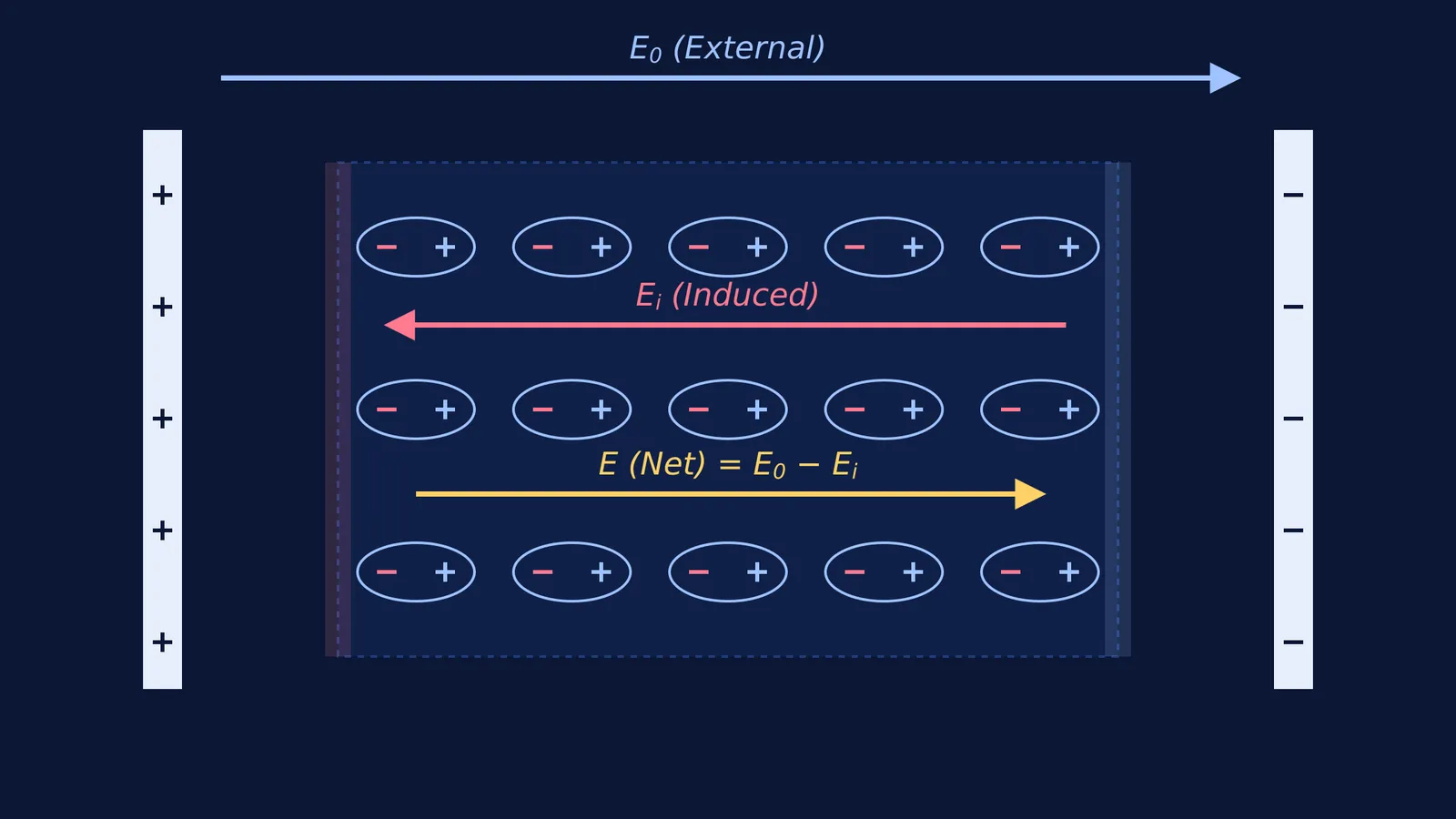
The appearance of these bound surface charges changes the electric field inside the capacitor. The bound charges create their own internal electric field, known as the induced electric field (Eᵢ). Because the negative bound charge faces the positive capacitor plate and the positive bound charge faces the negative plate, Eᵢ points in the exact opposite direction to the external field (E₀).
The net electric field (E) inside the dielectric is the vector sum of these two fields: E = E₀ - Eᵢ. Since the induced field opposes the external one, the total field inside the material is always reduced. The factor by which the field is reduced is called the dielectric constant (κ), defined mathematically as κ = E₀ / E.
The Fermi Concept Library contains every concept in physics, chemistry, biology, mathematics and computing, each with its own lesson and its place in the map. This is highly useful when you need to visualize how these vector fields overlap and oppose one another.
A mental checklist for dielectric problems
When solving physics problems involving dielectrics, students often make errors by confusing free charge with bound charge. Having a structured approach ensures you handle the variables correctly.
Identify the external field first. Calculate E₀ as if the dielectric block were not there, based only on the free charges on the plates.
Apply the dielectric constant. The net field inside the dielectric is always E = E₀ / κ.
Calculate the bound charge. Use the standard relationship for induced charge: Qᵢ = Q₀(1 - 1/κ). Notice that the bound charge Qᵢ will always be less than the free charge Q₀.
Check for breakdown. Remember that if the net field exceeds the material's dielectric strength, the insulator will break down and conduct electricity. According to OpenStax, Teflon undergoes dielectric breakdown at 60 MV/m.
If you struggle to apply these formulas in different scenarios, the Fermi Problem Library has worked problems with a step-by-step solver that explains the reasoning rather than printing an answer.


