On this page
Put a small plastic frog at the bottom of a mirascope and a second frog appears in the hole on top, sitting in mid-air. It looks solid. You reach for it and your fingers close on nothing. The toy is just two concave mirrors, and everything it does follows from two facts you already know: light from a focus leaves a concave mirror parallel, and parallel light is brought to the focus.
What is a mirascope and how is it built?
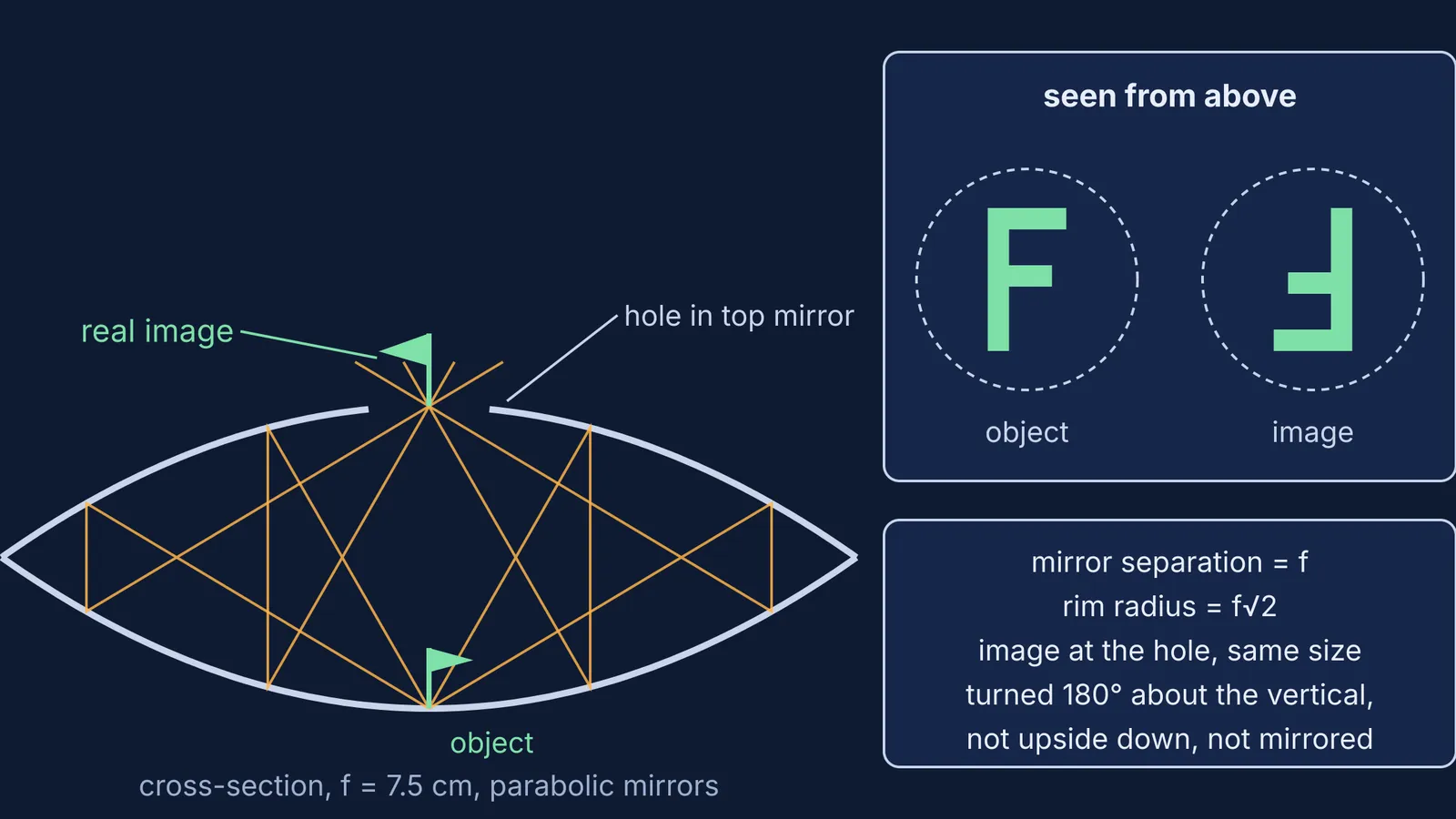
A mirascope is two identical concave mirrors placed rim to rim, facing each other, like a clam shell. The top mirror has a round hole in its centre. The object sits on the vertex (the lowest point) of the bottom mirror.
The key design rule is that the separation of the two vertices equals the focal length f. So the vertex of each mirror is at the focus of the other. The device was patented in 1972 by Virgil Elings and Caliste Landry as an optical display device, which describes a real image projected through the aperture of one of two facing concave mirrors.
For parabolic mirrors, the surface of the bottom mirror is z = r²/(4f), where r is the distance from the axis. The top mirror is the same shape turned over, with its vertex at height f. For the rims to meet, both must reach the same height, f/2. Put z = f/2 into z = r²/(4f) and you get r² = 2f², so the rim radius is f√2.
How does a mirascope form a floating image?
Follow the light from the frog in two steps.
Top mirror. The frog sits at the vertex of the bottom mirror, which is the focus of the top mirror. Light from a point at the focus of a concave mirror leaves it parallel to the axis. So the top mirror sends a parallel beam straight down. In mirror-formula terms, u = −f gives 1/v = 1/f − 1/f = 0, so v is at infinity.
Bottom mirror. The bottom mirror receives that parallel beam and brings it to its own focus, a distance f above its vertex. That point is exactly at the hole in the top mirror.
The rays really do cross there, so the image is real. That is why it looks solid, why a camera can photograph it, and why, as the University of Wisconsin's parabolic mirror illusion exhibit points out, you see different sides of it as you move your head. Why a parabola sends every ray from the focus out parallel, and back again, is shown in the reflection property of a parabola.
Worked example: a mirascope with f = 7.5 cm
Take two parabolic mirrors with f = 7.5 cm and a hole of radius 1.5 cm (illustrative values; real toys vary).
Separation. The vertices are f = 7.5 cm apart.
Depth of each bowl. f/2 = 3.75 cm.
Rim radius. f√2 = 7.5 × 1.414 = 10.6 cm, so the toy is 21.2 cm across.
Where is the image of a point on the bottom vertex? We traced about 1,500 rays from that point through both parabolas with a python ray tracer. Every one crosses the axis at 7.50 cm above the bottom vertex, in the plane of the hole.
A point 5 mm to the side. Its image lands 5.0 mm to the opposite side (the trace gives −5.007 mm), still in the hole. Moving the point 5 mm along y instead gives −5.007 mm along y. The sideways magnification is −1 in every horizontal direction.
A point 5 mm above the vertex. Its image is 5.3 mm above the hole plane, on the same side. A point 10 mm up images about 11.3 mm up. So the top of the frog is still on top.
Size. Sideways the image matches the object to within 0.6% for points 1 cm from the axis, so a small frog appears the same size.
Is the mirascope image upside down?
No. This is the part that surprises people, because a single concave mirror's real image is inverted.
Put the results from steps 5 and 6 together. A point at (x, y, z) relative to the object maps to roughly (−x, −y, +z) relative to the image. Flipping both horizontal coordinates while keeping height is exactly a rotation by 180° about the vertical axis. The frog is the right way up, but turned round. The patent drawing shows the same thing in a cross-section: it describes the image as having a left-right reversal from the object.
It is a rotation, not a mirror image. The image went through two reflections, and two reflections keep handedness, just as two plane mirrors at right angles show you your face the way others see it. Put a coin face up in a mirascope and its lettering reads normally, only turned through half a circle, as the letter F in the hero diagram shows.
There is a viewing consequence. Our trace shows that light reaching an eye on one side of the toy left the object travelling towards the opposite side. So if the frog faces you, you see the image of its back.
Why does the image get blurry away from the centre?
Parabolic mirrors focus perfectly only for points exactly on the axis. In our trace, the rays from a point 5 mm off axis miss a single image point by about 0.1 mm (rms), but from a point 2 cm off axis they spread by about 1.9 mm and the image is about 2% too large sideways. So small objects near the centre give the sharpest images. You can see how a single mirror's image moves as the object moves in this concave mirror simulation for six object positions, and the Simulation Lab has more interactive simulations for ideas easier to see than read.
Quick checklist
Two identical concave mirrors, vertices one focal length apart, hole in the top one.
Object at the bottom vertex sits at the top mirror's focus, so light goes down parallel.
The bottom mirror focuses that light at the hole: a real image.
Parabolic bowls meet when each is f/2 deep, with rim radius f√2.
Sideways magnification −1, height not inverted: the image is turned 180° about the vertical axis.
Two reflections: the image is not mirror-reversed.
Sharpest for small objects near the axis.