On this page
Draw any shape on graph paper that is convex (no dents), symmetric through the origin (a half turn lands it on itself) and bigger than 4 squares in area. However you tilt or stretch it, it will cover a grid point other than the origin. That is Minkowski's theorem, and it turns questions about whole numbers into questions about area.
What does Minkowski's theorem on lattice points say?
A lattice point has two integer coordinates, such as (2, −3). Wikipedia's article on Minkowski's theorem states it like this: every convex set in the plane that is symmetric about the origin and has area greater than 4 contains at least one lattice point other than the origin. Hermann Minkowski proved it in 1889, the article records. In n dimensions the volume must exceed 2^n, and for a slanted lattice whose basic cell has area d, the plane bound becomes 4d.
Symmetry adds a bonus: if (a, b) is inside, so is (−a, −b), so MathWorld's statement counts "at least three lattice points" including the origin.
Why must a region of area more than 4 contain a lattice point?
The neatest proof uses a lemma that Hans Blichfeldt published in 1914 in the Transactions of the American Mathematical Society. Blichfeldt's theorem says a bounded plane region can be slid so that it covers at least as many lattice points as its area, rounded up; Wikipedia calls it a continuous version of the pigeonhole principle. The proof, for a symmetric convex region S of area more than 4:
Shrink S by half towards the origin. The half-size copy, call it T, has area more than 4 ÷ 4 = 1.
Cut T along the grid lines and slide every piece, by whole-number steps, into the unit square with corners (0, 0) and (1, 1).
Total area more than 1 cannot fit in a square of area 1 without overlap, so two different points u and v of T land on the same spot. Then u − v has integer coordinates.
Now double back. 2u and 2v lie in S. By symmetry −2v lies in S too, and by convexity so does the midpoint of 2u and −2v, which is u − v.
So u − v is a lattice point in S, and it is not the origin because u and v were different.
A square and an ellipse: does the theorem really hold?
The square. The open square with corners (±1, ±1) is convex, symmetric and has area exactly 4, yet the only lattice point inside it is the origin: the nearest lattice points, such as (1, 0) and (1, 1), all sit on its boundary, which the open square leaves out. The Minkowski article uses this example to show the bound cannot be lowered.
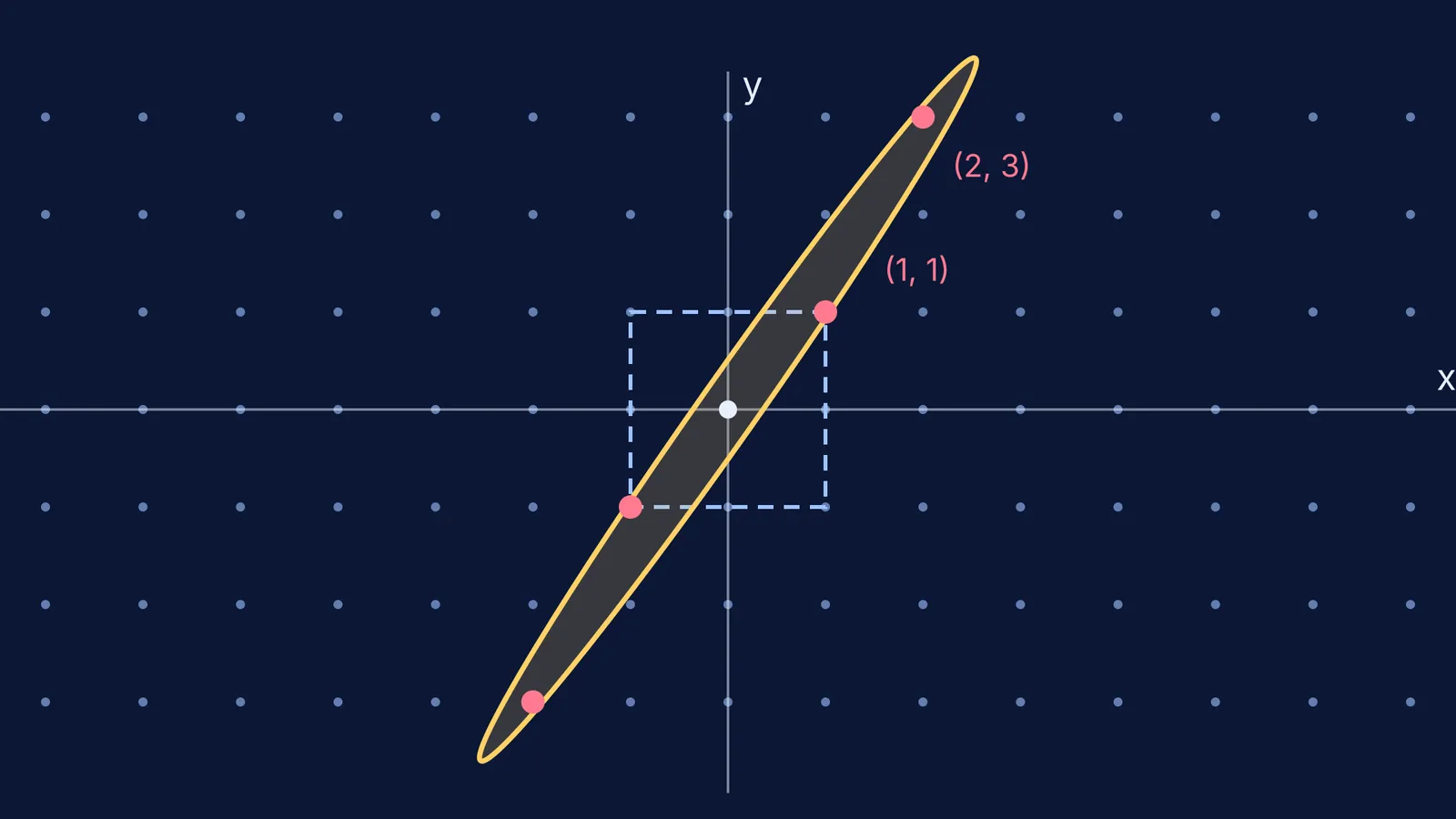
The ellipse. Take the region 10x² − 14xy + 5y² ≤ 1.3. Putting in −x and −y changes nothing, so it is symmetric, and it is convex. For a region Ax² + Bxy + Cy² ≤ r the area is πr ÷ √(AC − B²/4), and here AC − B²/4 = 50 − 49 = 1, so the area is 1.3π ≈ 4.08, just over 4. (1, 0) and (0, 1) give 10 and 5, far too big, so look along the long, tilted axis: (1, 1) gives 10 − 14 + 5 = 1 and (2, 3) gives 40 − 84 + 45 = 1. Both are inside, with their mirror images, as the diagram at the top shows.
How does Minkowski's theorem prove the two-squares theorem?
Fermat's theorem says every prime leaving remainder 1 on division by 4 is a sum of two squares (see which primes are a sum of two squares). Wikipedia proves it with Minkowski's theorem; here is that lattice argument with p = 13.
Find j with j² ≡ −1 (mod p). For 13, j = 5 works, since 25 = 26 − 1.
Keep only the points (a, b) with b ≡ 5a (mod 13). They form a lattice of determinant 13, so the theorem needs area more than 4 × 13 = 52.
Take the open disc a² + b² < 26. Its area is 26π ≈ 81.7, more than 52. In general the disc has area 2πp, which beats 4p because π > 2.
So the disc holds a non-zero point of the lattice. For that point a² + b² ≡ a² + 25a² = 26a² ≡ 0 (mod 13), and 0 < a² + b² < 26, so a² + b² = 13.
Check: (2, −3) is in the lattice because −3 ≡ 10 = 5 × 2 (mod 13), and 2² + 3² = 13.
To count every way a number splits into two squares, see how many lattice points lie on a circle.
How do you use it in a problem?
Before you reach for the theorem, check:
Is the region convex? A star or a ring shape does not qualify, however large.
Is it symmetric about the origin? If its centre is some other lattice point, shift that point to the origin first.
Is the area strictly more than 4 (or 4d for a lattice with cell area d)? Compute it exactly.
It proves a point exists, not where; to find one, search along the region's longest direction.
Test yourself: the theorem guarantees a lattice point in the disc x² + y² < r² once πr² > 4, so r > 2/√π ≈ 1.13. The true threshold is r > 1, when (1, 0) gets in. Why is the theorem not sharp for a disc but sharp for a square? For another way area and grid points meet, see Pick's theorem on a dot grid.
If lattice determinants still feel shaky, the Fermi Concept Library has a lesson for every concept in mathematics. To practise, the Fermi Problem Library has worked problems with a step-by-step solver that explains the reasoning rather than printing an answer.
Pick a prime such as 29 and run the five steps yourself; the answer is 2² + 5².