

On this page
At many airports you step into a booth, raise your arms, and two panels sweep round you in a couple of seconds. That booth is a millimetre-wave scanner. It sends out radio waves about a centimetre long, which pass through your clothes, bounce off your skin and off anything carried on it, and come back to an antenna array. Three ideas from Class 12 explain almost everything about it: the size of a wave compared with the objects it meets, reflection at a boundary, and the energy of a photon.
What frequency does an airport body scanner use?
The National Academies' 2017 report on millimetre-wave airport screening says the ProVision system used by the US Transportation Security Administration (TSA) operates at 24.25 to 30 GHz, and that its waves "pass through clothing, bounce off the skin (and potential threats)". Other makers may use other frequencies, so treat the numbers below as worked for this band.
With λ = c/f:
At 30 GHz, λ = 3.00 × 10⁸ / 3.0 × 10¹⁰ = 0.0100 m = 1.0 cm.
At 24 GHz, λ = 1.25 cm.
That places these waves at the short end of microwaves, between the bands used by mobile phones and the far infrared. Where they sit in the whole spectrum is covered in electromagnetic waves: the spectrum, E and B.
Why do 1 cm waves pass through clothes?
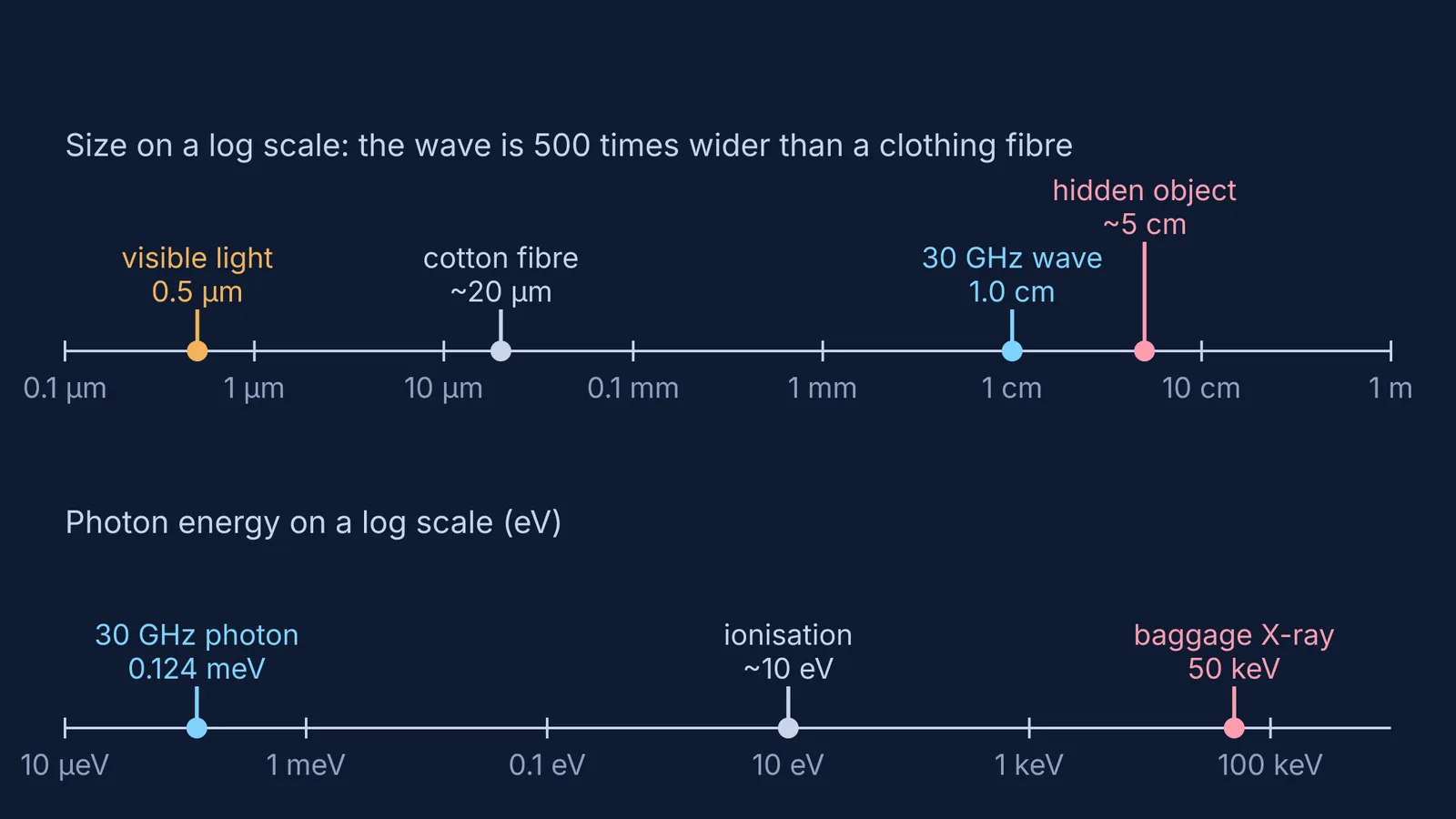
Whether an object scatters a wave depends on its size compared with the wavelength. A cotton or polyester fibre is roughly 20 µm across (an approximate, typical value). Compare that with the two waves:
Visible light, λ ≈ 0.5 µm. The fibre is 40 times wider than the wavelength, so it scatters and absorbs the light strongly. You cannot see through a shirt.
The 30 GHz wave, λ = 1.0 cm. The fibre is 1.0 cm / 20 µm = 500 times smaller than the wavelength.
For objects much smaller than the wavelength, the scattering compared with the object's size falls as (d/λ)⁴, the same Rayleigh law that makes the sky blue. Here (d/λ)⁴ = (20 × 10⁻⁶ / 10⁻²)⁴ = (2 × 10⁻³)⁴ = 1.6 × 10⁻¹¹. Each fibre is practically invisible to the wave. Dry fabric also has a refractive index close to 1 at these frequencies (an approximate statement; it varies with material), so little is reflected at its surfaces either.
Why does the wave bounce off skin and not go inside?
At a boundary between two media, a wave hitting it head-on reflects a fraction R = ((n − 1)/(n + 1))² of its power, where n is the relative refractive index. Skin is mostly water, and water has a very large refractive index at microwave frequencies, because its polar molecules turn to follow the field.
Worked example (illustrative values). Take n ≈ 5 for skin at about 30 GHz. The real value is a complex number that changes with frequency, temperature and water content, so this is a round illustrative figure.
n − 1 = 4 and n + 1 = 6.
(n − 1)/(n + 1) = 4/6 = 0.667.
R = 0.667² = 0.444, so about 44% of the power is reflected.
Compare clothing with n close to 1: for n = 1.5 (illustrative), R = (0.5/2.5)² = 0.04, only 4%.
So the skin acts like a mirror and the clothes like a window. The part that does enter the skin is absorbed within a fraction of a millimetre. The National Academies' report states that the power of 26 GHz waves entering tissue falls to about 13% of its surface value at a depth of about 0.65 mm (the report's chapter on the technology). That is why the scanner shows the outline of the body and anything on it, and no bones or organs.
Can millimetre waves ionise atoms like X-rays do?
No. Whether radiation can knock an electron out of an atom depends on the energy of each photon, E = hf, not on how many photons arrive. This idea is explained in is mobile phone radiation the same as X-ray radiation?, so here are just the numbers for the scanner.
E = hf = 6.626 × 10⁻³⁴ J s × 3.0 × 10¹⁰ Hz = 1.99 × 10⁻²³ J.
In electronvolts: 1.99 × 10⁻²³ / 1.602 × 10⁻¹⁹ = 1.24 × 10⁻⁴ eV, or 0.124 meV.
Ionising a typical atom or molecule takes about 10 eV. Ratio: 10 / 1.24 × 10⁻⁴ ≈ 80,000.
A 50 keV photon, typical of the X-rays in airport baggage scanners, carries 50,000 / 1.24 × 10⁻⁴ ≈ 4 × 10⁸ times more energy.
Each millimetre-wave photon is about 80,000 times too weak to ionise anything. Millimetre waves are classed as non-ionising radiation. Any effect they could have comes from heating, which depends on intensity.
How strong is the scanner's field?
For a radiation safety figure, go to a source that measured it. The National Academies' committee measured the ProVision system in a test chamber and reported a peak intensity of about −50 dBm per cm², which it said is about 100,000 times smaller than the IEEE exposure limit of 10 W/m² (the report's measurement chapter). You can check the conversion yourself: −50 dBm is 10⁻⁵ mW = 10⁻⁸ W, so −50 dBm/cm² = 10⁻⁸ W × 10⁴ cm²/m² = 10⁻⁴ W/m², and 10 / 10⁻⁴ = 10⁵.
How sharp is the image?
The finest detail any wave can resolve is set by diffraction. The textbook limit for an aperture of size D viewing a point at distance R is Δx ≈ 1.22λR/D.
Take λ = 1.0 cm, an antenna array D = 1.0 m tall and the body R = 0.5 m away (round illustrative values).
Δx = 1.22 × 0.010 × 0.5 / 1.0 = 0.0061 m, about 6 mm.
Real imagers differ in detail, but the answer is millimetres, not microns. That is enough to show a hidden object several centimetres across and far too coarse for fine detail. The same report notes that US law required these systems to display possible threats "on a generic figure rather than an image of the individual's body" (summary of the report).
If λ, f, E = hf and the bands still feel like a list to memorise, the Fermi Concept Library covers each concept in physics one at a time.
Quick checklist
Airport millimetre-wave scanners use roughly 24 to 30 GHz, so λ is about 1.0 to 1.25 cm.
Fibres are 500 times smaller than λ, so scattering, which goes as (d/λ)⁴, is negligible.
Skin is water-rich, with a large n, so it reflects a large share; with n ≈ 5, R = 44%.
What enters the skin is absorbed within about a millimetre.
E = hf = 0.124 meV at 30 GHz, about 80,000 times below the ~10 eV needed to ionise.
Diffraction limits detail to millimetres: Δx ≈ 1.22λR/D.


