On this page
A clockwork metronome fits on a piano lid, yet it can tick as slowly as a pendulum taller than a room. The trick is a small weight that slides up the rod above the pivot. Slide it up and the beat slows; slide it down and it speeds up. That surprises most students, because a "shorter pendulum" usually means a faster one. A metronome is a physical pendulum with two masses on opposite sides of the pivot, and that one detail explains the whole scale.
How does a mechanical metronome work?
The rod pivots near its lower end, inside the case. Below the pivot, out of sight, sits a heavy fixed weight. Above the pivot, a small weight slides along the visible part of the rod, against a printed tempo scale. A wound spring and an escapement give the rod a small push each swing, which keeps it going and makes the tick. The escapement replaces the energy lost to friction; the period is set almost entirely by the masses and their positions.
Wittner, a German maker of the classic Maelzel-type metronome, gives the scale in its instruction sheet for the Maelzel series: Largo 40–60 up to Prestissimo 200–208, so a range of 40 to 208 beats per minute. The same sheet explains that you set a tempo by moving the sliding weight until its upper edge lines up with the number, and that each swing of the pendulum marks one beat.
Why does sliding the weight up slow a metronome down?
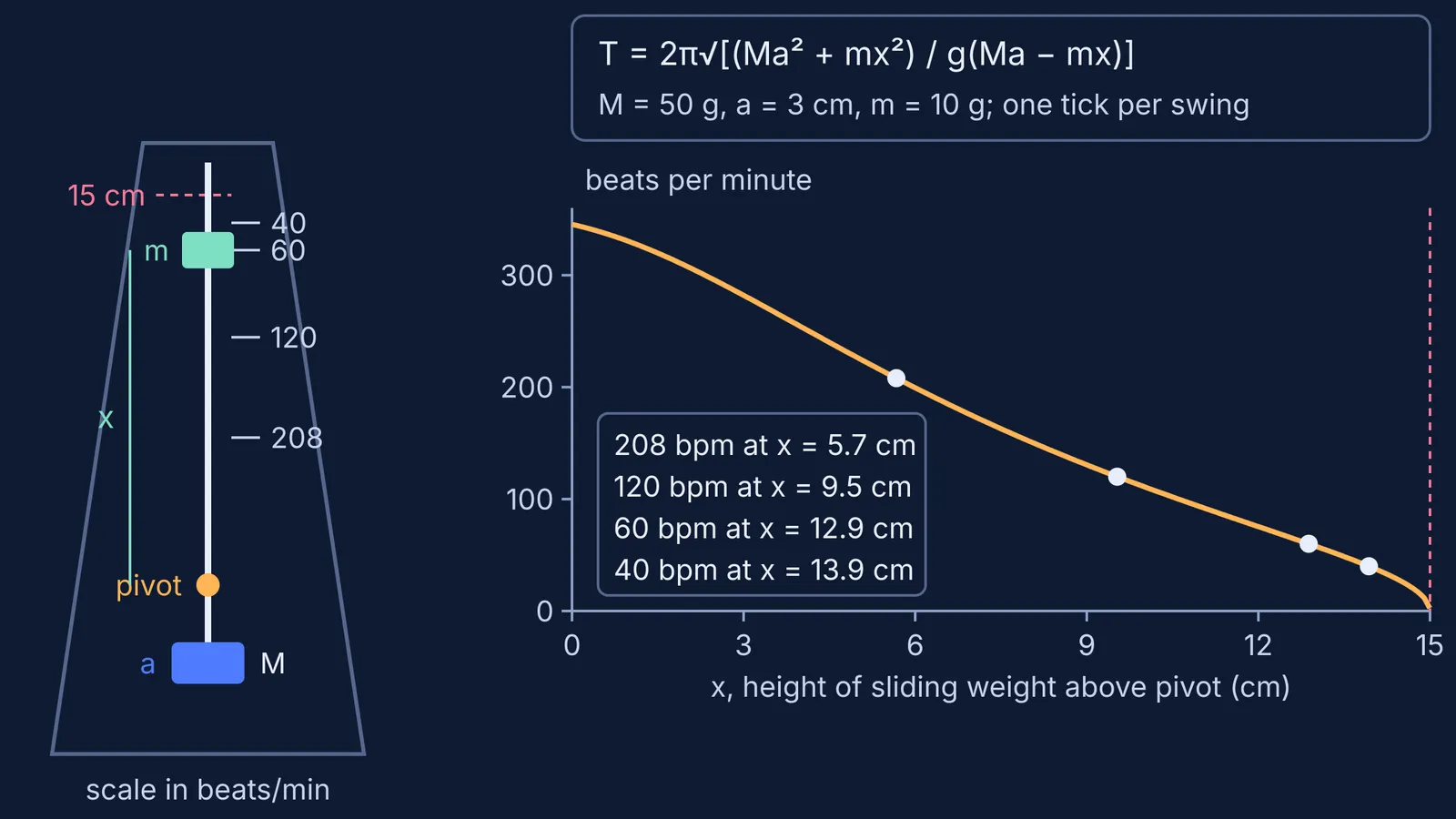
Call the fixed lower weight M, at a distance a below the pivot, and the sliding weight m, at a distance x above it. Ignore the rod's own mass. Tip the rod through a small angle θ.
The lower weight swings up and gravity pulls it back. Its torque is Mga sin θ, a restoring torque.
The upper weight leans over and gravity pulls it further. Its torque is mgx sin θ, a toppling torque.
So the net restoring torque is g(Ma − mx)θ for small θ. The moment of inertia is I = Ma² + mx², because both masses add inertia wherever they sit. Angular SHM then gives:
T = 2π√[(Ma² + mx²) / g(Ma − mx)]
Moving m upwards does two things at once. It adds inertia (mx² grows) and it removes restoring torque (mx grows). Both make the period longer. As x approaches Ma/m, the restoring torque falls towards zero and the period grows without limit. Past that point the rod would topple instead of swinging.
The general result T = 2π√(I/mgd) for one rigid body is worked in physical pendulum and angular SHM problems. The metronome is the case where part of the "d" is negative.
How do you calculate a metronome's tempo? A worked example
Take illustrative values: M = 50 g at a = 3.0 cm below the pivot, m = 10 g sliding above it, rod mass ignored. Real metronomes use different masses, but the shape of the result is the same.
Find the toppling limit. Ma/m = (0.050 × 0.030)/0.010 = 0.15 m. The weight must stay below 15 cm.
Place the weight at x = 12.9 cm. Moment of inertia: I = 0.050 × 0.030² + 0.010 × 0.129² = 4.50 × 10⁻⁵ + 1.664 × 10⁻⁴ = 2.11 × 10⁻⁴ kg m².
Restoring torque per radian. g(Ma − mx) = 9.81 × (0.00150 − 0.00129) = 9.81 × 0.00021 = 2.06 × 10⁻³ N m per radian.
Period. T = 2π√(2.11 × 10⁻⁴ / 2.06 × 10⁻³) = 2π√0.103 = 2.01 s.
Beats per minute. The metronome ticks once per swing, and there are two swings per period. So bpm = 2 × 60/T = 120/2.01 = 60.
Units check: I has units kg m², and g(Ma − mx) has units (m/s²)(kg m) = kg m²/s². Their ratio is s², and its square root is seconds.
Repeat for other positions and you get the scale: x = 0 would give 345 bpm (the lower weight alone), x = 5.7 cm gives 208 bpm, 9.5 cm gives 120 bpm, 12.9 cm gives 60 bpm and 13.9 cm gives 40 bpm.
How long would a simple pendulum need to be?
For a simple pendulum, T = 2π√(L/g), so L = g(T/2π)².
60 bpm, T = 2 s: L = 9.81 × (2/2π)² = 0.994 m.
40 bpm, T = 3 s: L = 9.81 × (3/2π)² = 2.24 m.
Our metronome does the 40 bpm job with weights within 14 cm of the pivot. Another way to see it is the equivalent length, I divided by the net "mass × distance": (Ma² + mx²)/(Ma − mx). At x = 12.9 cm this is 2.11 × 10⁻⁴ / 2.1 × 10⁻⁴ ≈ 1.0 m. The device behaves like a 1 m pendulum because the upper weight cancels most of the lower weight's restoring torque while adding to the inertia.
A different way to keep time without a long pendulum, using a vibrating crystal, is covered in why watches use a quartz crystal.
Why are the slow numbers crowded at the top of the scale?
Look at how far the weight moves between marks, using the numbers above:
From 208 to 120 bpm, the weight moves 3.9 cm (5.7 to 9.5 cm).
From 120 to 60 bpm, it moves 3.4 cm.
From 60 to 40 bpm, it moves only 1.0 cm.
Near the top, the net restoring torque Ma − mx is a small difference of two nearly equal numbers. A tiny change in x changes it by a large fraction, so the period changes fast. That is why the slow tempos sit close together at the top of a metronome's scale, and the fast ones are spread out lower down. It also means a metronome is most sensitive to small errors at slow settings.
How the pivot position changes the period of a single rod, with no sliding weight, is a separate question answered in where to pivot a metre rule so it swings fastest. If you want to practise more physical pendulum problems with the steps checked, the Fermi Problem Library has a step-by-step solver that explains the reasoning.
What mistakes do students make with metronomes?
Thinking the upper weight balances the rod like a counterweight. It works against the restoring torque; if mx exceeds Ma the rod topples.
Guessing that moving the weight up makes it faster, from "shorter pendulum, faster".
Using T = 60/bpm. It is T = 120/bpm, because one beat is half a period.
Thinking the clockwork sets the tempo. It only keeps the swing going.
Quick checklist
Restoring torque per radian: g(Ma − mx). Inertia: Ma² + mx².
T = 2π√[(Ma² + mx²) / g(Ma − mx)], valid for small swings.
Sliding m up adds inertia and removes restoring torque, so the beat slows.
The rod topples when mx ≥ Ma.
bpm = 120/T; 60 bpm means T = 2 s.
A 2.24 m simple pendulum beats 40 times a minute; the metronome does it in under 15 cm.