On this page
It is tempting to guess that hanging a metre rule closer to its middle, like shortening a pendulum, will speed it up. Near the centre the opposite happens: the rule slows sharply. In between sits a pivot where the swing is quickest, and you can predict it before you pick up a stopwatch.
Where should you pivot a ruler to make it swing fastest?
A rule swinging about a pivot is a physical (or compound) pendulum, and its period depends on the distance d between the pivot and the centre of mass. The Simon Fraser University compound pendulum lab sheet gives the period as T = 2π√((k² + d²)/(g·d)), where k is the radius of gyration about the centre of mass.
For a thin uniform rod of length L, the moment of inertia about its centre is ML²/12, according to HyperPhysics on moments of inertia. That makes k = L/√12, which is 28.9 cm for a 1 m rule.
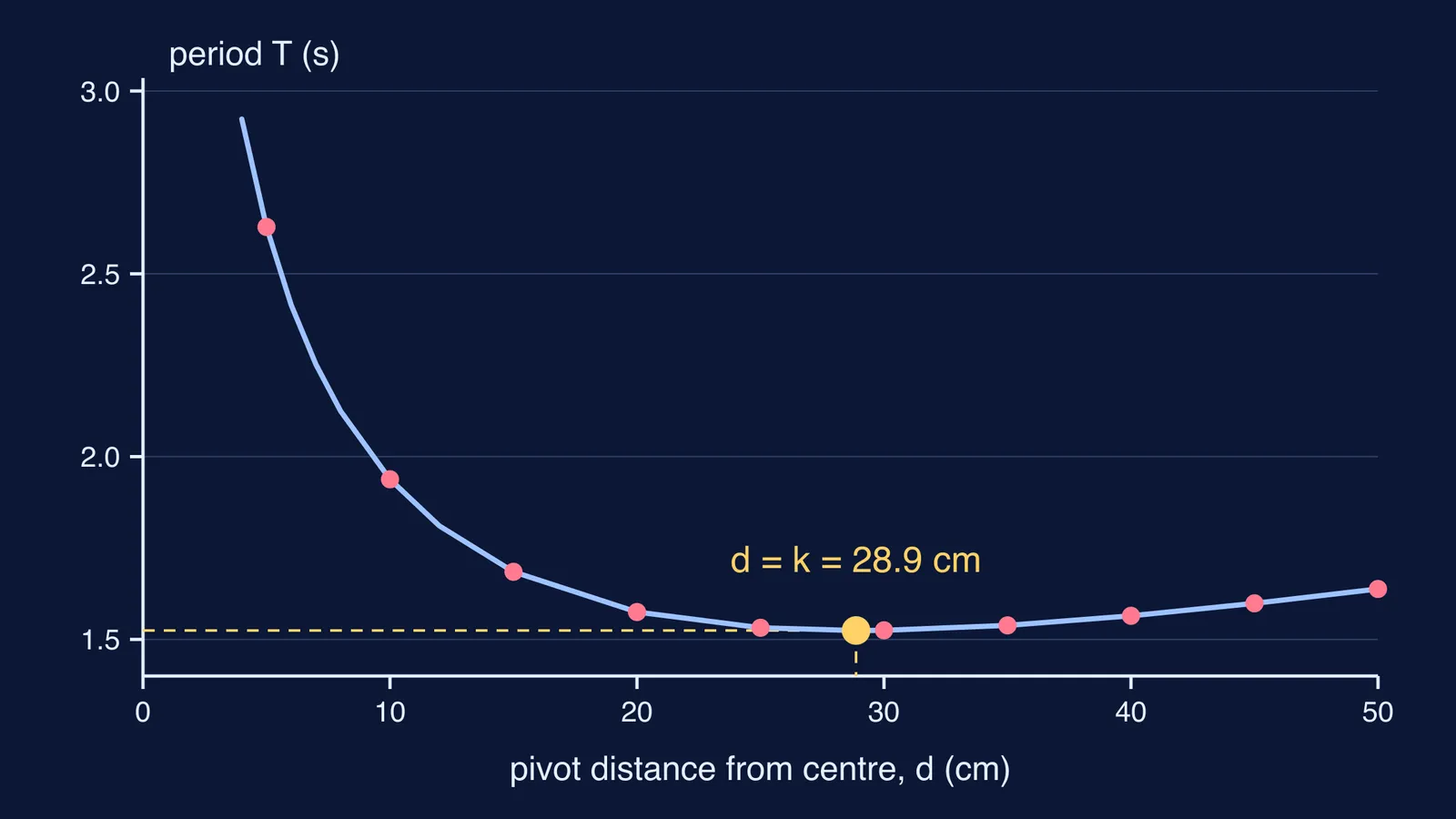
The same SFU sheet shows that the minimum period is T_min = 2π√(2k/g). The fastest swing comes when the pivot sits exactly k from the centre: about 28.9 cm, which is the 21.1 cm or 78.9 cm mark on the rule. With g = 9.81 m/s² (rounded from the NIST standard value of 9.80665 m/s²), that minimum is about 1.52 s.
Why does the ruler slow down near the centre?
Square the period formula and ignore the constants: T² is proportional to k²/d + d. Two terms are fighting.
The d term is the simple-pendulum effect. A pivot far from the centre puts the mass farther away, like a longer string.
The k²/d term is the rotation effect. Near the centre, gravity has almost no lever arm to pull the rule back, yet the whole rule still has to turn, so the restoring torque is tiny and the swing is slow.
The sum k²/d + d is smallest when the two terms are equal, which happens at d = k. You can check it with the AM-GM inequality, no calculus needed. If moment of inertia and the parallel axis theorem feel shaky, our guide to solving moment of inertia problems with the axis theorems covers both.
What period should each hole give?
Here is what T = 2π√((k² + d²)/(g·d)) from the SFU lab sheet predicts for a 1 m rule, with k = 28.9 cm and g = 9.81 m/s². In brackets is the time for 20 swings, which is what you will measure.
5 cm from centre: 2.63 s (52.6 s for 20)
10 cm: 1.94 s (38.8 s)
15 cm: 1.69 s (33.7 s)
20 cm: 1.58 s (31.5 s)
25 cm: 1.53 s (30.6 s)
30 cm: 1.52 s (30.5 s)
35 cm: 1.54 s (30.8 s)
40 cm: 1.56 s (31.3 s)
45 cm: 1.60 s (32.0 s)
50 cm (the end): 1.64 s (32.8 s)
The end value matches the HyperPhysics rod pendulum page, whose calculator gives T = 2π√(2L/3g) for a uniform rod hung from its end, the same period as a simple pendulum of length 2L/3.
Notice how flat the bottom is: every hole from 25 cm to 35 cm lands within 1% of the minimum, so you need many swings per reading.
That pairing is the idea behind Henry Kater's reversible pendulum, which used two pivots with equal periods to measure g.
How do you run the experiment?
The SFU procedure says to time about 20 complete swings, repeat each measurement several times, and not make the amplitude too large. For a metre rule at home:
Use a rule with holes along its length, or ask an adult to drill small ones every 5 cm on one side of the centre.
Push a thin nail or knitting needle through a hole and clamp it level, so the rule hangs freely.
Pull the bottom end aside by a few centimetres only. Large swings break the small-angle formula.
Time 20 full swings (out and back is one). Repeat three times and average.
Divide by 20 to get T. Measure d from the 50 cm mark to the hole centre.
Plot T against d, with the predicted values above on the same graph.
Compare the d at your lowest point with 28.9 cm.
If your minimum lands a little off, ask why. The SFU prelab questions point to two suspects: the holes remove some material, which changes k, and friction at the pivot damps the swing.
If the plot behaves unexpectedly, Fermi's Simulation Lab has interactive simulations for ideas that are easier to see than to read. For exam-style physical pendulum questions, the Fermi Problem Library has worked problems with a step-by-step solver that explains the reasoning rather than printing an answer. Our explainer on physical pendulums and angular SHM is a good next read once your graph is done.