

On this page
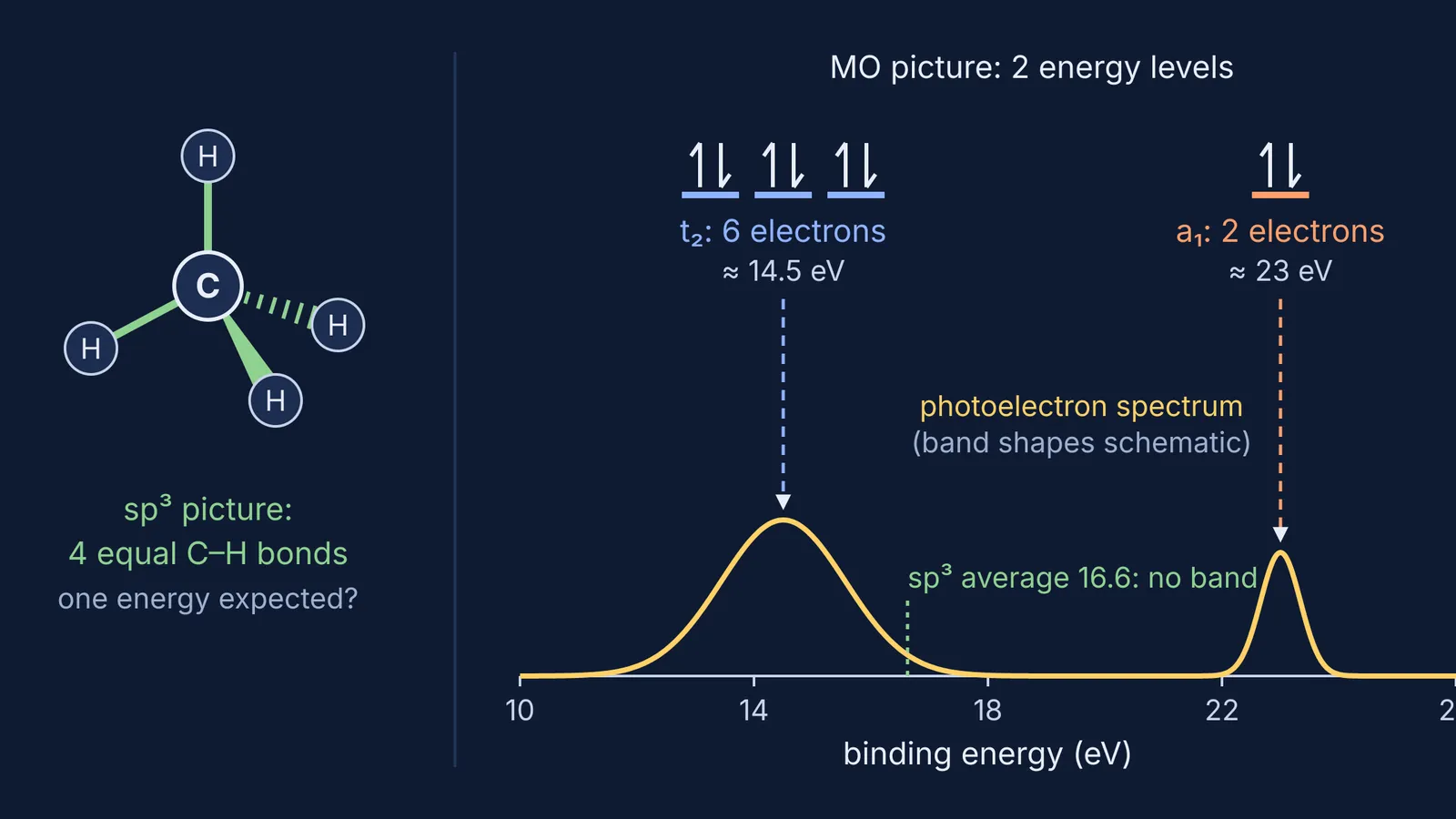
NCERT describes methane with four identical sp³ hybrid orbitals on carbon, each overlapping a hydrogen 1s orbital. So you would expect every bonding electron in CH₄ to need the same energy to remove. Shine ultraviolet light on methane gas and measure the electrons that come out, and you find two energies, not one: about 14.5 eV and about 23 eV. This photoelectron spectrum is the classic test that molecular orbital theory passes and the hybrid picture seems to fail. In fact both pictures are correct; they answer different questions.
What does NCERT say about bonding in methane?
In Class 11 Chemical Bonding, carbon's 2s orbital and three 2p orbitals mix to give four equivalent sp³ hybrids pointing to the corners of a tetrahedron, 109.5° apart. Each holds one electron and overlaps a hydrogen 1s orbital to make a C–H σ bond. Four identical orbitals give four identical bonds and the right shape. Our post on finding the hybridisation of any atom covers the counting rule.
For shape this is right: the four C–H bonds really are identical. The puzzle appears only when you remove an electron.
What does the photoelectron spectrum of methane show?
Photoelectron spectroscopy uses the photoelectric equation from Class 12 Physics, applied to a molecule:
kinetic energy of the electron = hν − binding energy
Fix the photon energy hν, measure the kinetic energies of the ejected electrons, and each band in the spectrum gives the binding energy (the ionisation energy) of one set of electrons.
For methane the valence spectrum has two bands. A study in the Journal of Chemical Physics by Carlsson Göthe and co-workers (1991) reports them at approximately 14 and 23 eV: a broad band with an average binding energy of about 14.5 eV, roughly 2.5 eV wide, and a second band at about 23.0 eV. The broad band starts lower: the lowest ionisation energy of methane, the onset of that band, is 12.61 eV in the NIST Chemistry WebBook. Do not confuse the 12.6 eV onset with the 14.5 eV band centre.
Eight valence electrons, two clearly separated energies. Four "identical" bonds cannot explain that directly.
Why does molecular orbital theory predict two energies?
In MO theory the eight valence electrons are not assigned to four separate bonds. Carbon's valence orbitals combine with a set of four hydrogen 1s orbitals to give orbitals that spread over the whole molecule:
One a₁ orbital. Carbon 2s combined with all four H 1s orbitals in phase. Göthe and co-workers note it has a dominant C 2s character. It is lowest in energy and holds 2 electrons: the 23 eV band.
Three t₂ orbitals. Each is one carbon 2p orbital combined with the four H 1s orbitals, with signs that match the two lobes of that p orbital. By the tetrahedral symmetry the three have exactly the same energy. Together they hold 6 electrons: the 14.5 eV band.
The labels a₁ and t₂ are just names for "single" and "set of three"; you do not need group theory to use them. (The broad width of the t₂ band is itself a clue: removing one electron from a set of three equal orbitals leaves an ion that distorts, which splits the band, as Göthe and co-workers describe.)
Is sp³ hybridisation wrong, then?
No, and it is worth being clear on this. For a molecule like methane, with every orbital filled, the four localised sp³ bond orbitals and the four delocalised MOs (one a₁, three t₂) are two ways of dividing up the same total electron cloud. Mixing the a₁ and t₂ orbitals in the right proportions gives back the four equivalent C–H bond orbitals, and the total electron density, energy and shape come out the same.
The difference is in what ionisation does. Removing one electron leaves a CH₄⁺ ion, and the possible states of that ion follow the delocalised orbitals. The spectrum therefore shows the a₁ and t₂ energies, not one "hybrid" energy.
Chemistry educators have argued about what this means for teaching. A. Grushow asked in the Journal of Chemical Education, Is it time to retire the hybrid atomic orbital? (2011), pointing to this kind of spectrum. Hiberty, Volatron and Shaik replied In defense of the hybrid atomic orbitals (2012), arguing that the two descriptions are equivalent and both useful. The fair summary: hybrids describe bonds and shapes well; delocalised MOs describe ionisation and spectra. For a fuller comparison of the two theories, see valence bond vs molecular orbital theory.
How do you work with methane's photoelectron spectrum?
Worked example. Use binding energies of 14.5 eV (t₂) and 23.0 eV (a₁). A helium lamp gives photons of 21.22 eV (He I line) or 40.81 eV (He II line).
He I photons. For the t₂ band, KE = 21.22 − 14.5 = 6.7 eV. For the a₁ band, 21.22 − 23.0 is negative, so these photons cannot remove an a₁ electron. A He I spectrum shows only the 14.5 eV band.
He II photons. KE = 40.81 − 14.5 = 26.3 eV and 40.81 − 23.0 = 17.8 eV. Both bands appear.
Convert to kJ/mol. Use 1 eV per particle = 96.49 kJ/mol. Then 14.5 eV is about 1400 kJ/mol and 23.0 eV about 2220 kJ/mol.
Compare with bond enthalpy. The mean C–H bond enthalpy is about 416 kJ/mol. Both ionisation energies are far larger, because they measure something different: removing an electron to make CH₄⁺, not splitting CH₄ into CH₃ and H atoms. Stepwise bond energies are covered in methane C–H bond energies: stepwise values vs the 416 mean.
Where would a "hybrid" band sit? Each sp³ bond orbital is one part a₁ to three parts t₂. Its energy is roughly the weighted average, (23.0 + 3 × 14.5) ÷ 4 ≈ 16.6 eV. The spectrum has no band there. That number is real as an average, but no single ionisation produces it.
One caution: do not read the two band areas as a strict 6 : 2 electron count. How strongly each orbital absorbs depends on the photon energy; in X-ray-excited spectra the 23 eV band is the more intense one, which Göthe and co-workers link to its C 2s character. The 6 : 2 split comes from the orbitals, not from measuring band areas.
If you want to see how s and p orbitals combine into bonding orbitals, the Concept Library has lessons on hybridisation and molecular orbital theory, each with its place in the map of chemistry.
What should you write in exams?
Hybridisation of carbon in CH₄: sp³, tetrahedral, 109.5°, four equivalent C–H bonds.
If asked why methane shows two ionisation energies: the valence MOs are one a₁ (2 electrons) and a set of three equal t₂ (6 electrons), so photoelectron spectroscopy shows two bands, near 23 eV and 14.5 eV.
Do not write that hybridisation is wrong. Both models describe the same molecule; ionisation follows the delocalised orbitals.
Quick checklist
KE of photoelectron = hν − binding energy.
Methane: broad band about 14.5 eV (t₂, 6 electrons), band about 23 eV (a₁, 2 electrons).
First ionisation onset 12.61 eV is not the band centre.
He I (21.22 eV) cannot reach the 23 eV band; He II (40.81 eV) can.
Ionisation energies (about 1400 and 2220 kJ/mol) are not bond enthalpies (416 kJ/mol).
sp³ for structure, MOs for spectra.


