On this page
Your Class 11 chemistry book says methane's four C–H bonds are identical, then gives four different energies for breaking them. That isn't a contradiction, and once you see why, you'll know which number belongs in a Hess's law numerical.
Why do the C–H bond dissociation energies in methane differ?
The NCERT Class 11 Chemistry chapter on thermodynamics (section 5.5(c), Bond Enthalpy) lists the four steps like this:
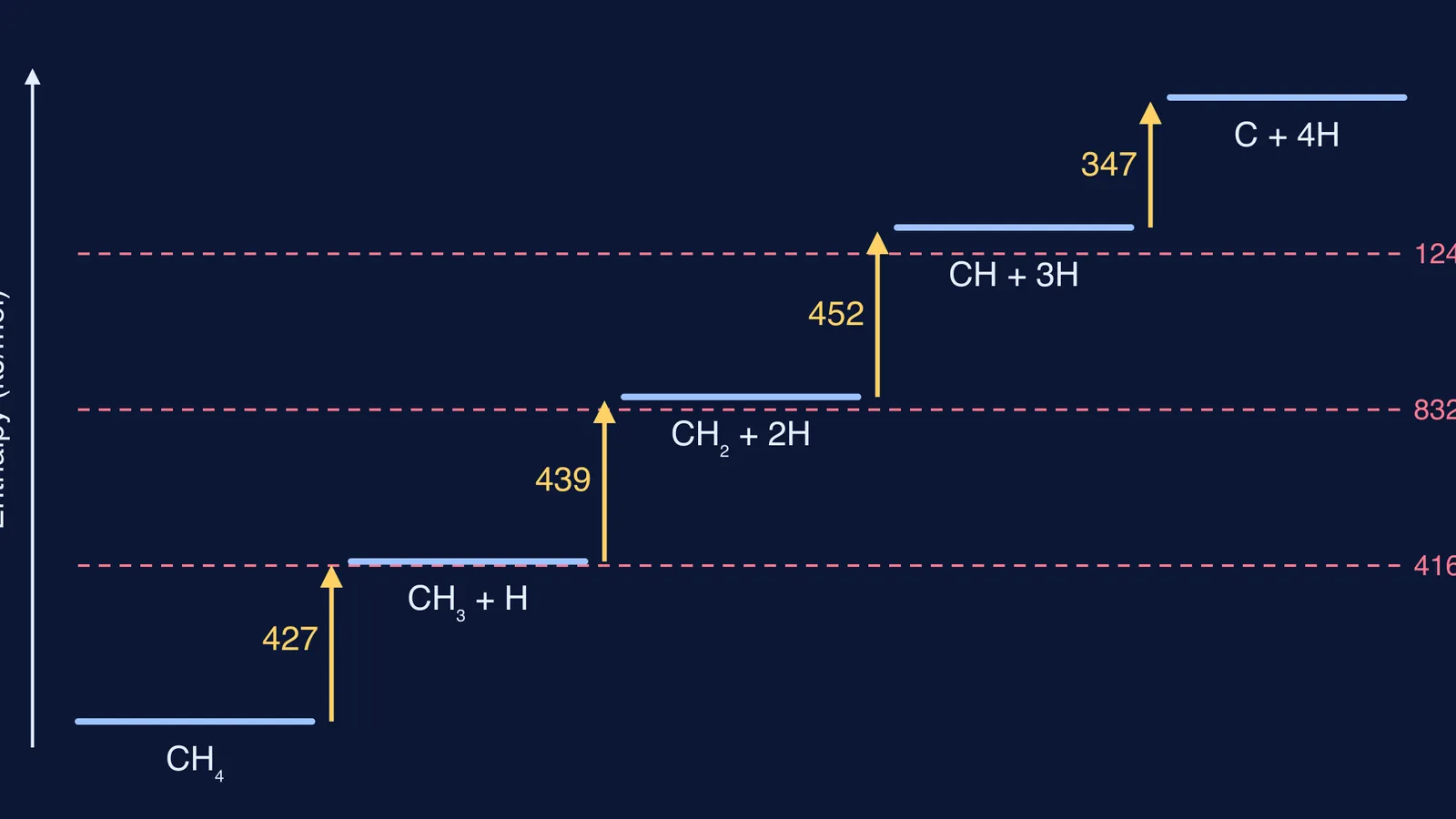
CH₄(g) → CH₃(g) + H(g): +427 kJ/mol
CH₃(g) → CH₂(g) + H(g): +439 kJ/mol
CH₂(g) → CH(g) + H(g): +452 kJ/mol
CH(g) → C(g) + H(g): +347 kJ/mol
A bond dissociation enthalpy is the enthalpy change when one mole of a particular bond in a gaseous molecule is broken to give products in the gas phase. The first step breaks a C–H bond in methane. The second breaks one in the methyl radical, CH₃, a different species with an unpaired electron. The last pulls the only hydrogen off a CH fragment. Four different species means four different bonds and four different energies.
Research tables differ in detail. The Wikipedia article on bond dissociation energy, citing a Berkeley data table, gives 439, 460, 423 and 339 kJ/mol, averaging about 414 kJ/mol, with no single step equal to the average. In exams, use the values your question or NCERT gives.
What is the mean C–H bond enthalpy of 416 kJ/mol?
Add the four steps and you get the whole atomisation, CH₄(g) → C(g) + 4H(g), with an enthalpy of 1665 kJ/mol, according to NCERT. Share that equally among the four bonds and you get the mean bond enthalpy: the mean C–H bond enthalpy in methane is 1665 ÷ 4 = 416 kJ/mol. It's an average, not the energy of any one real step. (Atomisation itself is explained in our post on enthalpies of atomisation, sublimation and phase change.)
You can check 1665 yourself with Hess's law, using the standard enthalpies of formation in NCERT's Table 5.2: C(g) +716.68, H(g) +217.97 and CH₄(g) −74.81 kJ/mol.
Atomisation enthalpy = ΔfH[C(g)] + 4 × ΔfH[H(g)] − ΔfH[CH₄(g)]
= 716.68 + 4(217.97) − (−74.81)
= 716.68 + 871.88 + 74.81 = 1663.37 kJ/mol
That is within 2 kJ/mol of the textbook figure. NCERT also notes that mean C–H bond enthalpies differ slightly from compound to compound, and its general Table 5.3(a) lists C–H as 414 kJ/mol, not 416.
Which value should you use in a Hess's law numerical?
Match the number to the process the question describes (values from the NCERT chapter):
If the question asks for one specific step, such as CH₄ → CH₃ + H, use that step's bond dissociation enthalpy (427 kJ/mol in NCERT).
If the question atomises the whole molecule, the answer is the same either way: the four steps add up to 1665, and 4 × 416 gives 1664, the same within rounding.
If the question gives only a table of bond enthalpies for a reaction, use the mean values from that table.
If the question gives enthalpies of formation, use those instead. Bond enthalpy estimates are approximate.
Use bond enthalpies only when every reactant and product is a gas. NCERT says the relation is approximate and valid when all substances are gases.
Worked example. Estimate ΔrH for CH₄(g) + Cl₂(g) → CH₃Cl(g) + HCl(g) using NCERT's Table 5.3(a) mean values: C–H 414, Cl–Cl 243, C–Cl 330 and H–Cl 431 kJ/mol.
Bonds broken: one C–H and one Cl–Cl = 414 + 243 = 657 kJ/mol
Bonds formed: one C–Cl and one H–Cl = 330 + 431 = 761 kJ/mol
ΔrH = 657 − 761 = −104 kJ/mol
The three surviving C–H bonds cancel, so count only the bonds that change. Had the question supplied the stepwise 427 for the first C–H bond, you would get 670 − 761 = −91 kJ/mol. Each answer is right for its data, so use what the question gives. For a refresher on why adding routes works at all, read why different routes give the same enthalpy.
If you get a different answer and can't see why, the Fermi Problem Library has worked problems with a step-by-step solver that explains the reasoning rather than just printing an answer.
What mistakes cost marks in bond enthalpy questions?
Both equations are in the NCERT chapter (5.15 and 5.17). Before you submit, check for these slips:
Taking products minus reactants with bond enthalpies, which flips the sign
Mixing stepwise and mean values when the question didn't ask you to
Forgetting to multiply: CH₄ has four C–H bonds
Using bond enthalpies for a liquid such as H₂O(l) without its enthalpy of vaporisation
Writing 416 for every C–H bond when the question's table says 414
If the signs themselves confuse you, start with whether bond breaking is endothermic or exothermic. To see how bond enthalpy fits with Hess's law and enthalpy of formation, the Fermi Concept Library gives each concept its own lesson and its place in the map.
Next time a question mentions methane, first ask: one step, or the whole molecule? That decides the number.