

On this page
In chemical reactions, atoms rearrange themselves by breaking old connections and forming new ones. Whether a reaction heats up the room or cools it down depends entirely on the balance between these two steps.
Is bond breaking endothermic or exothermic?
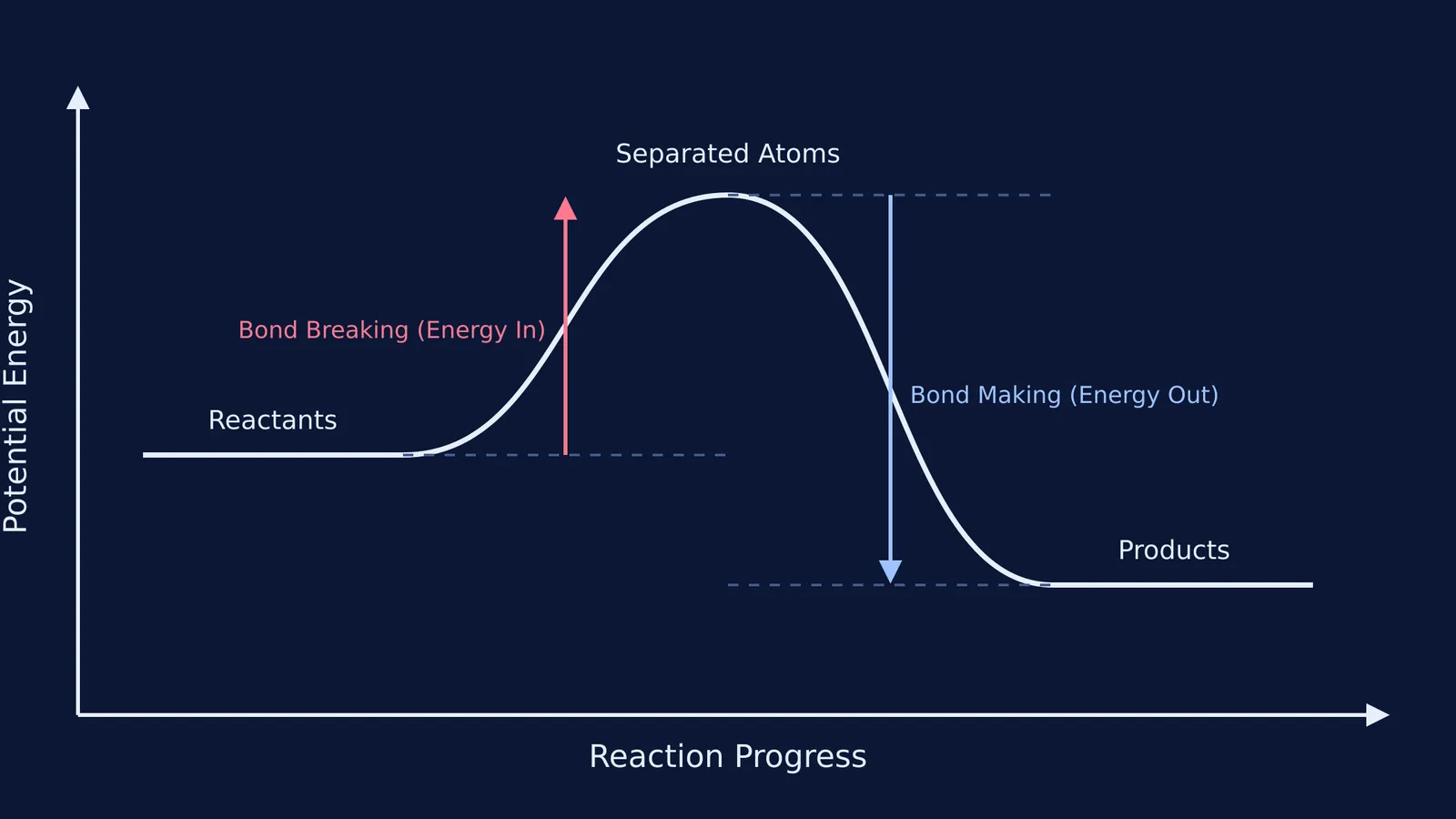
Breaking chemical bonds is always an endothermic process. Atoms in a stable molecule are held together by strong electrostatic forces between their shared electrons and the positive nuclei. Pulling them apart requires a continuous input of energy.
You can think of bond breaking like stretching a heavy mechanical spring. To snap an H-H bond and create two separate, high-energy hydrogen atoms, you must supply exactly 436 kJ/mol of energy/Thermodynamics/Energies_and_Potentials/Enthalpy/Bond_Enthalpies). Because energy is absorbed from the surroundings to overcome these attractive forces, the enthalpy change (ΔH) for bond breaking is always a positive number. In an energy level diagram, this step is represented by an upward climb from the stable reactants to a higher-energy state of separated atoms.
Why is bond formation exothermic?
Forming chemical bonds is always an exothermic process. When isolated, highly reactive atoms come close together to form a chemical bond, they drop into a more stable, lower-energy arrangement.
The excess potential energy that the atoms lose is released into the surroundings, usually as heat or light. For instance, when two oxygen atoms link up to form a strong O=O double bond, they release 498 kJ/mol/Thermodynamics/Energies_and_Potentials/Enthalpy/Bond_Enthalpies). Since energy leaves the chemical system, the ΔH for bond formation is always a negative number. This is why combustion reactions, which form very strong bonds in carbon dioxide and water, release so much heat.
How do you calculate the overall enthalpy change?
Every chemical reaction is a thermodynamic tug-of-war between the energy spent breaking the reactant molecules apart and the energy recovered by assembling the product molecules. You calculate the overall enthalpy change (ΔH) by taking the difference between them:
ΔH = Total energy to break bonds − Total energy released making bonds
Let's look at a simple gas-phase reaction: CO(g) + H₂O(g) → CO₂(g) + H₂(g).
Bonds broken (Energy in): Breaking the triple C≡O bond requires 1077 kJ/mol, and breaking two single O-H bonds requires 2 × 464 kJ/mol. The total energy you must put into the system is 2005 kJ/mol/Thermodynamics/Energies_and_Potentials/Enthalpy/Bond_Enthalpies).
Bonds formed (Energy out): On the product side, forming two C=O double bonds releases 2 × 805 kJ/mol, and forming one single H-H bond releases 436 kJ/mol. The total energy released to the surroundings is 2046 kJ/mol/Thermodynamics/Energies_and_Potentials/Enthalpy/Bond_Enthalpies).
The final balance: ΔH = 2005 − 2046 = -41 kJ/mol.
Because more energy was released making the new bonds than was initially spent breaking the old ones, the reaction is overall exothermic and the surroundings will heat up.
Average vs exact bond enthalpies
When calculating reaction energies, it is important to remember that most values in exam data booklets are *mean* bond enthalpies. The exact energy required to break a bond changes slightly depending on the surrounding atoms in the molecule. For example, breaking the first O-H bond in water (H₂O) takes a different amount of energy than breaking the second O-H bond in the remaining hydroxyl radical (OH). The standard value of 464 kJ/mol is an average taken across many different molecules/Thermodynamics/Energies_and_Potentials/Enthalpy/Bond_Enthalpies).
Because mean bond enthalpies are averages, using them to calculate the enthalpy of a reaction only gives an estimate and is not perfectly reliable. You should rely on standard enthalpies of formation if an exam question asks for the most precise possible answer.
Where do students go wrong in exams?
The most common mistake in thermochemistry exams is forgetting the physical state of the products. Average bond enthalpies are strictly defined and measured for substances in the gas state/Thermodynamics/Energies_and_Potentials/Enthalpy/Bond_Enthalpies). If a combustion reaction produces liquid water at room temperature instead of steam, you cannot simply plug the O-H bond energy into your formula. You must also account for the energy released when the water vapour condenses into a liquid—the enthalpy of vaporisation—to find the true heat of reaction.
Another frequent trap is missing hidden bonds in complex molecules. It is always safer to draw out the full structural formula of every reactant and product so you can count exactly how many C-H or C-C bonds are present.
If you find yourself losing marks on these multi-step calculations, the Concept Library can help. It covers every concept in chemistry with its own lesson, and the AI tutor holds a line of reasoning across a whole session to help you work through the thermodynamic cycle.
For more practice with phase changes, see how enthalpies of atomisation, sublimation and phase change fit together in Born-Haber cycles, or review how to measure heat in isobaric and isochoric processes when the volume or pressure changes.


