

On this page
Our post on freons, DDT and carbon tetrachloride quotes NOAA: CFC-12 lasts 102 years in the atmosphere. Our post on permafrost thaw and methane says methane lasts about a decade. Neither says where those numbers come from. The answer is one radical, the hydroxyl radical OH, and one rate law from Class 12 kinetics. It also explains why the CFC replacements called HCFCs do far less damage to the ozone layer.
What removes methane from the air?
Methane does not react with oxygen at air temperature. It is removed by OH, which is made in sunlight. Ultraviolet light splits ozone into an excited oxygen atom, written O(¹D), and that atom reacts with water vapour:
O₃ + hν → O₂ + O(¹D)
O(¹D) + H₂O → 2OH
OH pulls a hydrogen atom off methane:
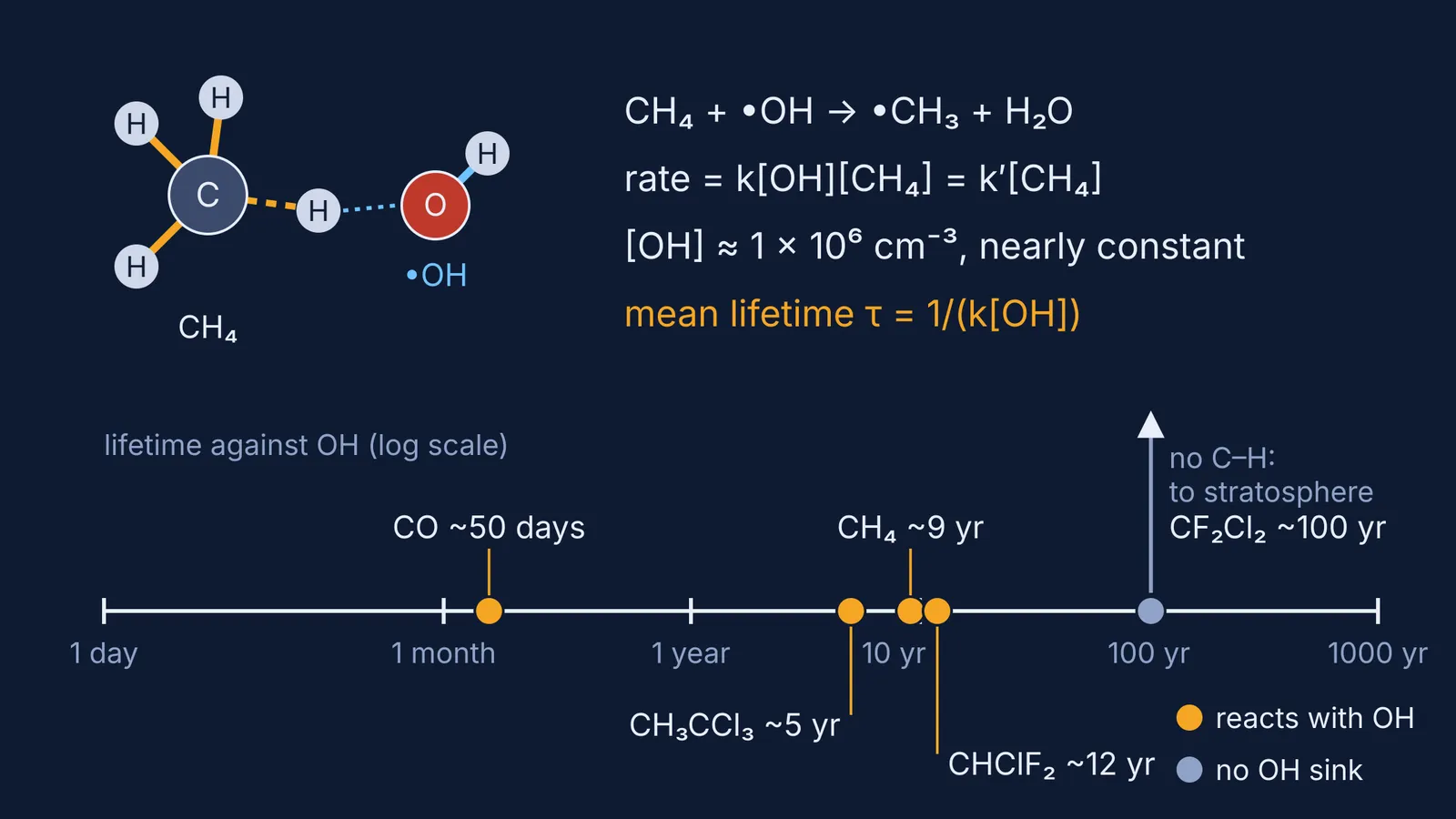
CH₄ + OH → CH₃ + H₂O
This is hydrogen abstraction, the step a chlorine atom performs in free-radical chlorination. It goes forward because the H–OH bond in water (about 497 kJ/mol) is stronger than the CH₃–H bond in methane (about 439 kJ/mol), so ΔH ≈ 439 − 497 = −58 kJ/mol. Further steps take CH₃ on to CO₂ and water.
The key point: OH attacks C–H bonds. A molecule with a C–H bond has a sink in the lower atmosphere; one with none usually does not.
Why is the rate law pseudo-first-order?
The rate is k[OH][CH₄], second order overall. But OH is extremely scarce. Its global mean concentration is about 1 × 10⁶ molecules per cm³. Air at 298 K and 1 atm holds about 2.46 × 10¹⁹ molecules per cm³, so OH is roughly 4 parts in 10¹⁴. Each OH survives about a second and sunlight keeps making more, so [OH] stays roughly steady.
That makes [OH] a constant you can fold into the rate constant, exactly as water is folded in for ester hydrolysis in pseudo first-order reactions:
rate = k[OH][CH₄] = k′[CH₄], where k′ = k[OH]
So methane decays as [CH₄] = [CH₄]₀ e^(−k′t), and its mean lifetime is τ = 1/k′ = 1/(k[OH]). The half-life is 0.693τ.
One caveat: global mean OH is not measured directly. It is inferred, mainly from methyl chloroform (CH₃CCl₃), whose emissions are known from industry records and which is removed almost entirely by OH.
How do you calculate methane's lifetime from k and [OH]?
Here is the calculation, using rate constants from the NASA JPL kinetics evaluation.
Part (a): methane.
JPL gives k = 2.45 × 10⁻¹² e^(−1775/T) cm³ molecule⁻¹ s⁻¹ for CH₄ + OH, an Arrhenius form with Eₐ/R = 1775 K.
Use T = 272 K, the usual tropospheric average for this reaction. Then 1775/272 = 6.53, e^(−6.53) = 1.47 × 10⁻³, and k ≈ 3.6 × 10⁻¹⁵ cm³ molecule⁻¹ s⁻¹.
k′ = k[OH] = 3.6 × 10⁻¹⁵ × 1.0 × 10⁶ = 3.6 × 10⁻⁹ s⁻¹. Check the units: cm³ molecule⁻¹ s⁻¹ × molecule cm⁻³ = s⁻¹.
τ = 1/k′ = 2.8 × 10⁸ s ÷ 3.16 × 10⁷ s per year ≈ 8.8 years. Half-life = 0.693 × 8.8 ≈ 6.1 years.
At 298 K, k ≈ 6.3 × 10⁻¹⁵, a value you will see in tables, which would give only about 5 years. The colder value is used because most of the air, and so most of the reaction, is in the cold troposphere above the ground.
This is only the loss to tropospheric OH. The IPCC Sixth Assessment Report gives methane a total lifetime of about 9.1 years, which also includes small losses to soils and the stratosphere, and a perturbation lifetime of about 11.8 years. The perturbation value is longer because extra methane uses up OH, slowing its own removal. Say which one you mean.
Part (b): the same clock for other gases (k at 272 K, [OH] = 1.0 × 10⁶ cm⁻³; values are approximate).
Carbon monoxide: k ≈ 2.4 × 10⁻¹³ near ground-level pressure (for CO, k depends on pressure). τ ≈ 4.2 × 10⁶ s, about 50 days. CO has no C–H bond; OH adds to it instead: CO + OH → CO₂ + H.
Methyl chloroform, CH₃CCl₃: k = 1.64 × 10⁻¹² e^(−1520/T) ≈ 6.1 × 10⁻¹⁵, so τ ≈ 5.2 years. The 2022 WMO/UNEP ozone assessment lists about 5 years.
HCFC-22, CHClF₂: k = 9.2 × 10⁻¹³ e^(−1560/T) ≈ 3.0 × 10⁻¹⁵, so τ ≈ 10.7 years. The assessment lists about 12 years; this simple estimate ignores the real spread of temperature and OH.
CFC-12, CF₂Cl₂: no C–H bond, no OH sink; about 100 years.
Part (c): a check by mass balance. At steady state, lifetime = amount in the air ÷ rate of removal.
The atmosphere's mass, about 5.15 × 10¹⁸ kg, divided by 0.02897 kg/mol gives 1.78 × 10²⁰ mol of air.
1 ppb of methane is 1.78 × 10¹¹ mol × 16.04 g/mol = 2.85 × 10¹² g = 2.85 Tg.
NOAA's global methane record puts the 2024 average at about 1,930 ppb. Burden ≈ 1,930 × 2.85 ≈ 5,500 Tg.
The Global Methane Budget (Saunois and colleagues, 2020) estimates emissions of about 576 Tg per year for 2008–2017 from atmospheric data. Methane rises only slowly, so removal is close to that.
τ ≈ 5,500 ÷ 576 ≈ 9.6 years.
A rate constant and a mass balance both land near 9 years.
Why does CFC-12 last a century?
CF₂Cl₂ has no hydrogen for OH to take. It does not dissolve in rain, and it does not absorb the sunlight that reaches the lower atmosphere. So nothing in the troposphere removes it. It mixes slowly upward and breaks apart only in the stratosphere, where shorter-wavelength ultraviolet light splits off chlorine atoms. That is why it lasts about a century and why almost all of its chlorine reaches the ozone layer (the ozone chain itself is in the freons post above).
Why are HCFCs less harmful to the ozone layer than CFCs?
Put one C–H bond back. OH can attack HCFC-22, CHClF₂, in the lower atmosphere. Most of it is broken down there, and its chlorine ends up in water-soluble forms such as HCl that rain washes out before they reach the ozone layer.
The Montreal Protocol's tables express this as an ozone depletion potential (ODP), measured against CFC-11 = 1. CFC-12 is listed at 1.0 in Annex A and HCFC-22 at 0.055 in Annex C, about one-twentieth. Newer WMO estimates differ slightly; the gap stays large.
About 12 years is still long enough for some HCFC-22 to reach the stratosphere, so its ODP is not zero, and HCFCs are being phased out too.
If Arrhenius steps and unit conversions cost you marks, the Fermi Problem Library has worked problems with a step-by-step solver that explains the reasoning.
Checklist
OH, made from O₃, sunlight and water vapour, removes most methane by C–H abstraction: CH₄ + OH → CH₃ + H₂O.
[OH] ≈ 1 × 10⁶ cm⁻³ is nearly constant, so the rate is pseudo-first-order: k′ = k[OH] and τ = 1/(k[OH]).
k(CH₄ + OH) at 272 K ≈ 3.6 × 10⁻¹⁵ gives about 9 years; IPCC: 9.1 years total, 11.8 perturbation.
Mass balance: 1 ppb CH₄ ≈ 2.85 Tg; burden ÷ yearly removal agrees.
No C–H (CFC-12): no OH sink, about 100 years, chlorine reaches the stratosphere.
One C–H (HCFC-22): about 12 years, ODP 0.055 instead of 1.0.


