

On this page
Think of permafrost as a continent-sized freezer that has kept dead roots, leaves and moss from rotting for thousands of years. As the Arctic warms, the door is opening, and what comes out depends largely on one thing from school biology: oxygen.
What is permafrost?
Permafrost is soil, sand, sediment or rock that remains at or below 0 °C for at least two years, according to the US National Snow and Ice Data Center (NSIDC). It is defined by temperature alone, not by how much ice it holds or whether snow covers it.
Permafrost covers about 23 million square kilometres, roughly 25 percent of the Northern Hemisphere's land not covered by glaciers, and about 65 percent of it is in Eurasia (NSIDC).
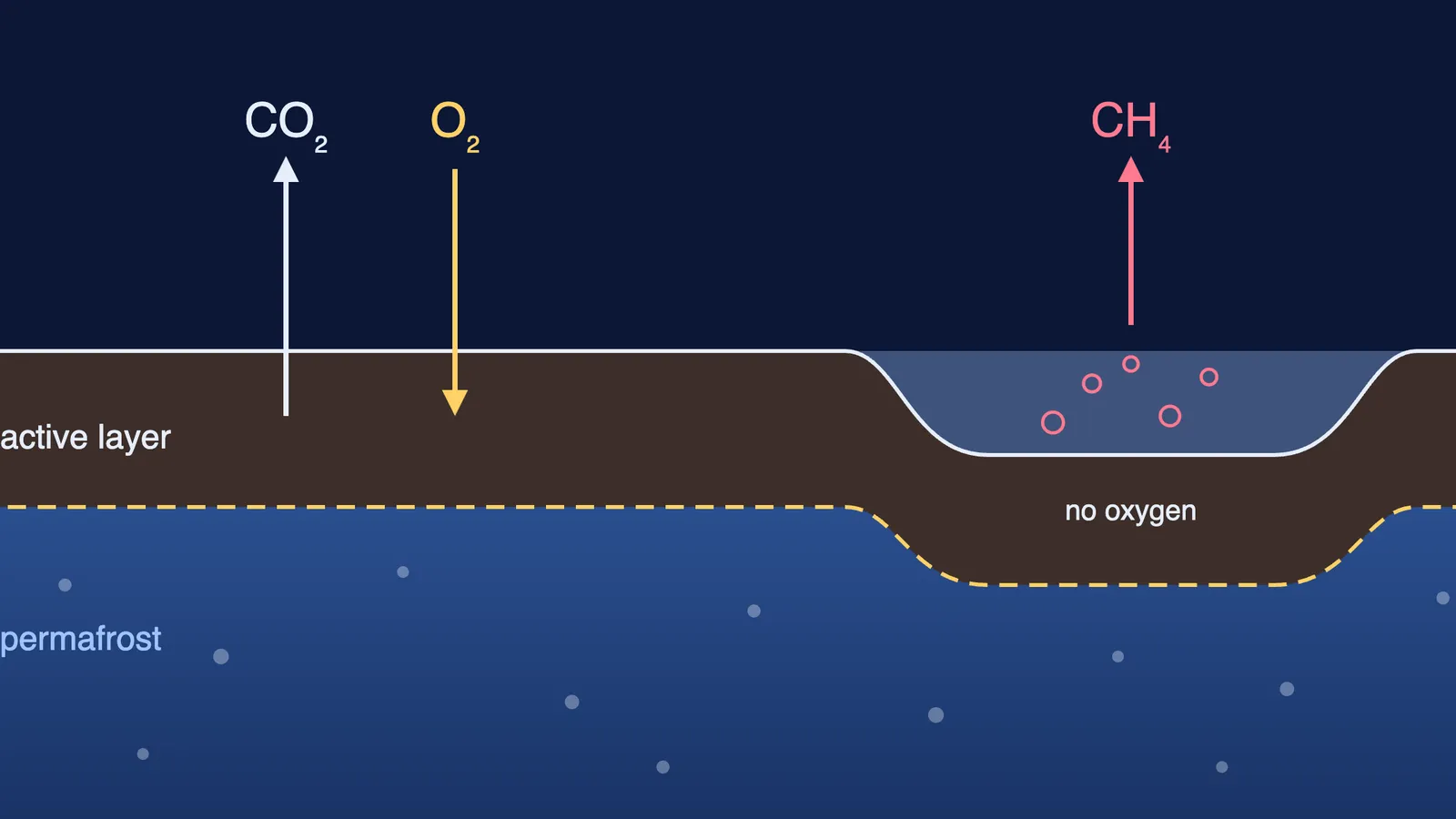
The active layer is the top layer of ground that thaws every summer and freezes again every winter (NSIDC, the science of frozen ground). Thawing permafrost means that summer thaw is reaching ground that used to stay frozen.
How much carbon is stored in permafrost?
Soils of the northern permafrost region store about 1,300 billion tonnes of organic carbon, with an uncertainty range of about 1,100 to 1,500 billion tonnes, according to a 2014 estimate led by Gustaf Hugelius in Biogeosciences. Of that, about 800 billion tonnes is frozen all year round; the other 500 billion tonnes sits in the active layer or in deeper ground that stays unfrozen.
NOAA's 2024 Arctic Report Card, drawing on that study and later work, puts it at "at least 1.4 to 1.6 trillion tonnes of carbon" in the region's soils and permafrost (NOAA Arctic Report Card 2024). Some has been locked up for hundreds of thousands of years (NSIDC). Cold did not destroy this plant matter; it paused decay.
Why does thawing permafrost release methane and CO2?
Once the soil thaws, microbes start decomposing the old plant matter. Which gas comes out depends on oxygen.
With oxygen (drier, well-drained soil): microbes respire aerobically, like your own cells, and the carbon leaves as carbon dioxide.
Without oxygen (waterlogged soil, bogs, ponds): methanogens, microbes that live only where there is no oxygen, turn part of the carbon into methane, CH4. This is the same group of microbes that makes rice paddy fields release methane.
A 2015 synthesis of laboratory incubations of oxygen-free Arctic soils, led by Claire Treat in Global Change Biology, notes that thaw often leaves soil saturated, shifting it to anaerobic decomposition. Maximum methane production was highest in soils that were flooded all or part of the time, and organic soils had about five times higher maximum methane production per gram of soil carbon than mineral soils.
Why does methane matter more than its amount suggests?
Methane traps far more heat per kilogram than CO2. The US Environmental Protection Agency, using IPCC figures, gives methane a global warming potential of 27 to 30 over 100 years and 81 to 83 over 20 years. Methane lasts about a decade in the air on average, much less than CO2.
Try this with Class 11 mole concept. Take 1 kg of carbon from thawed soil.
Released as CO2: each 12 g of carbon becomes 44 g of CO2, so 1 kg of carbon gives 44 ÷ 12 = 3.67 kg of CO2.
Released as methane: each 12 g of carbon becomes 16 g of CH4, so 1 kg of carbon gives 16 ÷ 12 = 1.33 kg of CH4.
Over 100 years, using the lower EPA figure of 27: 1.33 × 27 = 36 kg of CO2-equivalent.
Over 20 years, using 81: 1.33 × 81 = 108 kg of CO2-equivalent.
So, by this measure, the same kilogram of carbon warms about 10 times more over a century (36 ÷ 3.67), and about 29 times more over 20 years, as methane than as CO2. That is why scientists watch how wet the thawing Arctic becomes, not only how much carbon it loses. If the mole step is where you slip, the Fermi Problem Library has worked problems with a step-by-step solver that explains the reasoning rather than printing an answer.
For why these gases trap heat at all, see our post on how the greenhouse effect works.
Is permafrost carbon already being released?
Yes. NOAA's 2024 report found that, once wildfire emissions are included, the Arctic tundra has shifted to a carbon dioxide source and is a consistent methane source, with the permafrost region releasing 15 to 39 million tonnes of methane carbon a year in 2000 to 2020 (NOAA Arctic Report Card 2024). In 2024, permafrost temperatures were the highest on record at nearly half of Alaska's long-term monitoring stations (NOAA Climate.gov).
The picture is not one-sided: the same report finds the Arctic as a whole was roughly CO2 neutral from 2001 to 2020, and the boreal forest region remains a CO2 sink.
For a four-mark answer, name the store (frozen plant carbon), the trigger (a deepening active layer), the condition (oxygen or none) and the gas (CO2, or methane with its higher warming potential). If this is work you would like to do, read our guide to becoming a climate scientist in India.


