

On this page
A grain of table salt is a cube of Na⁺ and Cl⁻ ions held together by Coulomb's law. You know the energy of one pair of charges. Add up every attraction and repulsion in the whole crystal and you get one number, the Madelung constant, about 1.748 for rock salt. With it, a few lines of physics predict the lattice energy of NaCl to within about 4%.
Why isn't the energy of salt just one Na⁺–Cl⁻ pair?
For two point charges, U = kq₁q₂/r. The sign rules are in the potential energy of two charges and what its sign means. For one Na⁺ and one Cl⁻ at the distance they sit apart in the crystal, r₀ = 281.4 pm (the value used in this LibreTexts treatment of the NaCl Born–Haber cycle/09%3A_Ionic_and_Covalent_Solids_-_Energetics/9.04%3A_Born-Haber_Cycles_for_NaCl_and_Silver_Halides)):
ke²/r₀ = (8.99 × 10⁹)(1.602 × 10⁻¹⁹)²/(2.814 × 10⁻¹⁰) = 8.20 × 10⁻¹⁹ J, which is 5.12 eV.
Per mole of pairs: 8.20 × 10⁻¹⁹ × 6.022 × 10²³ = 494 kJ/mol.
But in a crystal each Na⁺ is surrounded by Cl⁻ ions that attract it and, further out, by Na⁺ ions that repel it. All of them count.
Who are an ion's neighbours in a rock-salt crystal?
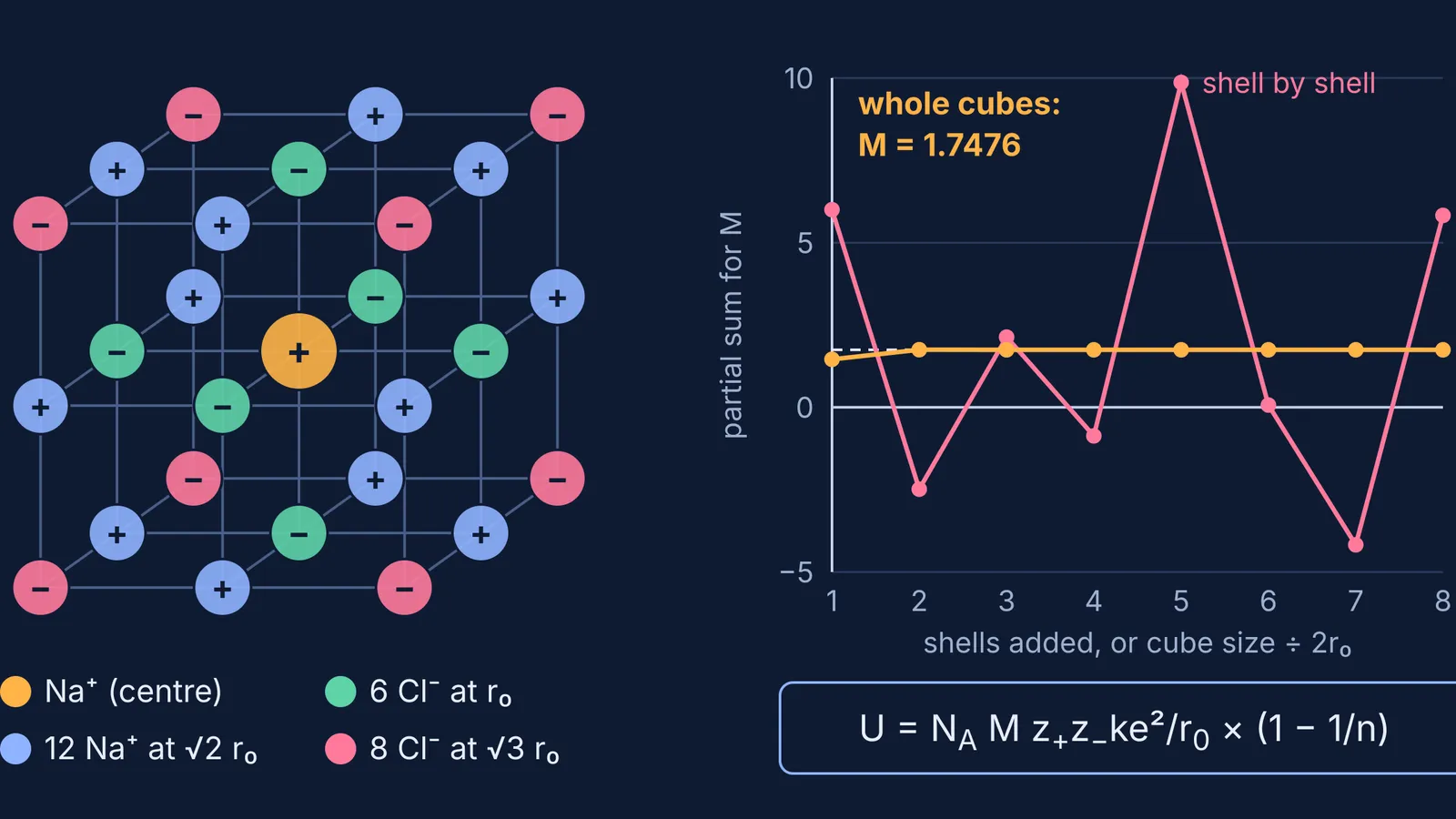
Put a Na⁺ at the origin and measure distances in units of r₀. Every ion sits at a point (i, j, k) with whole-number coordinates, and its distance is √(i² + j² + k²). Ions with i + j + k odd are Cl⁻; ions with i + j + k even are Na⁺. Grouping them by distance gives shells:
6 Cl⁻ at r₀ (the face neighbours), attracting.
12 Na⁺ at √2 r₀ (the edge diagonals), repelling.
8 Cl⁻ at √3 r₀ (the cube corners), attracting.
6 Na⁺ at 2r₀, repelling.
24 Cl⁻ at √5 r₀, and so on outwards.
The energy of the central ion with all the others is then −M ke²/r₀, where
M = 6 − 12/√2 + 8/√3 − 6/2 + 24/√5 − …
M is the Madelung constant. It depends only on the lattice geometry.
Why does adding shell by shell never settle?
The running totals after one to four shells are 6, −2.49, 2.13 and −0.87. Then 9.87, 0.07, −4.17. The sum swings wildly and never closes in.
This is not a rounding problem. Shell populations grow roughly like r² while each term falls only like 1/r, so shells do not shrink. The series is only conditionally convergent: its value depends on the order of adding.
The physical fix, due to H. M. Evjen, is to add whole neutral blocks. Take a cube centred on the Na⁺ and give each ion on its surface a weight equal to the fraction of it inside the cube: ½ on a face, ¼ on an edge, ⅛ at a corner. Each cube is then electrically neutral, and the totals settle fast. For cubes of side 2, 4, 6, 8 and 12 r₀ the sums are 1.4560, 1.7518, 1.7470, 1.7477 and 1.7476. That agrees with the accepted value of 1.74756 quoted in this LibreTexts chapter on the ionic model/09%3A_Ionic_and_Covalent_Solids_-_Energetics/9.03%3A_Energetics_of_Crystalline_Solids-_The_Ionic_Model).
A warm-up you can do by hand: a line of alternating + and − charges, spacing r₀, gives M = 2(1 − ½ + ⅓ − ¼ + …) = 2 ln 2 = 1.386. The 3D crystal does better, 1.748, because each ion has more opposite-charge neighbours close by.
Summing Coulomb terms over a body is the move used in the self-energy of a charged sphere; here the charges are discrete and alternate in sign.
How do you calculate the lattice energy of NaCl?
Here "lattice energy" is the energy needed to pull one mole of solid NaCl apart into gaseous ions, quoted as positive. Some books give it with a minus sign, as energy released on forming. Lattice enthalpy differs from it by about 2RT, roughly 5 kJ/mol at 298 K.
What stops the ions collapsing is a short-range repulsion between their filled electron shells. The Born–Landé model writes this as a factor (1 − 1/n), where n is the Born exponent. It is fitted to how hard the crystal is to compress, not derived from first principles. Approximate values listed in the Born–Landé equation reference are 7 for ions with a neon-like shell (Na⁺) and 9 for an argon-like shell (Cl⁻), so NaCl takes the average, n = 8.
Worked example: lattice energy of NaCl
One pair, per mole. N_A ke²/r₀ = 494 kJ/mol with r₀ = 281.4 pm (from above).
Whole crystal. Multiply by M: 1.74756 × 494 = 863 kJ/mol. Each ion gets 75% more binding than a lone pair would give it.
Do not double count. M counts every partner of one ion. Multiplying by N_A pairs of ions, not 2N_A ions, counts each interaction once. That is why the formula has N_A.
Repulsion. Multiply by (1 − 1/8) = 0.875: 863 × 0.875 = 755 kJ/mol. With n = 9 you would get 767 kJ/mol.
Compare. The value from the Born–Haber cycle is about 786 kJ/mol (the figure in the lattice energy reference table, from Shriver and Atkins' Inorganic Chemistry; the Born–Landé article quotes 787). The calculation is 4% low.
Check units. k is in N m²/C², e² in C², r₀ in m, so ke²/r₀ is in N m = J; times N_A per mole gives J/mol.
The model leaves out weak van der Waals attraction and zero-point vibration. Getting within a few per cent with one geometric number and one fitted exponent still shows that ionic solids are held together by Coulomb forces.
The measured value comes from the Born–Haber cycle, which our chemistry posts work step by step, along with lattice energy trends with ion charge and size. For more practice with sums like these, the Fermi Problem Library has a step-by-step solver that explains the reasoning.
Why is MgO so much harder to pull apart than NaCl?
MgO has the same rock-salt structure, so M is the same. The difference is z₊z₋ = 2 × 2 = 4 instead of 1 × 1. The ions are also a little smaller, which shrinks r₀ and adds a bit more. The same reference table gives about 3,795 kJ/mol for MgO, 4.8 times the NaCl value, and the factor of 4 from the charges is most of it.
The same Coulomb energy also explains why salt still dissolves in water: water's high dielectric constant weakens every one of those attractions about 80 times, as worked in why water pulls a salt crystal apart.
What mistakes cost marks on Madelung constant questions?
Using only the nearest neighbours. That gives M = 6, more than three times too big.
Adding shells one by one and expecting the answer to converge.
Multiplying by 2N_A instead of N_A, which double counts every pair.
Mixing sign conventions for lattice energy within one answer.
Quick checklist
One pair: U = −ke²/r₀; 494 kJ/mol for NaCl.
Rock salt neighbours: 6 at r₀, 12 at √2 r₀, 8 at √3 r₀, 6 at 2r₀.
Madelung constant M = 1.7476 for rock salt; 2 ln 2 = 1.386 for a line of charges.
Sum by neutral cubes, never shell by shell.
Lattice energy = N_A M z₊z₋ke²/r₀ × (1 − 1/n) = 755 kJ/mol for NaCl, against about 786 kJ/mol measured.


