

On this page
Between 1972 and 2016, the world's clocks paused for one extra second 27 times. Each pause was a leap second, added to keep atomic time in step with the turning Earth. The reason sounds tiny: the average day is a millisecond or two longer than 86,400 SI seconds. But a few milliseconds a day add up to most of a second a year, and over 2,000 years a slowly lengthening day adds up to hours.
Why does the length of a day not match 86,400 seconds?
Since 1967 the SI second has been defined by the caesium atom, not by Earth. The story of that atomic second is in how Louis Essen's caesium clock defined the second. Its length was chosen to match the older astronomical second, which itself matched the average day of about 1820. A large study of ancient eclipses by Stephenson, Morrison and Hohenkerk (Proceedings of the Royal Society A, 2016) puts the epoch when the mean solar day equalled 86,400 SI seconds at around 1820 to 1825.
Earth has slowed since then. Tidal friction from the Moon, explained in why the Moon is slowly drifting away from Earth, brakes Earth's spin. The same study finds that the length of day grows on average by about 1.8 ms per century (1.78 ms, measured), a little less than the 2.3 ms per century that tides alone would give. The gap is put down to non-tidal effects, such as the land rising since the last ice age and coupling between the core and the mantle.
So today's day is slightly longer than the atomic day. Leap seconds are needed because each day is a little long, not because Earth slows by a whole second every year.
How much drift does a 2 ms longer day cause?
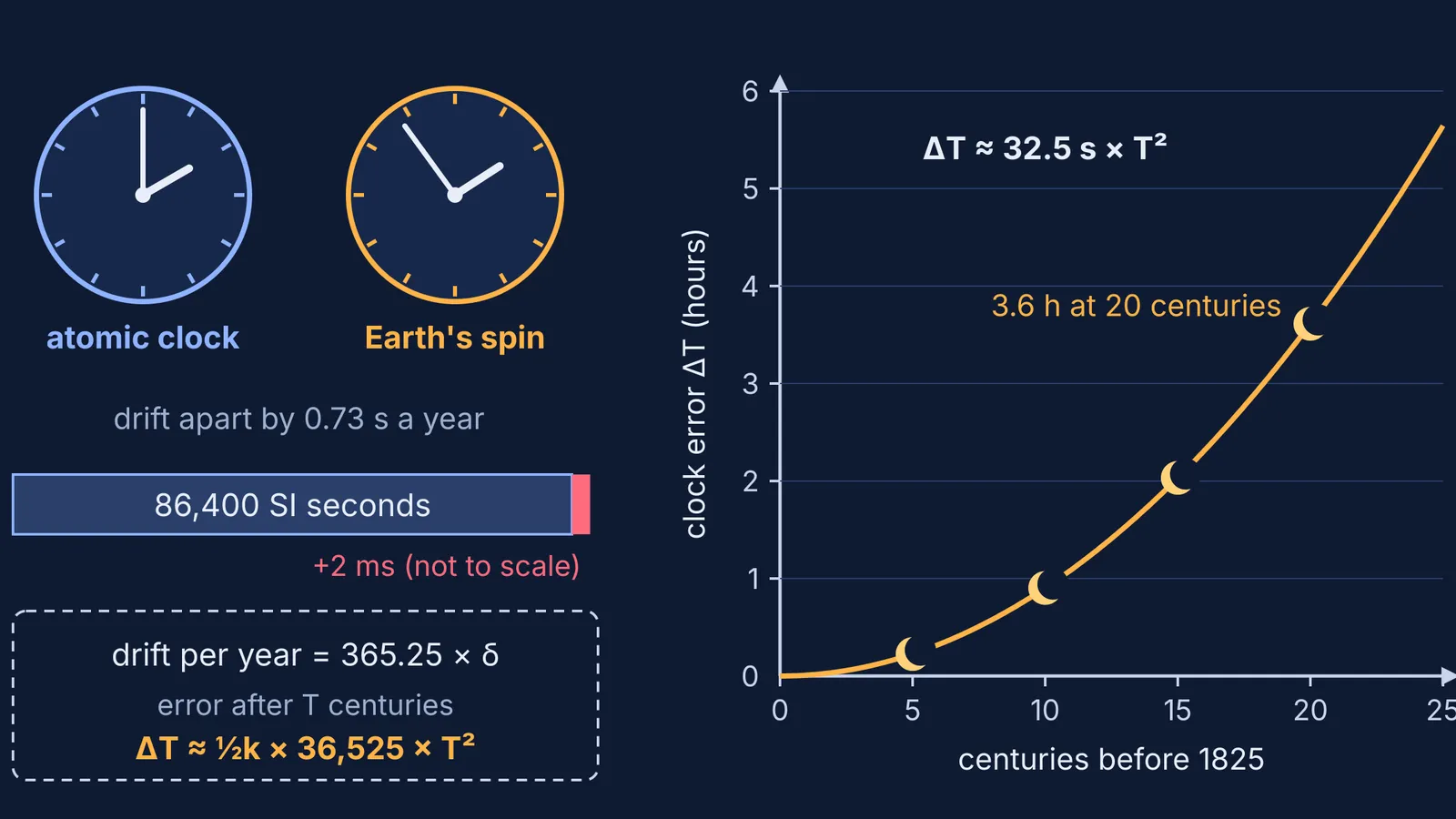
Call the excess length of each day δ. Each day Earth falls δ behind the atomic clocks, and a year has 365.25 days.
Drift per year = 365.25 × δ.
δ = 1.0 ms. Drift = 365.25 × 0.001 s = 0.365 s a year. A leap second is needed every 1/0.365 = 2.7 years.
δ = 2.0 ms. Drift = 0.731 s a year, one leap second every 1.37 years, about every 16 months.
δ = 2.5 ms. Drift = 0.913 s a year, one every 1.10 years.
The IERS leap-second table shows atomic time minus UTC rising from 10 s on 1 January 1972 to 37 s on 1 January 2017: 27 leap seconds in 45 years, or 0.60 s a year. Divide by 365.25 and the average excess was 1.6 ms a day.
The rate was not steady:
1972 to 1999: 22 leap seconds in 27 years, 0.81 s a year, so δ averaged about 2.2 ms.
1999 to 2017: 5 in 18 years, 0.28 s a year, so δ averaged about 0.8 ms.
Since 2017: none. The IERS Bulletin C of July 2026 says no leap second will be added at the end of 2026.
The day's length wobbles by a millisecond or so over years and decades, because the core, the oceans and the atmosphere trade angular momentum with the solid Earth. That is why leap seconds come irregularly and are announced only about six months ahead.
Worked example: how far off is Earth's clock after 2,000 years?
Assume the day was exactly 86,400 s at T = 0 (around 1825) and its excess grows steadily at k = 1.78 ms per century. Go back T centuries.
Excess of one day, t centuries away. δ(t) = k × t.
Days per century. 100 × 365.25 = 36,525.
Total clock error. Add up δ over every day. Because δ grows linearly, the sum is the area of a triangle: ΔT = ½ × k × 36,525 × T².
Put in numbers. ½ × 0.00178 s × 36,525 = 32.5 s, so ΔT ≈ 32.5 s × T².
After 1,000 years (T = 10). ΔT = 32.5 × 100 = 3,250 s = 0.90 hours.
After 2,000 years (T = 20). ΔT = 32.5 × 400 = 13,000 s = 3.6 hours.
This is the same algebra as distance under constant acceleration, s = ½at². The excess δ plays the part of velocity and k the part of acceleration. The fitted curve in the 2016 study is ΔT = −320 s + 32.5 s × T², with T in centuries from 1825. Evaluate it yourself and you get about 10,500 s (2.9 hours) at the start of the Common Era and about 17,200 s (4.8 hours) at 500 BC.
That is why eclipses recorded in ancient Babylon, China and Arabia happen hours "late" if you compute them with a uniform clock. Total eclipses are seen only along a narrow path, so a record of one from a known city fixes Earth's rotation angle at that moment. The medieval Cairo records used this way are covered in Ibn Yunus and the Hakemite tables.
What torque slows Earth down?
Turn the day-length change into an angular deceleration. Earth's angular speed is ω = 7.292 × 10⁻⁵ rad/s. A fractional change in the day gives the same fractional change in ω.
Fractional change per century. 0.00178 s ÷ 86,400 s = 2.06 × 10⁻⁸.
One century in seconds. 100 × 3.156 × 10⁷ s = 3.156 × 10⁹ s.
Angular deceleration. ω̇ = 7.292 × 10⁻⁵ × 2.06 × 10⁻⁸ ÷ 3.156 × 10⁹ = 4.8 × 10⁻²² rad/s². The study quotes 4.7 × 10⁻²².
Moment of inertia. About 0.331 MR² = 0.331 × 5.97 × 10²⁴ kg × (6.371 × 10⁶ m)² = 8.0 × 10³⁷ kg m² (approximate).
Net torque. τ = Iω̇ = 8.0 × 10³⁷ × 4.8 × 10⁻²² = 3.8 × 10¹⁶ N m.
This huge torque changes the day by under 2 ms a century only because Earth's moment of inertia is so large. If you like to see rotation like this rather than read about it, the Simulation Lab has interactive simulations for ideas that are easier to see than read.
Will leap seconds stop?
Yes, very likely. Leap seconds upset computer networks, which expect every minute to have 60 seconds. In 2022 the General Conference on Weights and Measures decided that the allowed gap between UT1 (Earth time) and UTC will be increased in, or before, 2035. The same resolution warns that a negative leap second, never used before, might be needed.
Why negative? Earth has recently been spinning slightly faster than the long-term trend. A 2024 study in Nature by Duncan Agnew estimated that a negative leap second might be needed around 2029, later than it would have been because melting polar ice is moving water towards the equator, raising Earth's moment of inertia and slowing it slightly. Treat that date as a forecast, not a fact.
Quick checklist
The SI second is atomic; it matches the average day of about 1820.
Drift per year = 365.25 × δ. A 2 ms longer day gives 0.73 s a year.
27 leap seconds were added from 1972 to 2016; none since.
With a steady growth k in the day's length, the clock error grows as ½kt²: ΔT ≈ 32.5 s × T².
About 3.6 hours after 2,000 years, which ancient eclipse records confirm in size.
ω̇ ≈ 4.7 × 10⁻²² rad/s², net braking torque ≈ 4 × 10¹⁶ N m.


