

On this page
When we want to know what time an event happened, we simply look at a clock. But for astronomers in the ancient and medieval world, mechanical and water clocks were rarely precise enough to time a celestial event perfectly. To solve this problem, the Egyptian astronomer Ibn Yunus found a better way: he used the sky itself as his clock. Working in Cairo, his precise measurements left a record so reliable that it solved a modern geophysical mystery.
What were the Hakemite Tables?
Ibn Yunus was one of the preeminent astronomers of the Fatimid era. He conducted his observations from the Muqattam Hills and other prominent sites around Cairo. His life's work culminated in a massive astronomical handbook called the *al-Zij al-Kabir al-Hakimi*, or the Great Hakemite Tables, which he dedicated to the Caliph al-Hakim (Stephenson, 1997).
The Hakemite Tables were an extensive reference work meant to improve upon earlier mathematical models of the heavens. Unlike earlier astronomers who often mixed their own data with older records without clearly distinguishing them, Ibn Yunus meticulously separated his own original observations from the ones he inherited. The surviving fragments of his work contain records of approximately 30 solar and lunar eclipses observed between 977 and 1004 CE (Stephenson, 1997). His commitment to empirical accuracy made this handbook a gold standard for later scholars.
How did Ibn Yunus measure eclipses in Cairo?
Before Ibn Yunus, many astronomers relied on water clocks to time the beginning, middle, and end of an eclipse. Because water flows at different rates depending on temperature and pressure, these clocks could drift by several minutes over the course of a night, introducing significant errors into the data.
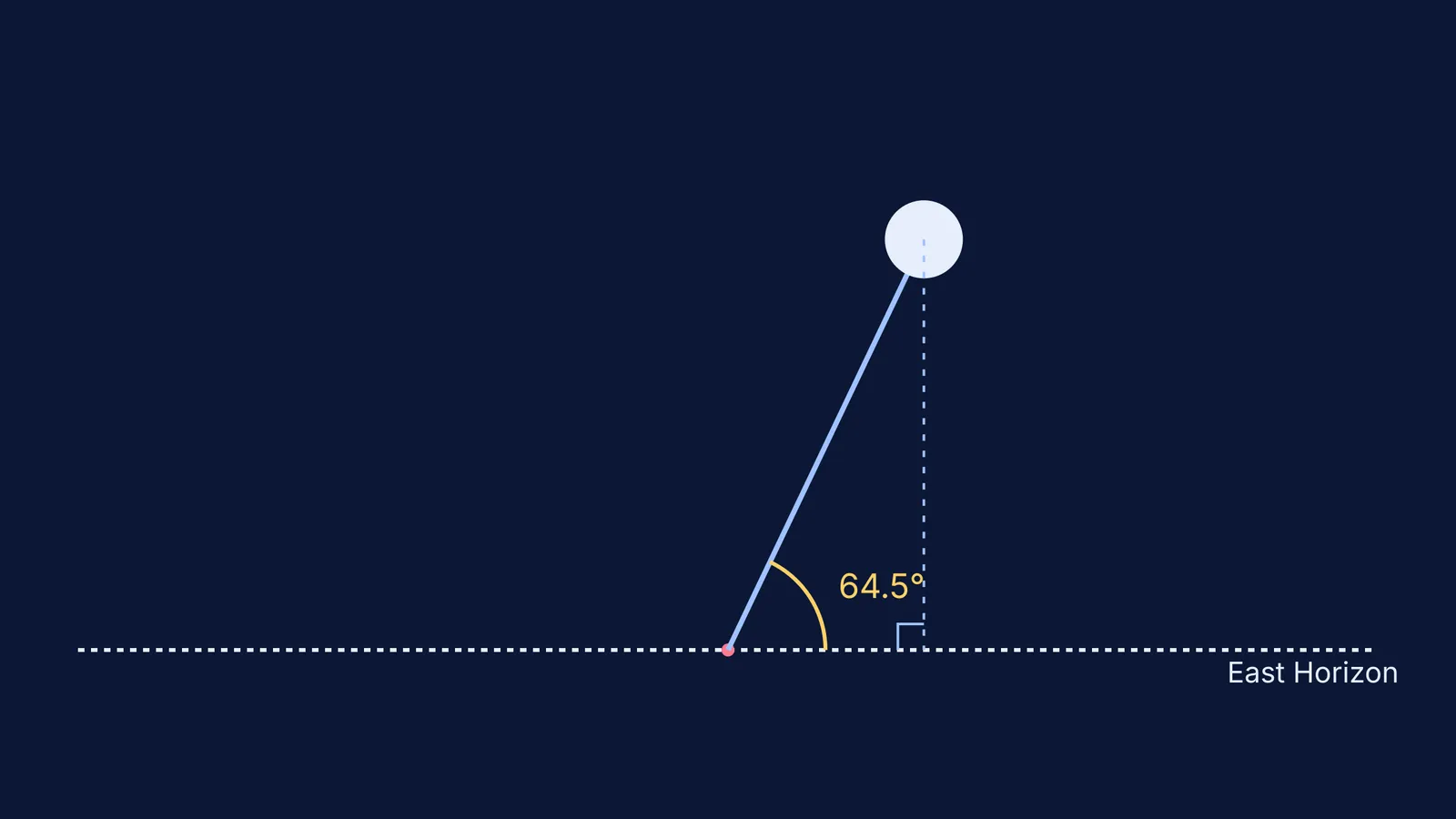
Ibn Yunus bypassed the water clock entirely. Instead, he used a large astrolabe to measure the altitude (the angle above the horizon) of the Sun, Moon, or a bright star at the exact moment a phase of the eclipse began or ended. For instance, during the lunar eclipse of November 979 CE, he recorded the Moon's altitude at first contact as 64.5° in the east, and at clearance as 65° in the west (Stephenson, 2003). Because the position of celestial bodies can be calculated mathematically through spherical geometry, modern astronomers can convert these altitude angles back into exact local times, completely eliminating the uncertainty of medieval clocks.
Why do these Cairo observations matter today?
Centuries after Ibn Yunus's death, his data became a crucial tool for modern geophysicists. In the late 19th century, the astronomer Simon Newcomb used Ibn Yunus's eclipse timings to calculate the secular acceleration of the Moon, determining that its orbit was changing slightly over time.
More recently, F. Richard Stephenson used the Hakemite Tables in his comprehensive study *Historical Eclipses and Earth's Rotation*. By comparing the exact times Ibn Yunus recorded with where the Moon should have been if the Earth spun at a perfectly constant rate, Stephenson proved that the Earth's rotation has been gradually slowing down, with the length of a day increasing by about 1.7 milliseconds per century (Stephenson, 2003). This deceleration is caused by tidal friction: the Moon's gravity pulls on our oceans to create tidal bulges, and as the Earth rotates, this water creates a dragging force that acts like a brake on the planet's spin. Without the meticulous altitude measurements taken from a Cairo hillside a millennium ago, mapping this microscopic change would have been nearly impossible.
If you get stuck trying to picture how angles, eclipses, and orbits change over time, Fermi's AI tutor works out what you already know and builds a plan for the session so you can master the spherical geometry.
How can you measure altitude like Ibn Yunus?
You can measure the altitude of the Moon tonight using a simple homemade tool, applying the exact same geometric principles that Ibn Yunus used with his astrolabe.
Get a standard mathematical protractor and tie a piece of string to the small hole at the centre of its straight edge.
Tie a small weight (like a washer or a metal nut) to the other end of the string so it hangs straight down towards the ground.
Hold the straight edge of the protractor up to your eye and sight the Moon along it.
Let the string hang freely so gravity pulls it straight down, and pinch it firmly against the curved edge of the protractor.
Read the angle where the string crosses the numbered scale. Subtract this reading from a right angle to find the Moon's true altitude above the horizon.
By tracking this altitude at different times of the night, you are gathering the same kind of observational data that eventually proved our planet is slowing down.
Read more about historical astronomy and eclipses:


