On this page
In November 1919 the world learned that light bends as it passes the Sun, by the amount Albert Einstein's general theory of relativity predicted. The evidence came from photographs of stars taken during a total solar eclipse on 29 May 1919 by two British expeditions, one led in the field by Arthur Eddington. This post explains what was measured, walks through the prediction so you can calculate it yourself, looks honestly at how strong the evidence was, and draws out what a student can learn.
Who was Arthur Eddington?
The MacTutor biography from the University of St Andrews gives his dates as 28 December 1882, in Kendal, England, to 22 November 1944, in Cambridge. He was Senior Wrangler, the top student in the Cambridge mathematics examinations, in 1904, and became Plumian Professor of Astronomy at Cambridge in 1913. He came from a Quaker family and was a conscientious objector during the First World War. Besides relativity, he did major work on the inside of stars, including the relation between a star's mass and its brightness.
What were the expeditions trying to measure?
The official report by Frank Dyson, Eddington and Charles Davidson appeared in the Philosophical Transactions of the Royal Society in 1920. Its opening sets out three possibilities for a star seen just at the edge of the Sun:
No deflection at all.
A Newtonian deflection, if light is pulled by gravity like ordinary matter: 0.87 arcseconds.
Einstein's deflection from general relativity: 1.75 arcseconds, exactly double the Newtonian value.
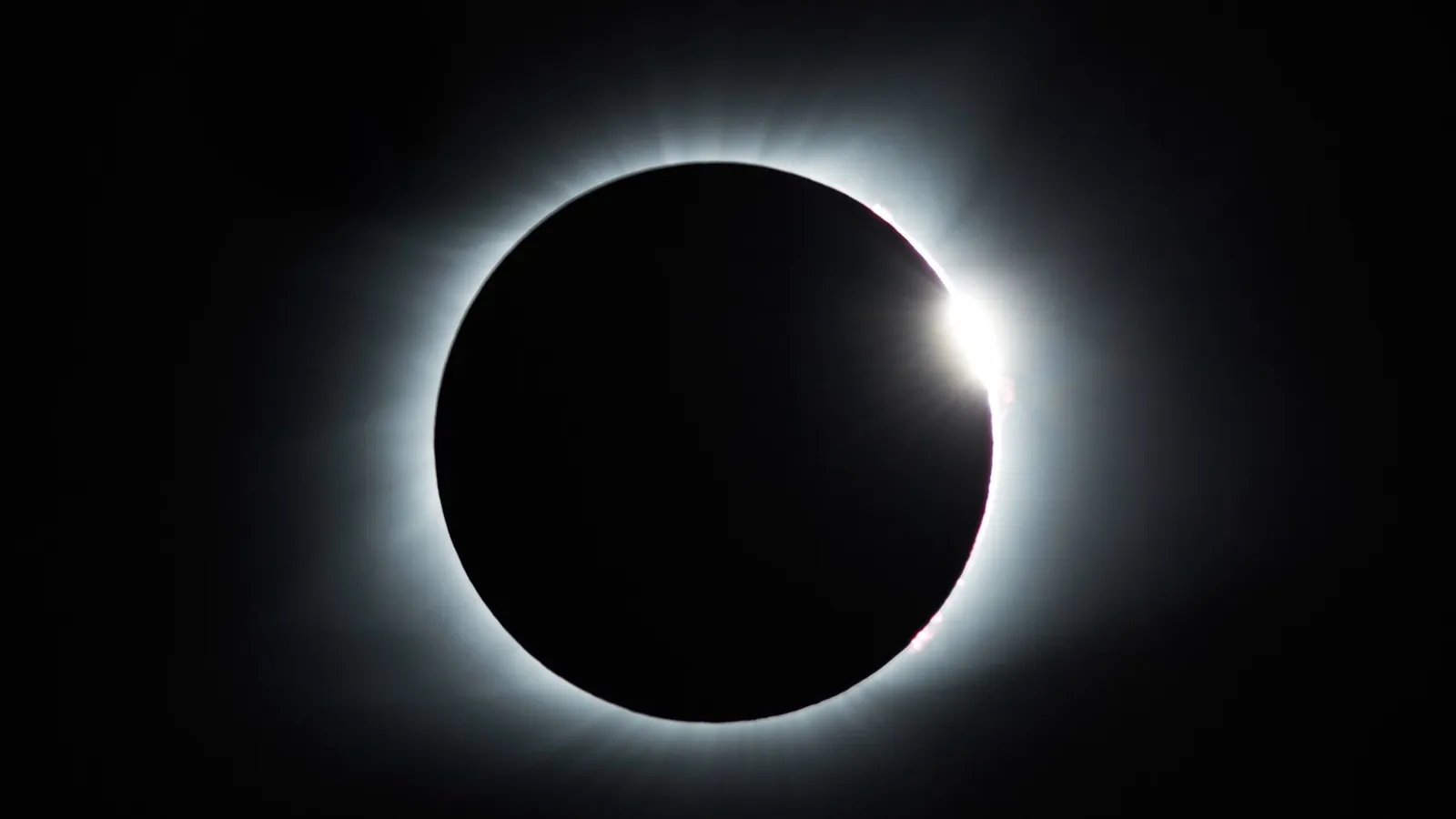
During a total eclipse the Moon blocks the Sun's glare, so stars close to the Sun can be photographed. Compare those positions with photographs of the same star field taken at night, when the Sun is elsewhere, and any shift shows up. One team went to Sobral in Brazil, and Eddington, with his assistant Cottingham, went to the island of Príncipe off the coast of West Africa.
Worked example: where does 1.75 arcseconds come from?
General relativity gives the deflection of light grazing a mass M at distance R as δ = 4GM / (c²R). The Newtonian argument gives half of that. Use NASA's Sun fact sheet: GM = 1.32712 × 10²⁰ m³ s⁻² and radius R = 6.957 × 10⁸ m. Take c = 2.998 × 10⁸ m/s.
Numerator: 4 × 1.32712 × 10²⁰ = 5.3085 × 10²⁰ m³ s⁻².
Denominator: c²R = 8.988 × 10¹⁶ × 6.957 × 10⁸ = 6.253 × 10²⁵ m³ s⁻².
δ = 5.3085 × 10²⁰ / 6.253 × 10²⁵ = 8.49 × 10⁻⁶ radians.
One radian is 206,265 arcseconds, so δ = 8.49 × 10⁻⁶ × 206,265 ≈ 1.75 arcseconds.
Halve it for the Newtonian value, about 0.87 arcseconds. Both shifts fall off as 1/R, so a star seen at twice the Sun's radius moves half as far. And 1.75 arcseconds is less than a thousandth of a degree, which is why the measurement was so hard.
Common mistakes:
Skipping the unit conversion. The formula gives radians. Multiply by 206,265 to get arcseconds.
Using the diameter. R is the distance of closest approach, the Sun's radius for a grazing ray.
Thinking Newton predicts no bending. Newtonian gravity acting on light also bends it, by half as much. The eclipse test was about which of the two values was right.
General relativity is beyond the school syllabus, but the arithmetic needs nothing more than Class 11 gravitation and careful units.
What did the photographs show?
A 2019 historical review by the physicist José Lemos, Shadow of the Moon and general relativity, sets out the results announced at a joint meeting of the Royal Society and the Royal Astronomical Society on 6 November 1919:
Sobral, 4-inch telescope, seven stars: 1.98 ± 0.12 arcseconds.
Príncipe, where cloud spoiled most of the 16 plates: 1.61 ± 0.30 arcseconds.
The main Sobral telescope had focus problems, and the team discarded its results.
Both usable results were far from zero and from 0.87, and close to 1.75. The 1920 report said that "the greatest weight must be attached to those obtained with the 4-inch lens at Sobral", which had the smaller error.
Lemos reports that the 1979 reanalysis by G. M. Harvey of the Royal Greenwich Observatory gave 1.90 ± 0.11 arcseconds for the 4-inch plates and 1.55 ± 0.34 arcseconds for the plates from the larger telescope.
What can a student take from how Eddington worked?
Write down the possible outcomes before you measure. The 1920 report named three results in advance, so the data could not be bent to fit a story afterwards.
Always report the uncertainty. The ±0.12 and ±0.30 told readers which result to trust more. Put error estimates in your own practical records.
Welcome a second look. The plates were re-examined 60 years later, and that is part of why the conclusion is trusted today.
To see where Einstein's ideas began, read our post on Einstein's 1905 papers, and for Eddington's well-known dispute with a young Indian physicist, our profile of Chandrasekhar and his limit. If gravity and light paths are hard to picture, the Fermi Simulation Lab has interactive simulations for ideas that are easier to see than read.
Try this now: calculate Einstein's deflection for a star whose light passes at three solar radii from the Sun's centre.