

On this page
This set follows our first laws of motion practice set for JEE Main and tests the parts of the chapter it skipped. New here: F = dp/dt, a water jet on a wall, a hump, a pulley's support, the slipping angle, a banked road, a pushed wedge and a block thrown up a rough slope. Take g = 10 m/s², sin 37° = 0.6 and cos 37° = 0.8.
Which laws of motion topics does set 2 cover?
Laws of Motion is Unit 3 of Physics in the NTA syllabus for JEE (Main) 2027. It lists momentum, static and kinetic friction, and vehicles on banked roads, all tested below. Angle of repose and banked roads are worked in Chapter 4 of the NCERT Class 11 Physics Part I textbook. For theory and a plan, see our guide on how to prepare laws of motion for JEE Main.
How should you use this practice set?
Hide the solutions; allow 25 minutes. Q6 needs a number.
Draw one free-body diagram per body first.
Commit to an option, then read the solution and trap.
Easy: can you apply F = dp/dt and F = ma cleanly?
Q1 (easy). A particle moving in a line has momentum p = (3t² + 2t) kg m/s, with t in seconds. What force acts on it at t = 2 s?
(A) 14 N (B) 16 N (C) 8 N (D) 6 N
Answer: (A). Force is the rate of change of momentum: F = dp/dt = 6t + 2 = 14 N at t = 2 s. Trap: (B) is the momentum itself; (C) the average force over 2 s.
Q2 (easy). A hose sends 2 kg of water per second horizontally at 15 m/s onto a wall. It runs down the wall without bouncing back. What force does the water exert on the wall?
(A) 15 N (B) 30 N (C) 60 N (D) 7.5 N
Answer: (B). Each second, 2 kg of water loses 2 × 15 = 30 kg m/s of horizontal momentum, so the wall pushes the water with 30 N. By the third law, the water pushes the wall with 30 N. Trap: (C) assumes the water bounces back at 15 m/s, doubling the change in momentum.
Q3 (easy). An 800 kg car crosses the top of a hump of radius 40 m at 36 km/h. What normal force acts on it there?
(A) 8000 N (B) 10000 N (C) 6000 N (D) 2000 N
Answer: (C). At 10 m/s, mg − N = mv²/r = 800 × 100 / 40 = 2000 N, so N = 6000 N. Trap: (B) adds the centripetal term, which is right for a dip, not a hump.
Medium: can you handle pulleys, slipping angles and banked roads?
Q4 (medium). Masses of 1 kg and 4 kg hang from a light string over a light, smooth pulley. The pulley hangs from a spring balance. What does it read while the masses move?
(A) 50 N (B) 32 N (C) 16 N (D) 40 N
Answer: (B). a = (4 − 1) × 10 / 5 = 6 m/s². For the 1 kg mass, T − 10 = 1 × 6, so T = 16 N. Both string ends pull down on the pulley: reading = 2T = 32 N. Trap: (A) adds the weights, true only at rest.
Q5 (medium). A plank is tilted slowly. A block on it starts to slip at 37° and then slides down at 2 m/s². What are the coefficients of static and kinetic friction?
(A) μs = 0.75, μk = 0.5 (B) μs = 0.6, μk = 0.4 (C) μs = 0.75, μk = 0.4 (D) μs = 0.5, μk = 0.75
Answer: (A). At the angle of repose, μs = tan 37° = 0.75. Sliding, a = g(sin 37° − μk cos 37°): 2 = 10(0.6 − 0.8μk), so μk = 0.5. Trap: (C) drops the cos 37° from the normal force.
Q6 (medium, numerical). A curve of radius 160 m is banked with tan θ = 0.25. At what speed, in km/h, does a car need no friction?
Answer: 72. With no friction, tan θ = v²/(rg), so v² = 160 × 10 × 0.25 = 400 and v = 20 m/s = 72 km/h. Trap: entering 20, the m/s value.
Hard: can you combine two bodies and two directions?
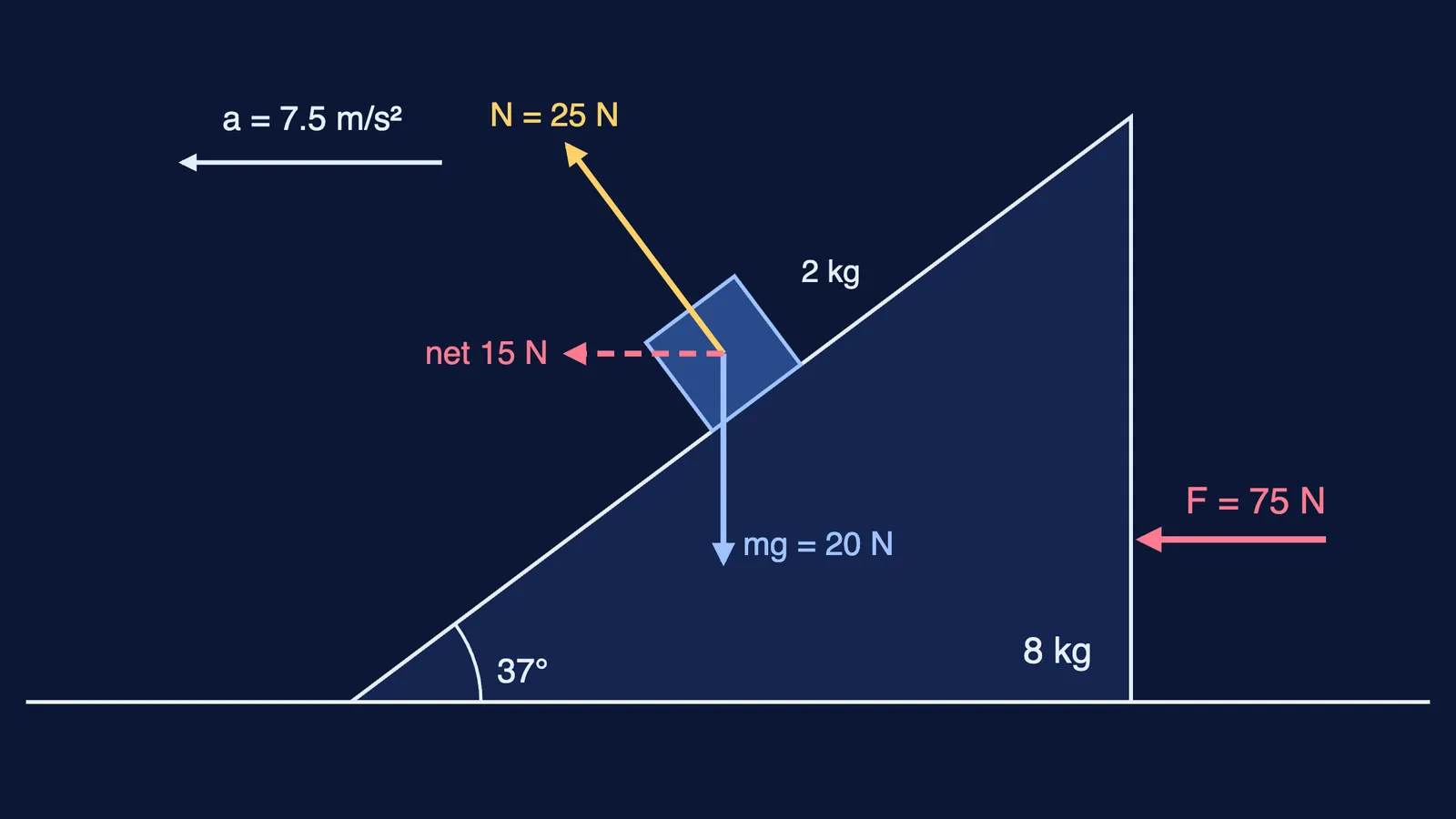
Q7 (hard). A 2 kg block sits on the smooth 37° face of an 8 kg wedge, which rests on a smooth floor. A horizontal force F on its back face pushes the wedge toward the side its slope faces. For what F does the block stay at rest on the wedge?
(A) 75 N (B) 15 N (C) 60 N (D) 133 N
Answer: (A). Only gravity and the normal force act on the block. Vertically, N cos 37° = 20 N, so N = 25 N, whose horizontal part, 15 N, gives a = 7.5 m/s² (g tan 37°). Both bodies share it, so F = 10 × 7.5 = 75 N. Trap: (B) is the net force on the block alone; F must accelerate the wedge too.
Q8 (hard). A block is sent up a 37° incline at 10 m/s. The coefficient of friction (static and kinetic) is 0.5. With what speed does it return to its starting point?
(A) 10 m/s (B) 2√5 m/s (C) 2 m/s (D) 2√15 m/s
Answer: (B). Going up, friction and gravity both pull down the slope: a = 10(0.6 + 0.4) = 10 m/s², so it stops after 100 / 20 = 5 m. As tan 37° = 0.75 > 0.5, it slides back with friction now up the slope: a = 10(0.6 − 0.4) = 2 m/s². Then v² = 2 × 2 × 5 = 20, so v = 2√5 ≈ 4.5 m/s. Trap: (A) ignores friction; (D) keeps friction on the way up but forgets it on the way down.
The diagram at the top shows Q7's forces to scale.
What should you do after this set?
Missed Q1 or Q2? Write the momentum before and after. Missed Q4? Ask what each string pulls on. Missed Q7 or Q8? Redraw for each stage of the motion. For more questions like these, the Fermi Problem Library has worked problems with a step-by-step solver that explains the reasoning rather than printing an answer.


