

On this page
Open your NCERT book and group 3 reads scandium, yttrium, lanthanum, actinium. Open some university textbooks or posters and the same column reads scandium, yttrium, lutetium, lawrencium. Chemists have argued about the difference for decades. Here is the evidence you can check with Class 11 and 12 data, where IUPAC stands, and what to write in the exam, where NCERT's answer (La) earns the mark.
Which elements are in group 3 of the periodic table?
The first two members are not in dispute: scandium (Z = 21) and yttrium (Z = 39). The argument is about periods 6 and 7.
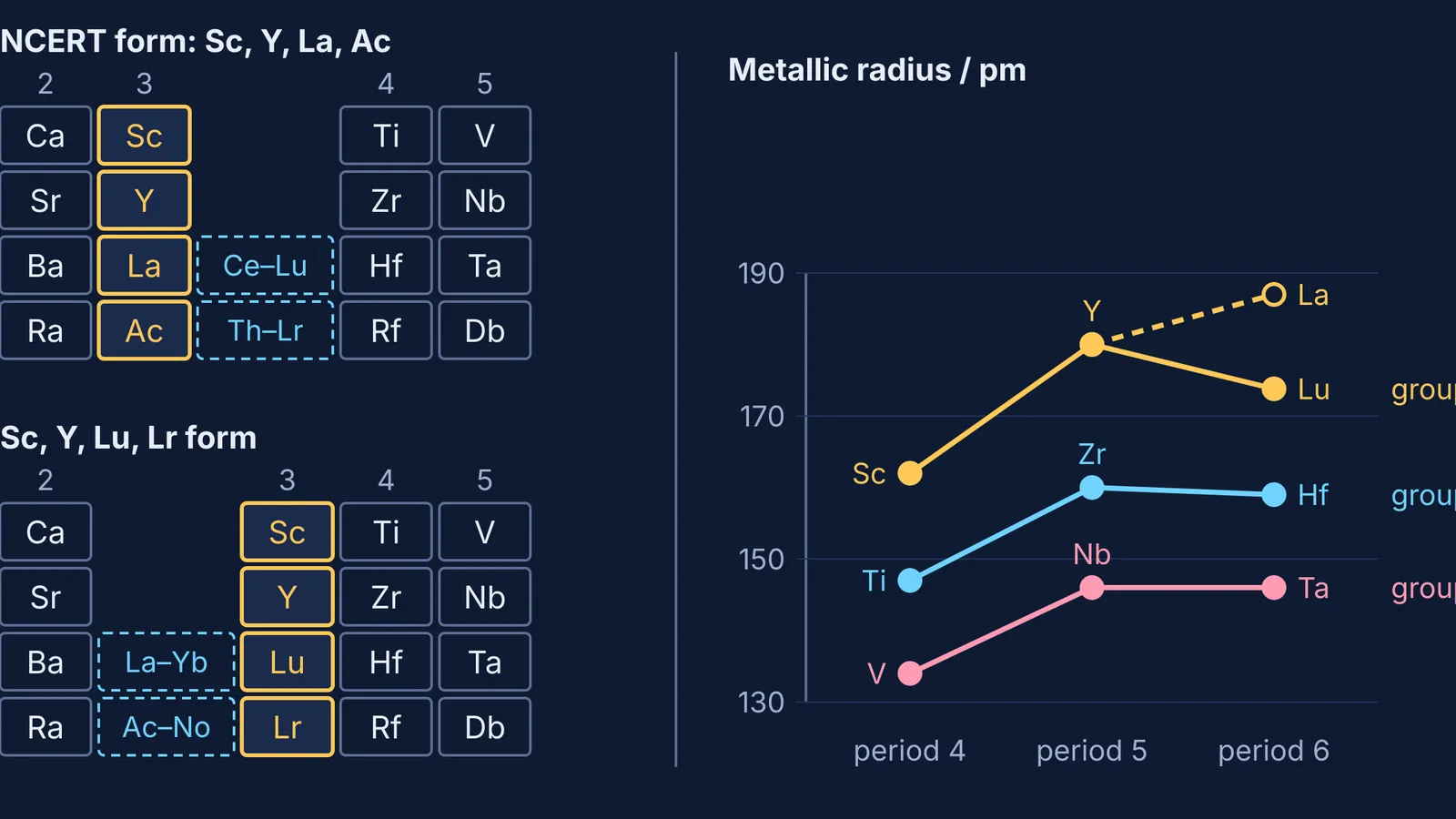
Form 1 (NCERT): Sc, Y, La, Ac. The current NCERT Class 12 chapter on the d- and f-block elements lists the 5d series as "La and Hf to Hg" and the lanthanoids as the 4f series "Ce to Lu".
Form 2: Sc, Y, Lu, Lr. Here lutetium (71) and lawrencium (103) sit under yttrium, and the f-block rows run La to Yb and Ac to No.
Form 3: Sc, Y and then a placeholder that stands for all fifteen lanthanoids (La–Lu) and all fifteen actinoids (Ac–Lr). The IUPAC periodic table is drawn this way.
It is a placement puzzle like why hydrogen's position in the periodic table is anomalous, argued here from configurations, radii and block shape.
What do the electron configurations of La and Lu say?
Write the ground states (NCERT Table 4.9 gives La and Lu):
Sc: [Ar] 3d¹ 4s²
Y: [Kr] 4d¹ 5s²
La: [Xe] 5d¹ 6s² (4f empty)
Lu: [Xe] 4f¹⁴ 5d¹ 6s²
Both La and Lu end in d¹s², so the outer electrons alone do not settle it. That is the strongest point for lanthanum.
Now look at the rest of period 6. Hafnium is [Xe] 4f¹⁴ 5d² 6s², and every 5d metal from Hf to Hg has a full 4f¹⁴ shell underneath. Lutetium is exactly one d electron short of hafnium, just as yttrium is one d electron short of zirconium. Lanthanum differs from hafnium by fourteen f electrons and one d electron. So Lu fits the row it sits in; La fits only if you ignore the empty 4f.
Lawrencium is harder: calculations predict a 7s² 7p¹ ground state (a relativistic effect), so period 7 is usually argued by analogy with period 6.
Why does the lanthanoid contraction favour lutetium?
Down groups 4 to 12, the 5d metal is almost the same size as the 4d metal above it. NCERT's example is Zr 160 pm and Hf 159 pm. The reason is the lanthanoid contraction: fourteen poorly shielding 4f electrons are added before the 5d series begins, and the shrinkage cancels the extra shell.
That only works for elements that come after the 4f set fills, like hafnium and lutetium. Lanthanum comes before any 4f electrons are added, so it gets the full size jump of a new shell with nothing to cancel it. With La, group 3 behaves unlike groups 4 and 5; with Lu, it behaves like them.
Where does the f-block start and end?
An f subshell holds 14 electrons, so each f-block row should be 14 elements wide. Between barium (56) and hafnium (72) there are 15 elements, La to Lu. One of them has to go in group 3.
With La in group 3, the f-row is Ce to Lu. In a full 32-column table, the d-block is split: La sits on its own, then the f-block, then Hf to Hg.
With Lu in group 3, the f-row is La to Yb, and the d-block runs Lu to Hg without a break.
The neat, unbroken d-block is the main reason many chemists prefer Lu. NCERT's choice keeps the older 18-column layout and matches its lanthanoid count of 14 (Ce–Lu), with La "usually included in any discussion of the lanthanoids". For why the f-block is pulled out below the table at all, see why lanthanoids and actinoids are placed separately.
Has IUPAC decided whether La or Lu goes in group 3?
No. IUPAC set up project 2015-039-2-200 on the constitution of group 3, with Eric Scerri as chair, and described the question in Chemistry International in 2016. The task group's provisional report, published in Chemistry International in January 2021, argued that some convention is unavoidable and leaned towards Sc, Y, Lu, Lr, partly because it gives a 32-column table with an unbroken d-block. It asked for comments.
A provisional report is not a recommendation. IUPAC's own periodic table page still says a project was "initiated to resolve the question" and draws group 3 with placeholders for the lanthanoids and actinoids. We found no final recommendation. So do not write "IUPAC moved lutetium into group 3"; write "an IUPAC task group's provisional report favours lutetium".
Worked example: test La and Lu against group 3
Data: metallic radii (12-coordinate) from Greenwood and Earnshaw's Chemistry of the Elements; six-coordinate ionic radii from Shannon's 1976 table; melting points from the CRC Handbook. Tables differ by a few pm or degrees, so treat every value as approximate.
(a) Configurations. Mark the outer (n−1)d and ns electrons:
Sc: 3d¹ 4s², Y: 4d¹ 5s², La: 5d¹ 6s², Lu: 5d¹ 6s² with 4f¹⁴ full underneath.
Both candidates pass this test. Configurations alone cannot decide.
(b) Radius test. Metallic radii: Sc 162, Y 180, La 187, Lu 174 pm.
Group 3, Sc → Y: 180 − 162 = +18 pm (a new shell, normal increase).
Group 4 for comparison: Zr → Hf is 160 → 159 pm, a change of −1 pm. Group 5: Nb → Ta is 146 → 146 pm, no change.
Y → La: 187 − 180 = +7 pm. The 5d atom is bigger.
Y → Lu: 174 − 180 = −6 pm. The 5d atom is the same size or slightly smaller.
Ions tell the same story. Shannon gives Y³⁺ 90.0, La³⁺ 103.2 and Lu³⁺ 86.1 pm. Y³⁺ → La³⁺ is +13.2 pm; Y³⁺ → Lu³⁺ is −3.9 pm. Compare Zr⁴⁺ 72 → Hf⁴⁺ 71 pm, −1 pm.
Neither step is flat, but Lu, like Hf and Ta, does not grow; La does.
(c) Melting points. Sc 1541, Y 1522, La 918, Lu 1663 °C.
In group 4 the 5d metal melts highest: Ti 1668, Zr 1855, Hf 2233 °C.
Y → Lu: 1663 − 1522 = +141 °C, the same direction.
Y → La: 918 − 1522 = −604 °C. Lanthanum melts at only about 0.6 times yttrium's temperature, the clear outlier.
(d) Exam check. "Which element is in period 6, group 3?" Answer from the NCERT table: lanthanum (La).
To rebuild the contraction from shielding and effective nuclear charge, the Concept Library gives each concept its own lesson, and the Fermi Problem Library has a step-by-step solver that explains the reasoning.
Quick checklist
Group 3 in NCERT: Sc, Y, La, Ac. That is your exam answer.
La is 5d¹ 6s² with empty 4f; Lu is 4f¹⁴ 5d¹ 6s².
Zr ≈ Hf and Nb ≈ Ta in size; Y → Lu fits that pattern, Y → La does not.
La's melting point (about 918 °C) is far below Y and Lu.
An f-row holds 14 elements, so either La or Lu must sit in group 3.
IUPAC: provisional report (2021) leans to Lu; no final decision.


