

On this page
You have probably seen the periodic table hanging on a classroom wall: a neatly stacked castle of elements with a separate, two-row block resting at the bottom. Those disconnected rows are the lanthanoids and actinoids. But why were they exiled from the main grid? It comes down to their shared chemical properties and the physical space a poster can take up.
Why not use a 32-column periodic table?
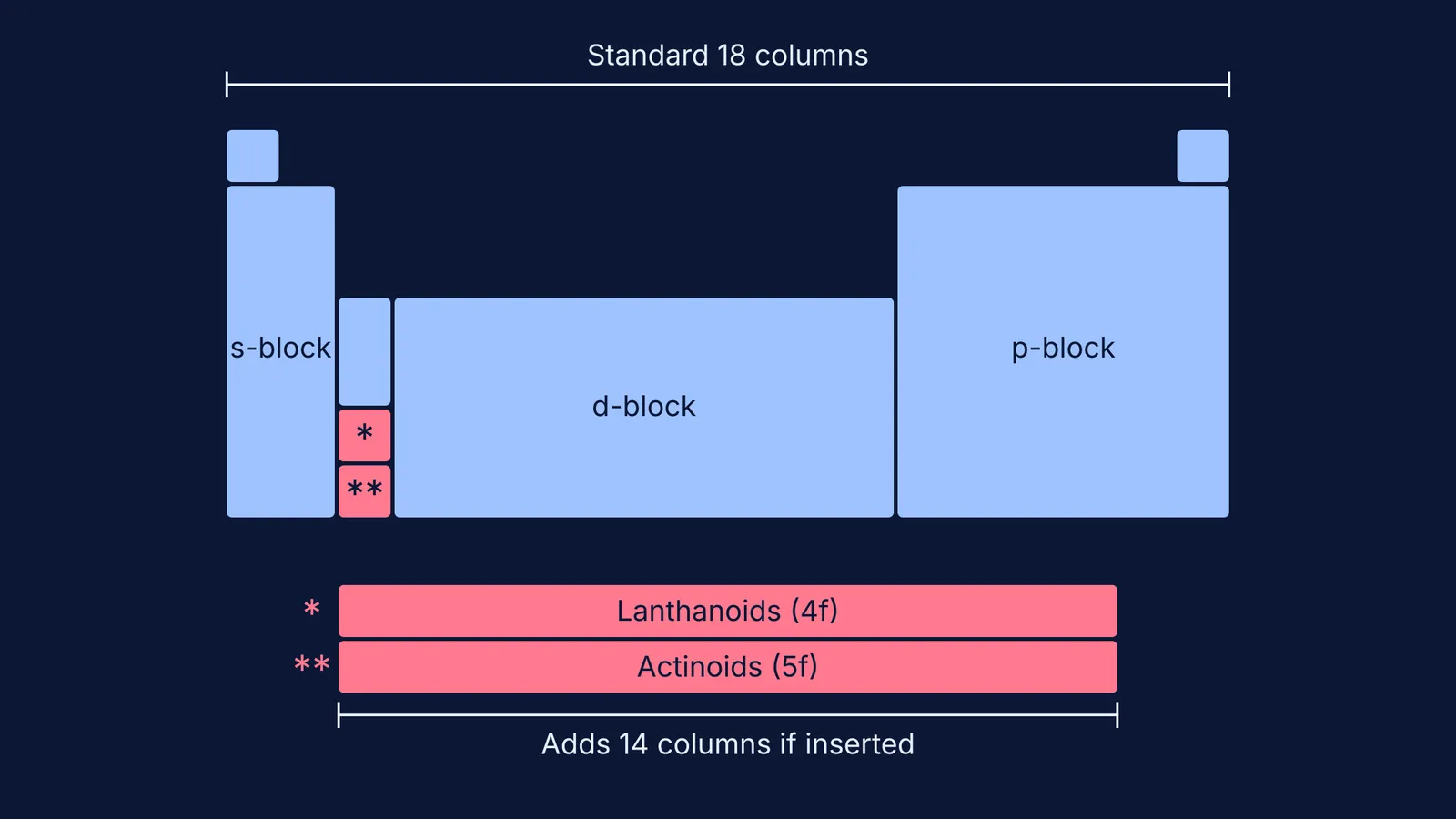
If we inserted the lanthanoids and actinoids exactly where they belong—between groups 2 and 4 in periods 6 and 7—the periodic table would stretch out enormously.
The standard periodic table is 18 columns wide, but inserting these extra 14 f-block elements expands the grid to 32 columns. Printing a 32-column chart on a standard A4 page or in a chemistry textbook would shrink the atomic symbols until they were almost unreadable. A chart that wide would look like a long, thin ribbon with too much empty space above the d-block and p-block. To solve this formatting problem, chemists pull these 28 elements out and place them below, creating the compact, 18-column format used today.
Who decided to separate the actinoids?
While the lanthanoids had been separated out for a long time, the actinoids were a different story. Until the mid-1940s, heavy radioactive elements like uranium and plutonium were placed in the main d-block (the transition metals) because their chemical behaviour appeared to mirror elements like tungsten and osmium.
In 1944, Glenn T. Seaborg proposed the "actinide concept", a hypothesis that these heavy elements were not transition metals, but were actually filling their 5f electron shell, just as the lanthanoids fill their 4f shell. His insight provided an explanation for observed deviations in their chemistry and was quickly accepted, resulting in the placement of a new actinide series directly below the lanthanoids. This adjustment gave us the familiar modern periodic table layout we still use today.
Why are the f-block elements grouped together?
The lanthanoids (atomic numbers 57–71) and actinoids (89–103) are grouped together because they share remarkably similar chemical properties within their respective rows. When you look at the main blocks of the periodic table—the s, p, and d blocks—chemical properties change quite dramatically as you move from left to right across a period. For example, moving across period 3 takes you from a highly reactive metal (sodium) to a non-metal gas (argon).
However, chemical behaviour is largely driven by an atom's outermost electrons. In the f-block, as you move across the row from left to right, new electrons are added to an inner shell (the 4f or 5f subshell) rather than the outermost shell. Because their outermost valence electron configurations remain nearly identical across the entire series, they react in very similar ways. For example, almost all lanthanoids prefer a +3 oxidation state and behave so similarly that early chemists struggled for decades to separate them from one another in naturally occurring ores.
The actinoids follow a similar pattern, filling the 5f subshell. Though they show a bit more variety in their oxidation states than the lanthanoids, they are still distinctly grouped together by their atomic structure.
How do you classify f-block elements in exams?
When tackling periodic table questions in chemistry exams, it is easy to get tripped up by the f-block's strange position. Use this quick checklist to categorise these elements correctly:
Check the atomic number: Elements 57 to 71 are lanthanoids (filling the 4f subshell), and elements 89 to 103 are actinoids (filling the 5f subshell).
Identify the group: Both series officially fit into Group 3 (in Periods 6 and 7). Even though they are drawn in 14 columns of their own, they are not scattered across Groups 4 to 17.
Know your blocks: Remember why zinc, cadmium and mercury are not called transition elements (they have full d-shells). In contrast, f-block elements are characterised by their partially filled (n-2)f subshells. If you are ever confused by how these inner subshells fill up and dictate properties, the Fermi Concept Library contains interactive lessons breaking down electron configurations shell by shell.
Compare their states: While the lanthanoids are mostly stable (with the exception of promethium), every actinoid is radioactive.
You can explore how standard d-block transition elements behave differently in our guide on E° values of 3d metals: why copper is positive and Mn²⁺ is stable. Understanding why the periodic table is shaped the way it is will help you predict the behaviour of an element just by knowing its postcode on the grid.


