On this page
Food-grade lactic acid is sold as a syrup, and the Indian Standard for it, IS 9971:1981, does not simply titrate it with alkali. It boils the sample with excess sodium hydroxide for 20 minutes first, then titrates back what is left. The reason is an ester hiding in the syrup. It also explains why the assay can report more lactic acid than the mass of acid actually dissolved.
What is in food-grade lactic acid, according to BIS?
Lactic acid is 2-hydroxypropanoic acid, CH₃CH(OH)COOH, molar mass 90.08. Clause 2.1 of IS 9971 says the product "consists of a mixture of lactic acid (C₃H₆O₃) and lactic acid lactate (C₆H₁₀O₅)". It may be "obtained by lactic fermentation of sugars or is prepared synthetically", and "purity of common products of commerce is 50 to 90 percent".
The note under it explains the second compound: lactic acid "when concentrated by boiling, it condenses to form lactic acid lactate, which on dilution and heating hydrolyzes to lactic acid".
Lactic acid has both an OH and a COOH, so one molecule can esterify another. The OH of one molecule reacts with the COOH of the next, giving the linear dimer, lactoyllactic acid:
2CH₃CH(OH)COOH ⇌ CH₃CH(OH)CO–O–CH(CH₃)COOH + H₂O
Check it: 2 × C₃H₆O₃ = C₆H₁₂O₆, and losing H₂O gives C₆H₁₀O₅, the formula BIS prints. The molar mass is 162.14. If both ends close into a ring you get lactide, C₆H₈O₄, which is covered in what hydroxy acids give on heating. This post is about the open-chain dimer.
Why does a direct titration undercount lactic acid?
Titrate the syrup straight away with NaOH and only free COOH groups react. A lactic acid molecule has one. The dimer also has only one, because its other carboxyl is tied up in the ester. So one dimer, made from two lactic acids, reacts as one acid.
Per gram, that means:
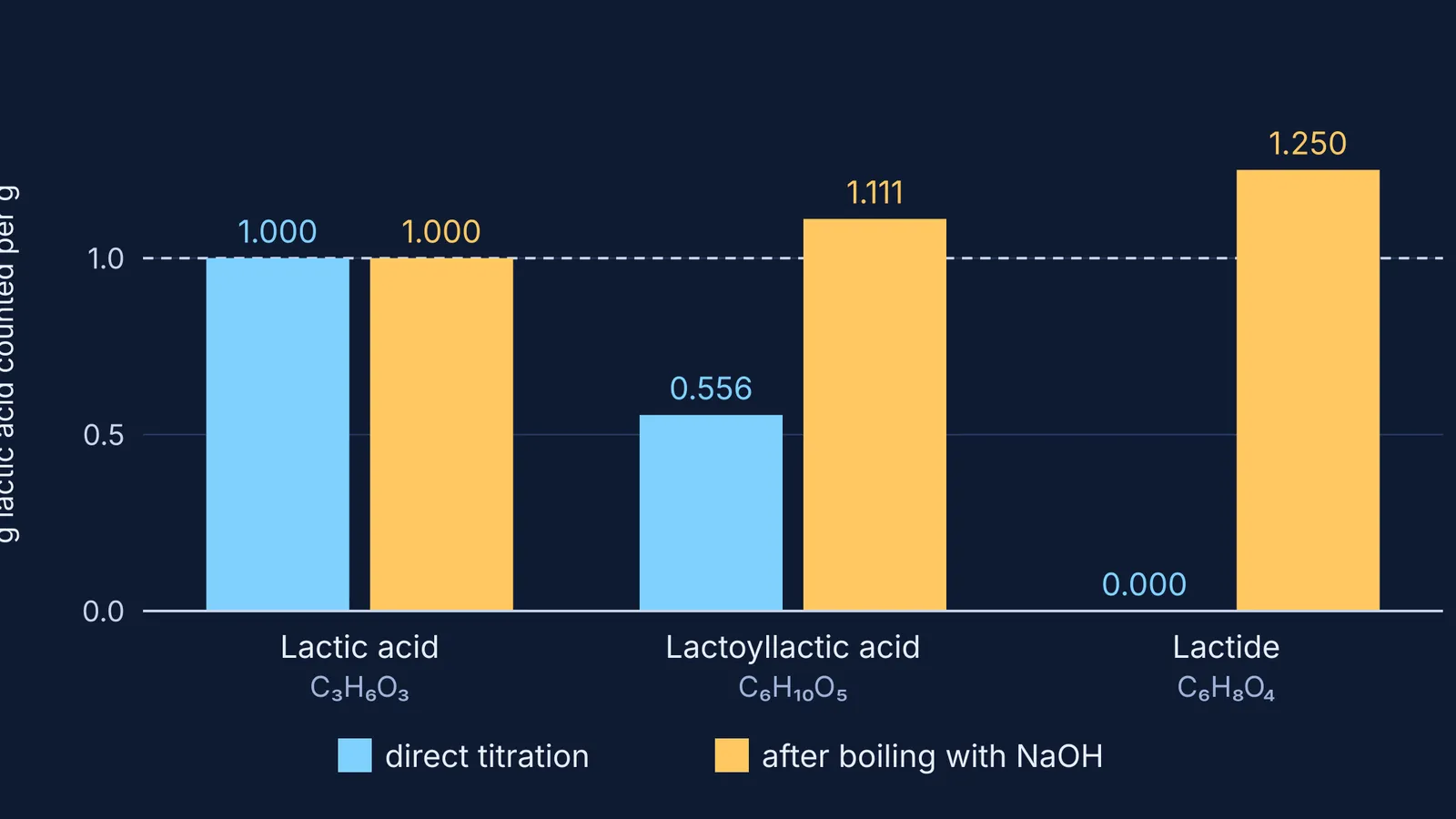
lactic acid counts as 1.000 g of lactic acid;
lactoyllactic acid counts as 90.08/162.14 = 0.556 g by direct titration;
after the ester is hydrolysed it counts as 2 × 90.08/162.14 = 1.111 g.
The last line is the surprise. The dimer lost a water molecule when it formed, so when it is split again it yields more lactic acid than its own mass. Lactide, which lost two waters, would give 1.250 g per gram.
How does the BIS back titration work?
Appendix A-1 weighs a portion "equivalent to 5 g of lactic acid", adds 50 mL of 1 N NaOH, boils for 20 minutes, adds phenolphthalein and titrates the excess alkali in the hot solution with 1 N H₂SO₄. A blank is run the same way. Each mL of 1 N NaOH used is 90.08 mg of lactic acid.
Boiling with alkali saponifies the ester:
CH₃CH(OH)CO–O–CH(CH₃)COOH + 2NaOH → 2CH₃CH(OH)COONa + H₂O
The free acid is neutralised at the same time, and the leftover alkali is titrated:
2NaOH + H₂SO₄ → Na₂SO₄ + 2H₂O
All three equations balance in atoms and charge. The pattern is the same one used in back titration calculations: alkali used = blank titre − sample titre.
Do one check on the printed numbers. Five grams of lactic acid is 5/90.08 = 55.5 mmol, but 50 mL of 1 N NaOH is only 50 mmol. As printed, there would be no alkali left to titrate. A smaller portion, for example about 3 g of lactic acid (33.3 mmol), leaves a workable excess, and the worked example below uses one.
How can the assay report more lactic acid than is dissolved?
Question. A 10.00 g sample of syrup contains 6.30 g of lactic acid, 1.62 g of lactoyllactic acid and 2.08 g of water. The label claims 80% lactic acid. Find what a direct titration and the BIS method report, and whether it meets the limit.
Moles. Lactic acid: 6.30/90.08 = 69.94 mmol. Dimer: 1.62/162.14 = 9.99 mmol.
Direct titration. One acid each: 69.94 + 9.99 = 79.93 mmol, which reads as 79.93 × 90.08 = 7.20 g. That is 72.0%.
After saponification. The dimer gives two: 69.94 + 2 × 9.99 = 89.92 mmol, which reads as 8.10 g, or 81.0%.
Compare. The real solute is 6.30 + 1.62 = 7.92 g, or 79.2%. The assay is higher than the mass of acid present.
BIS titration. Take 4.000 g of syrup. It contains 0.810 × 4.000 = 3.240 g, or 35.97 mmol, of lactic acid after hydrolysis. With 50.00 mL of 1 N NaOH and a blank of 50.00 mL of 1 N H₂SO₄, the sample needs 50.00 − 35.97 = 14.03 mL.
Result. (50.00 − 14.03) × 90.08/4000 × 100 = 81.0%. Against the label: 81.0/80 × 100 = 101.3%, inside the BIS window of 95.0 to 105.0% of the labelled concentration.
The assay counts every lactate unit, free or esterified, as if it were C₃H₆O₃. That is why a figure above 100% of a sample's acid mass is not an error. Pure lactoyllactic acid would assay at 111.1%.
For more practice on multi-step titration numericals, the Fermi Problem Library has a step-by-step solver that explains the reasoning.
How many stereoisomers do the dimer and lactide have?
Lactic acid has one stereocentre, so it exists as (R) and (S). Fermentation can give one enantiomer, while synthesis gives the racemate. BIS allows both and sets no optical rotation limit, so a sample may be either.
Lactoyllactic acid, CH₃CH(OH)CO–O–CH(CH₃)COOH, has two stereocentres. They carry different groups (one end is the OH carbon, the other the COOH carbon), so no internal mirror plane is possible. That gives 2² = 4 stereoisomers, no meso form: (R,R), (S,S), (R,S) and (S,R), as two pairs of enantiomers.
Lactide also has two stereocentres, but the ring is symmetric, so the two centres are equivalent. That gives 3: (R,R), (S,S) and meso-(R,S).
From pure (S)-lactic acid only the (S,S) dimer forms. From racemic acid all four form. For the general rule, see counting stereoisomers from the number of chiral centres.
What else does IS 9971 test, and where is this in the syllabus?
Lime water test (A-5): 1 g diluted and boiled with Ca(OH)₂ must stay clear. Citric, oxalic, phosphoric and tartaric acids would give insoluble calcium salts.
Fehling's test (A-6): no red Cu₂O precipitate, so no reducing sugars are left over.
Chloride (A-3): Mohr titration with chromate; 1 mL of 0.1 N AgNO₃ = 3.545 mg of Cl.
Sulphate (A-4): weighed as BaSO₄; the factor 0.412 is 96.06/233.39.
In the syllabus this sits in Class 12 carboxylic acids (esterification, saponification, hydroxy acids), Class 11 stoichiometry and titrations, and stereoisomerism with up to two stereocentres. If you are preparing for these chapters, Fermi Test Prep is built for JEE Main and Advanced preparation, with an AI tutor.
Quick checklist
Lactic acid syrup contains lactoyllactic acid, C₆H₁₀O₅, an ester dimer.
A direct titration counts the dimer as one acid; boiling with NaOH counts it as two.
One gram of dimer is worth 1.111 g of lactic acid, so assays can exceed the true acid mass.
BIS: 50 mL 1 N NaOH, boil 20 minutes, back-titrate hot with 1 N H₂SO₄; 1 mL = 90.08 mg.
Linear dimer: 4 stereoisomers. Lactide: 3, one meso.