

On this page
How many times does 2 divide 120? You can factorise it in your head. How many times does 2 divide C(1000, 500)? Factorising is hopeless, but Kummer's theorem gives the answer from one addition in binary.
What does Kummer's theorem say?
Kummer's theorem: for a prime p and whole numbers m and n, the exponent of p in C(m+n, m) equals the number of carries when you add m and n in base p (Kummer's theorem, Wikipedia). Ernst Kummer proved it in 1852, in a paper in the Journal für die reine und angewandte Mathematik (Kummer, 1852).
The exponent of p in a number x is written ν_p(x) and called its p-adic valuation: the number of times p divides x. For the bigger picture, see what p-adic numbers are and how they measure size by divisibility.
How do you count carries? A worked example with C(10, 3)
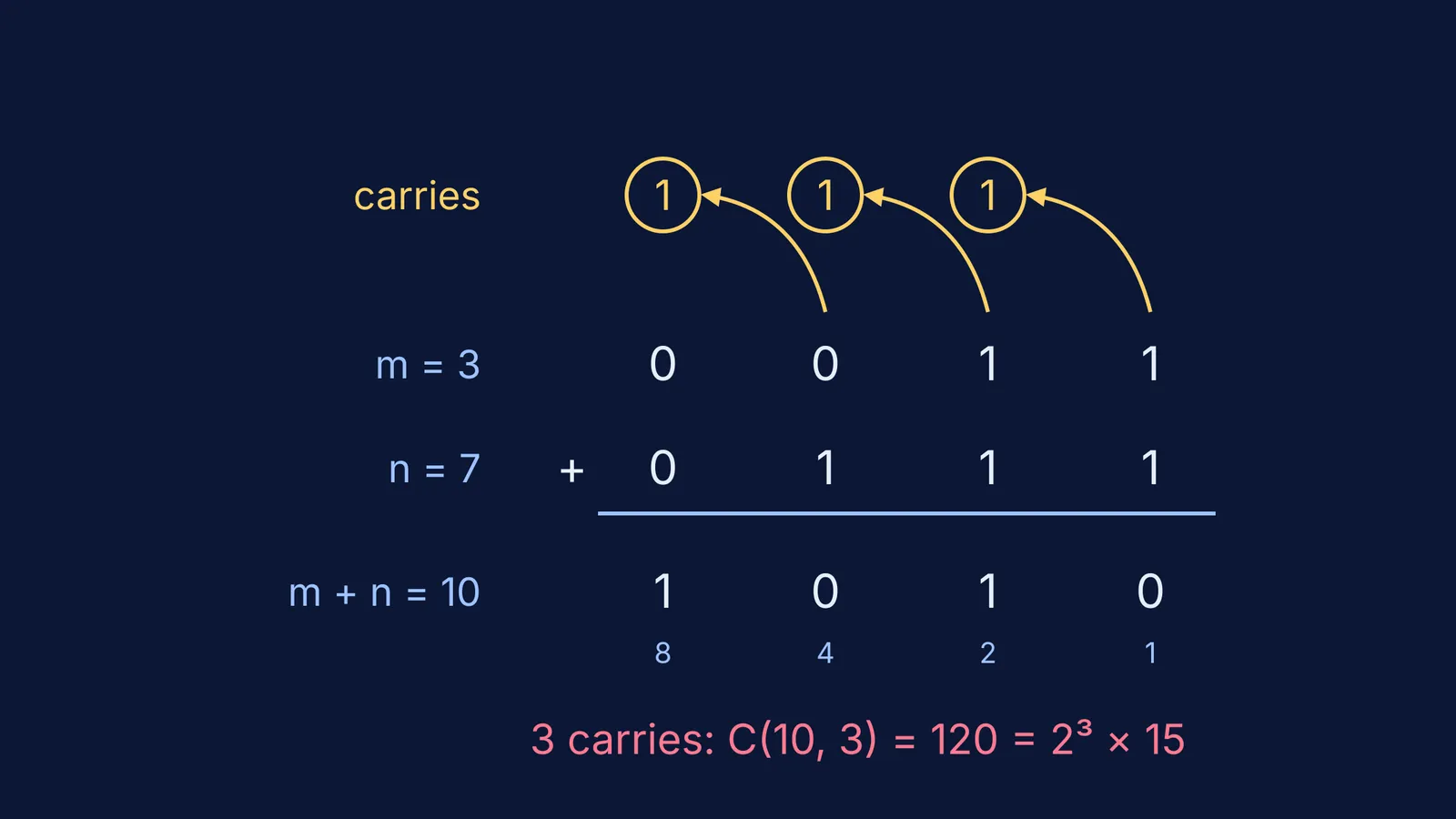
Take p = 2, m = 3 and n = 7, so the coefficient is C(10, 3) = 120.
Write both numbers in base 2: 3 = 0011 and 7 = 0111.
Units column: 1 + 1 = 2, which is 10 in binary. Write 0, carry 1.
Twos column: 1 + 1 + the carried 1 = 3, which is 11. Write 1, carry 1.
Fours column: 0 + 1 + the carried 1 = 2. Write 0, carry 1.
Eights column: 0 + 0 + the carried 1 = 1. Write 1, no carry.
The sum is 1010, which is 10, with three carries. So 2³ divides 120 but 2⁴ does not. Check: 120 = 8 × 15, and 15 is odd.
Now try other primes:
Base 3: 3 = 10 and 7 = 21. Units: 0 + 1 = 1. Threes: 1 + 2 = 3, carry. One carry, and 120 = 3 × 40.
Base 5: 3 = 3 and 7 = 12. Units: 3 + 2 = 5, carry. One carry, and 120 = 5 × 24.
Base 7: 3 = 3 and 7 = 10. No carries, so 7 does not divide 120.
No prime above 10 divides C(10, 3), so four additions give the full factorisation 120 = 2³ × 3 × 5.
Why is Kummer's theorem true?
The proof rests on Legendre's formula. If s_p(N) is the sum of the base-p digits of N, then ν_p(N!) = (N − s_p(N)) / (p − 1), the same count as ⌊N/p⌋ + ⌊N/p²⌋ + ⌊N/p³⌋ + … (Legendre's formula, Wikipedia).
Apply it to C(m+n, m) = (m+n)! / (m! n!). The terms m, n and m + n cancel, leaving
ν_p(C(m+n, m)) = (s_p(m) + s_p(n) − s_p(m+n)) / (p − 1).
With no carries, each column of the answer is the sum of the two digits above it, so s_p(m+n) = s_p(m) + s_p(n). A carry takes p away from one column and puts 1 into the next, so the digit sum drops by exactly p − 1. With c carries, s_p(m+n) = s_p(m) + s_p(n) − c(p − 1). Substitute, and the valuation is c. On our example, (s₂(3) + s₂(7) − s₂(10)) / 1 = 2 + 3 − 2 = 3. Dorel Miheţ's article in Resonance treats both theorems in more depth (Miheţ, 2010).
Why is C(2n, n) always even?
Write C(2n, n) as C(n + n, n) and add n to itself in binary. For any n ≥ 1, the lowest 1 in n meets another 1 in the same column and produces a carry, so C(2n, n) is even.
The digit-sum form says more. Doubling in binary shifts the digits, so s₂(2n) = s₂(n), and ν₂(C(2n, n)) = 2s₂(n) − s₂(n) = s₂(n): the power of 2 in C(2n, n) is the number of 1s in n written in binary. So 4 divides C(2n, n) exactly when n is not a power of 2, a consequence the Legendre's formula article states (Legendre's formula, Wikipedia). Try it: C(8, 4) = 70 = 2 × 35, and 4 = 100 has one 1; C(6, 3) = 20 = 4 × 5, and 3 = 11 has two. For another fact about n and 2n, see is there always a prime between n and 2n.
How do you use Kummer's theorem in a problem?
For any question about the highest power of p dividing C(N, k):
Write k and N − k in base p, not N and k: the two numbers must sum to N.
Add from the right and count every carry, including one out of the leftmost column.
Zero carries means p does not divide C(N, k).
Confirm with digit sums: (s_p(k) + s_p(N − k) − s_p(N)) / (p − 1) must give the same number.
For the JEE syllabus side, see preparing the Binomial Theorem for JEE Main. To revisit factorials, bases and divisibility, the Fermi Concept Library covers every concept in mathematics, and the Fermi Problem Library has a step-by-step solver that explains the reasoning.
Try it now: find the power of 3 in C(100, 50) by adding 50 and 50 in base 3.


