

On this page
If you have used Jensen's inequality with AM-GM and olympiad examples, you know it compares a convex function at the average with the average of its values. Karamata's inequality asks a sharper question: when one list with the same total is more spread out than another, what happens to the sum of f?
What does Karamata's inequality say?
The statement below follows the paper by Kadelburg, Đukić, Lukić and Matić in The Teaching of Mathematics (2005), adapted from their book for students preparing for mathematical competitions, including the International Mathematical Olympiad.
A list a = (a1, ..., an) majorizes a list b = (b1, ..., bn), written a ≻ b, when both are sorted from largest to smallest, a1 + ... + ak ≥ b1 + ... + bk for every k from 1 to n − 1, and the full sums are equal.
Karamata's inequality: if a ≻ b and f is convex on an interval containing all the numbers, then f(a1) + ... + f(an) ≥ f(b1) + ... + f(bn).
For a concave f the inequality reverses, and for a strictly convex f equality holds only when b is a rearrangement of a, as the Wikipedia article on Karamata's inequality notes. Jovan Karamata published the result in French in 1932 in Publications Mathématiques de l'Université de Belgrade, volume 1, pages 145–148; the 2005 paper notes that the literature also connects the inequality with Schur, Hardy, Littlewood, Pólya and Weyl.
The intuition: a convex curve bends upward, so pushing numbers apart while keeping their total fixed raises the sum of f. Majorization makes "more spread out" precise.
How do you check majorization with partial sums?
Sort both lists in decreasing order.
Check the totals are equal.
Write the running sums of each list side by side.
The first list majorizes the second only if each of its running sums is greater than or equal to the matching one.
The 2005 Teaching of Mathematics paper gives a useful warning: (5, 2, 2) and (4, 4, 1) both total 9, yet neither majorizes the other. Running sums are 5, 7, 9 against 4, 8, 9: the first list leads at step one and trails at step two. So always check every step.
How does Karamata generalise Jensen?
Let m be the mean of x1, ..., xn. The list (x1, ..., xn) always majorizes (m, m, ..., m): the k largest numbers have an average at least m, so their sum is at least km. Karamata then gives f(x1) + ... + f(xn) ≥ n·f(m), and dividing by n is exactly the finite Jensen inequality, as shown on the Wikipedia page. Jensen compares a list with its most even version; Karamata compares any two lists. Jensen is also a common route to the power mean inequality linking QM, AM, GM and HM.
Worked example: why is sin A + sin B + sin C > 2 in an acute triangle?
Let A ≥ B ≥ C be the angles of an acute triangle, so each is less than 90° and A + B + C = 180°.
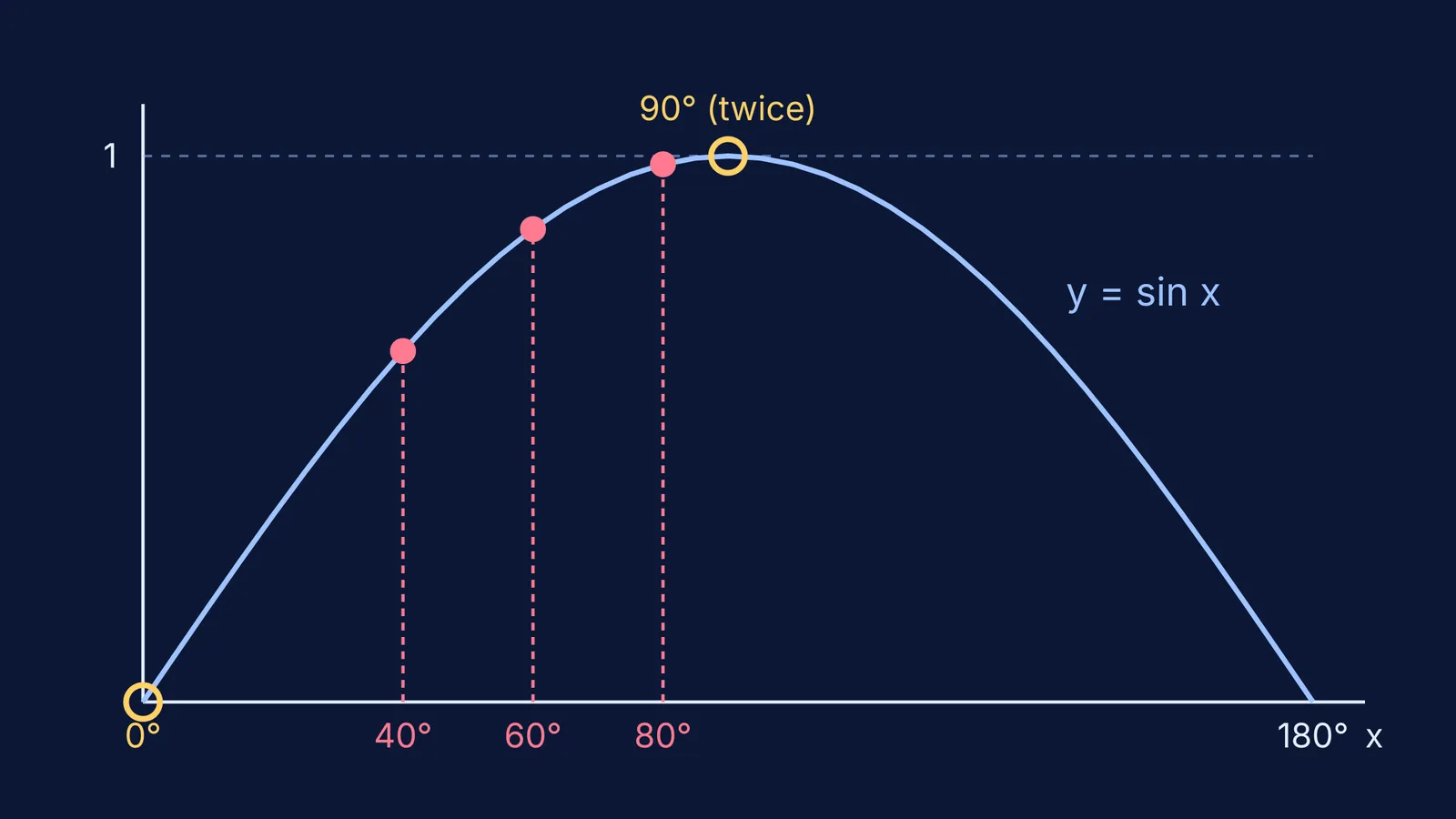
Pick the function. sin x is strictly concave on [0°, 180°], so Karamata runs in reverse.
Pick the comparison list. Take (90°, 90°, 0°), which also totals 180°.
Check partial sums. First: 90° ≥ A, because the triangle is acute. Second: 180° ≥ A + B, because C > 0. Totals: both 180°. So (90°, 90°, 0°) ≻ (A, B, C).
Apply Karamata for concave f. sin 90° + sin 90° + sin 0° ≤ sin A + sin B + sin C, so the sum is at least 2.
Strictness. (A, B, C) is not a rearrangement of (90°, 90°, 0°), since C > 0, so the inequality is strict.
Check with numbers: for angles 80°, 60°, 40°, the sines are about 0.9848, 0.8660 and 0.6428, which add to about 2.494. At the other end, (A, B, C) ≻ (60°, 60°, 60°), which is Jensen, gives the upper bound 3 × sin 60° = 3√3/2 ≈ 2.598, reached by the equilateral triangle. Every acute triangle's sum is greater than 2 and at most 3√3/2.
Why does "acute" matter? For angles 150°, 15°, 15°, step 3 fails at the first partial sum (90° < 150°), and indeed the sum is about 0.5 + 0.259 + 0.259 ≈ 1.02, below 2.
What mistakes do students make with Karamata?
Comparing lists that are not sorted.
Forgetting that the totals must be equal.
Using a function that is convex or concave on only part of the range, such as sin x, which is concave on [0°, 180°] but not beyond it.
Getting the direction wrong for concave functions.
For a refresher on convexity itself, the Fermi Concept Library covers every concept in mathematics, and the Fermi Problem Library has a step-by-step solver that explains the reasoning. When majorization feels heavy, compare it with the tangent line trick for inequalities.


