

On this page
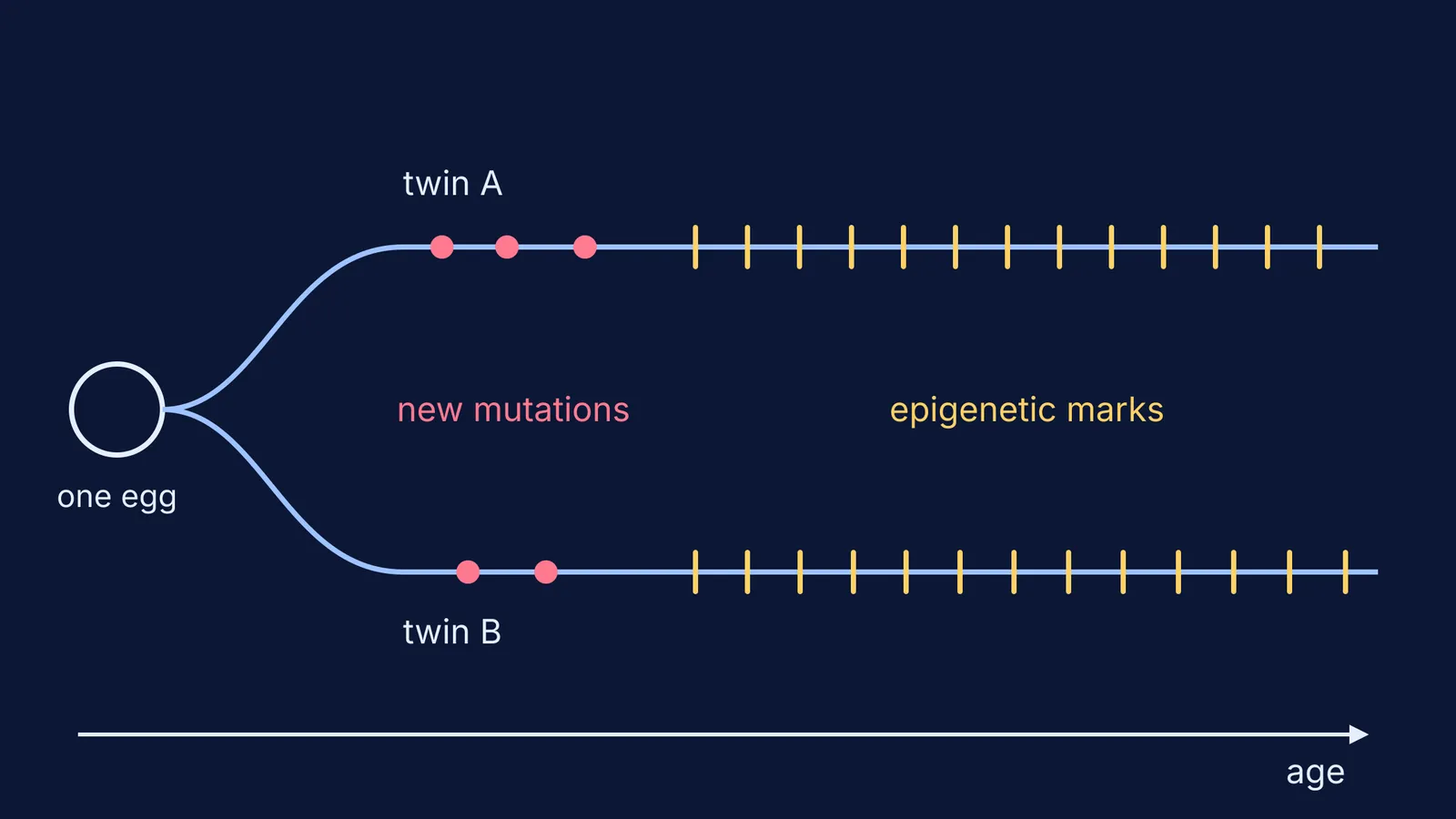
Identical twins, called monozygotic twins in textbooks, form when one fertilised egg splits into two embryos. So they start with the same DNA. Yet they are not carbon copies. Three things explain this: small changes in the DNA itself, chemical marks on top of the DNA, and the different lives the twins lead.
Are identical twins genetically identical?
Almost, but not quite. Every time a cell divides, it copies its DNA, and now and then the copy carries a small error. If an error happens after the embryo splits, only one twin carries it.
A team in Iceland sequenced the genomes of identical twins and used their parents and children to trace when each change arose. In a 2021 Nature Genetics study, they found that monozygotic twins differ on average by 5.2 early developmental mutations. The same study found that about 15% of twin pairs had a substantial number of these mutations in only one of the twins.
That is a small number across a whole genome. The point is that "identical" describes where the twins came from, not a guarantee of identical DNA. For a refresher, see our explainer on how identical and fraternal twins form and share genes, and for where new variation comes from in general, mutation vs recombination.
What are epigenetic marks, and how do they make twins different?
Epigenetic marks are chemical tags, such as methyl groups on DNA and acetyl groups on the histone proteins DNA wraps around, that help decide which genes are switched on without changing the DNA sequence. Think of the genome as a recipe book and the marks as sticky notes saying "use this page" or "skip this one".
A 2005 study in PNAS compared DNA methylation and histone acetylation in a large group of identical twins. Twins were epigenetically indistinguishable in the early years of life, but older twin pairs showed remarkable differences in these marks, differences that affected which genes were expressed.
The NASA Twins Study gives an extreme example. One identical twin astronaut spent a year on the International Space Station while his twin stayed on Earth as a genetically matched control. The twin who flew showed changes in DNA methylation, gene activity, gut microbes and telomere length. Average telomere length, overall gene activity and gut microbes returned to near pre-flight levels within 6 months of landing, but more short telomeres remained and the expression of some genes was still disrupted.
What do twin studies tell us about genes versus environment?
Twin studies compare identical twins, who share nearly all their DNA, with fraternal twins, who are genetically like ordinary siblings. If identical twins are much more alike for a trait, genes probably matter for it.
A 2015 meta-analysis in Nature Genetics, covering virtually all published twin studies of complex traits, pooled 17,804 traits from 2,748 publications and 14,558,903 partly dependent twin pairs. Across all traits, the reported heritability was 49%. For a majority (69%) of traits, the twin correlations were consistent with a simple model in which resemblance came from additive genetic effects alone. Overall, the data did not support large effects of the environment twins share, such as the same home.
Heritability is easy to misread. It describes how much of the variation between people in one group, living in their particular environments, lines up with genetic differences. It does not say what share of your own height or marks "comes from" your genes, and it does not mean a trait cannot change.
How do you check a "genes vs environment" headline?
Run these four questions on any story about twins or "the gene for" something.
Which comparison was made? Identical twins against fraternal twins, twins raised apart, or something else?
What kind of difference is it? A change in the DNA sequence, an epigenetic mark, or a difference in life experience?
Heritability of what, in whom? A figure from one country, age group or decade may not carry over to another.
Is the claim about a group or a person? Twin studies describe variation across many people, not any one student's future.
Worked example: a headline says "Maths ability is mostly genetic". Question 3 tells you the figure belongs to one sample in one setting. Question 4 tells you it says nothing about whether you can improve. Teaching and practice are part of the environment.
For parents, this matters at home. Two identical twins can bring back very different report cards, and that is normal biology plus different experiences, not a sign that one child is "the clever one". Our guide on what parents can do when twins get very different marks turns that into practical steps.
If words like methylation, histone or genotype feel shaky while you revise genetics, the Fermi Concept Library has a lesson for every concept in biology and shows its place in the map. And if you are not sure where to start, Fermi's AI tutor can work out what you already know and build a plan for the session.


