On this page
One twin gets 92 in maths, the other gets 61. Before long one child is "the smart one" and the other is "the careless one". This is common, and it doesn't mean one twin has a ceiling. Here is what twin research says, and what you can do at home.
Is it normal for twins to get very different marks?
Yes, even for identical twins, who share all their genes. A study in *Developmental Science* followed 2,768 pairs of identical twins and found that they differed in school performance. The gaps were moderately stable between ages 12 and 16, and differences at 12 and 14 accounted for 20% of the variance in the gap at 16.
The same study found that the twin who scored higher in school also tended to score higher on 16 learning-related measures, including intelligence, personality and attitudes to school. These differences accounted for 22% of the variance in the twins' gap in school performance at 16. The authors, von Stumm and Plomin, wrote that their findings suggest experiences the twins do not share affect school performance in "systematic ways". In plain terms, the gap is probably not just random bad luck.
Why do twins in the same class score differently?
Same home, same school, even the same teacher, but not the same experience. In one study, researchers phoned 61 pairs of identical 10-year-old twins every school day for two weeks. Each pair shared a classroom, a teacher and classmates. The twins still described their days differently.
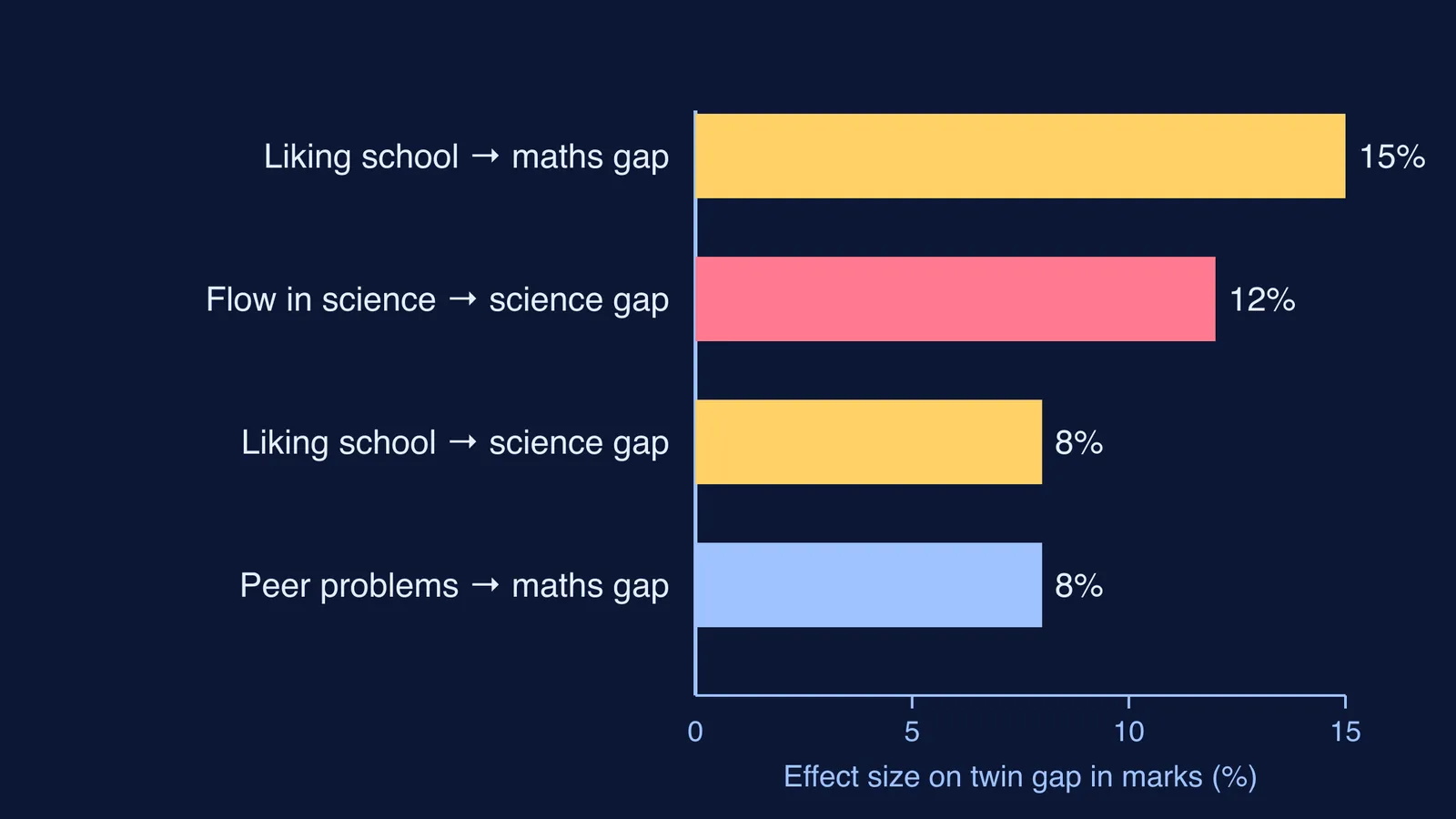
Those differences tracked their marks. In that study, differences in how positive each twin felt about school were linked to the gap in their maths marks (effect size 15%) and science marks (8%). Differences in how often they felt absorbed ("flow") in science lessons were linked to the science gap (12%). Problems with classmates were linked to the maths gap (8%).
For parents, this shifts the question. "Why can't you be like your brother?" doesn't help. Ask instead: how does each child experience maths class, and what would make it go better for this one?
What's wrong with calling one twin "the smart one"?
A label like that is praise for ability, and ability praise can backfire. In six studies, Claudia Mueller and Carol Dweck found that children praised for intelligence showed less persistence, less enjoyment and worse performance after a failure than children praised for effort. They were also more likely to see intelligence as fixed. That's a problem for the "smart" twin, who may start avoiding hard problems. It's a bigger problem for the other twin, who hears that the question has already been settled.
How you treat each twin matters too. A 2024 meta-analysis in the *Journal of Family Psychology* looked at 13 samples of siblings. The child who got less warmth and more hostility than their sibling tended to have more behaviour problems. The link was small but significant, and strongest for harsh treatment.
How do you talk about two report cards?
See each twin alone, and start with their own trend rather than their sibling's marks. Our guide to discussing report cards when siblings are present has more on setting this up. A short script:
"Show me the subject you're happiest with this term. What went right?"
"Which one felt hardest? Where did the marks go: not knowing it, silly slips, or running out of time?"
"Compared with last term, what changed?"
"What's one thing you want to try before the next test, and how can I help?"
Never read one twin's marks aloud to the other. If a teacher or relative compares them, our article on when a teacher compares your two children suggests what to say. If one twin teases the other, a house rule helps. See sibling teasing about low marks.
A one-term plan for each twin
Separate goals. Each twin picks one subject and one measurable target compared with their own last result, such as "from 61 to 70 in maths".
Separate strengths. Name one thing each twin is good at that has nothing to do with the other twin, inside or outside school.
Separate time. Give each twin a short slot every week with you alone, sometimes on studies and sometimes not.
Separate help. If one twin keeps losing marks in the same chapter, fix that gap directly. The Fermi Concept Library has a lesson for every concept in physics, chemistry, biology and mathematics, so they can go back to basics without studying beside their twin's notebook.
Compare with last term, not with each other. At the end of term, each twin compares their marks only with their own earlier results.
If one twin seems withdrawn, stops eating or sleeping well, or talks about feeling worthless, speak to the school counsellor or a doctor. You can also call Tele MANAS, the government's mental-health helpline, on 14416.