On this page
In 1921, at 51, Ynes Mexia signed up for botany classes at the University of California, Berkeley. A year later she joined her first plant-collecting trip, and from 1925 she kept collecting for the rest of her life. If you think science belongs only to people who start young, her life is a useful correction.
Who was Ynes Mexia?
Ynés Mexía was born on 24 May 1870 in Washington, D.C., and died on 12 July 1938, according to the Bancroft Library's guide to her papers. Her father was a Mexican diplomat, the Library of Congress notes, and PBS American Masters describes her as a U.S.-born Mexican American who began her scientific career at 51.
The California Academy of Sciences biographical sketch gives the turning points. In 1921 she enrolled in botany classes at Berkeley. In July 1925, at 55, she wrote to the Academy's botanist Alice Eastwood that she was joining Stanford's Roxanna Ferris on a collecting trip to Mexico, paying her own way. The Bancroft guide adds that this was her second trip: the first, in 1922, was to Mexico with a group led by E. L. Furlong, and the important collecting began in 1925. Seven more trips followed over twelve years, to Alaska, Mexico, Brazil, Peru, Ecuador, Chile and Argentina. Another late starter: Inō Tadataka began surveying Japan at 55.
How many plants did Ynes Mexia collect?
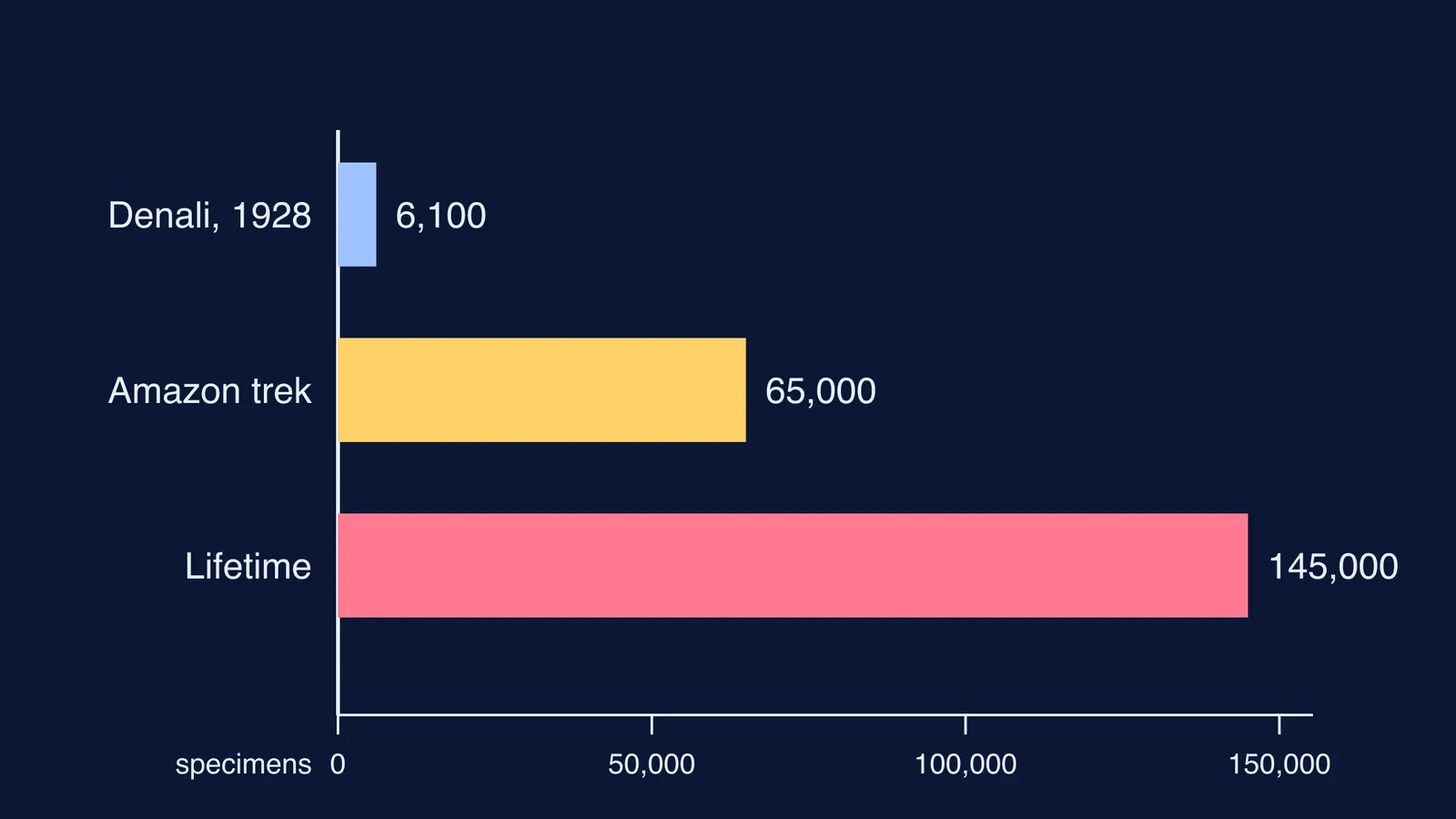
Ynes Mexia collected approximately 145,000 plant specimens, according to the Bancroft Library. The same guide credits her with two new genera and about 500 new species, and says 50 species were named after her.
Treat the species count with care. The California Academy of Sciences sketch says there is substantial agreement that she collected some 150,000 specimens, but that estimates of her new species range from two to 500.
Two trips stand out. In 1928 she collected 6,100 specimens of 365 plant types in Mount McKinley National Park, now Denali, and the US National Park Service calls her Denali's first botanist. On a 3,000-mile trek across South America along the Amazon and Marañón rivers she brought back 65,000 specimens, the Library of Congress reports. She sold specimens to pay for her expeditions.
What is the difference between a specimen and a collection number?
The Bancroft guide counts her work two ways: about 145,000 specimens under 8,800 collection numbers. Many collectors number what they collect, starting at 1, and write the number on the newspaper the plant is pressed in, as the University of Wisconsin-Green Bay herbarium guide explains.
Mexia sent duplicate specimens to many herbaria: the Academy sketch lists Harvard's Gray Herbarium, the Field Museum in Chicago and collections in London, Paris, Geneva and Stockholm, among others. Divide 145,000 by 8,800 and you get about 16 sheets per number on average. Her letters also mention how hard it was to find paper to dry plants.
How did plants get named after Ynes Mexia?
Your NCERT Class 11 Biology chapter The Living World sets out the rules of binomial nomenclature: the genus comes first with a capital letter, the specific epithet second in small letters, both in italics (or underlined separately when handwritten), and the describing author's name abbreviated at the end, as in *Mangifera indica* Linn.
Now read two real names from the International Plant Names Index:
*Begonia mexiae* Standl. (published 1929): genus *Begonia*, epithet *mexiae* honouring Mexia, and Standl. is the describing botanist.
*Mexianthus* B.L.Rob. (published 1928 in Contributions from the Gray Herbarium): here a whole genus in the family Asteraceae carries her name.
Quick check: which is written correctly, "Begonia Mexiae", "begonia mexiae" or "Begonia mexiae"? Only the last, in italics.
If ranks such as genus, family and order blur together, the Fermi Concept Library has every concept in biology with its own lesson and its place in the map, so you can see where each rank sits.
How can you press a plant specimen at home?
Steps 2 to 6 of this weekend plan follow the Royal Horticultural Society's pressing guide:
Pick a common plant, with permission. Never take rare or protected plants.
Note what pressing will hide: colour, habit, form and scent.
Arrange it on blotting paper, keeping the character of the plant.
Stack corrugated card, two sheets of blotting paper, the plant, two more sheets and card, then weigh it down evenly with bricks or a heavy object.
After 24 hours, swap the damp card and top paper for dry ones, then check at least once a week. Drying takes two days to three weeks.
Label it with the plant's name, date, collector and place, and give it collection number 1.
If you are coming back to biology after years away, Fermi's AI tutor works out what you already know and builds a plan for the session, so you start where you actually are.
For two more botanists who worked far from home, read about Mary Agnes Chase, the grass botanist who wrote for beginners, and Jeanne Baret, who sailed around the world collecting plants.