On this page
In December 1766, a young woman from Burgundy boarded the French storeship Étoile at Rochefort dressed as a man. She called herself Jean and signed on as servant to the expedition's naturalist, Philibert Commerson. When she next stood in France, around 1775, Jeanne Baret had gone right round the planet, working as a field botanist along the way.
Who was Jeanne Baret?
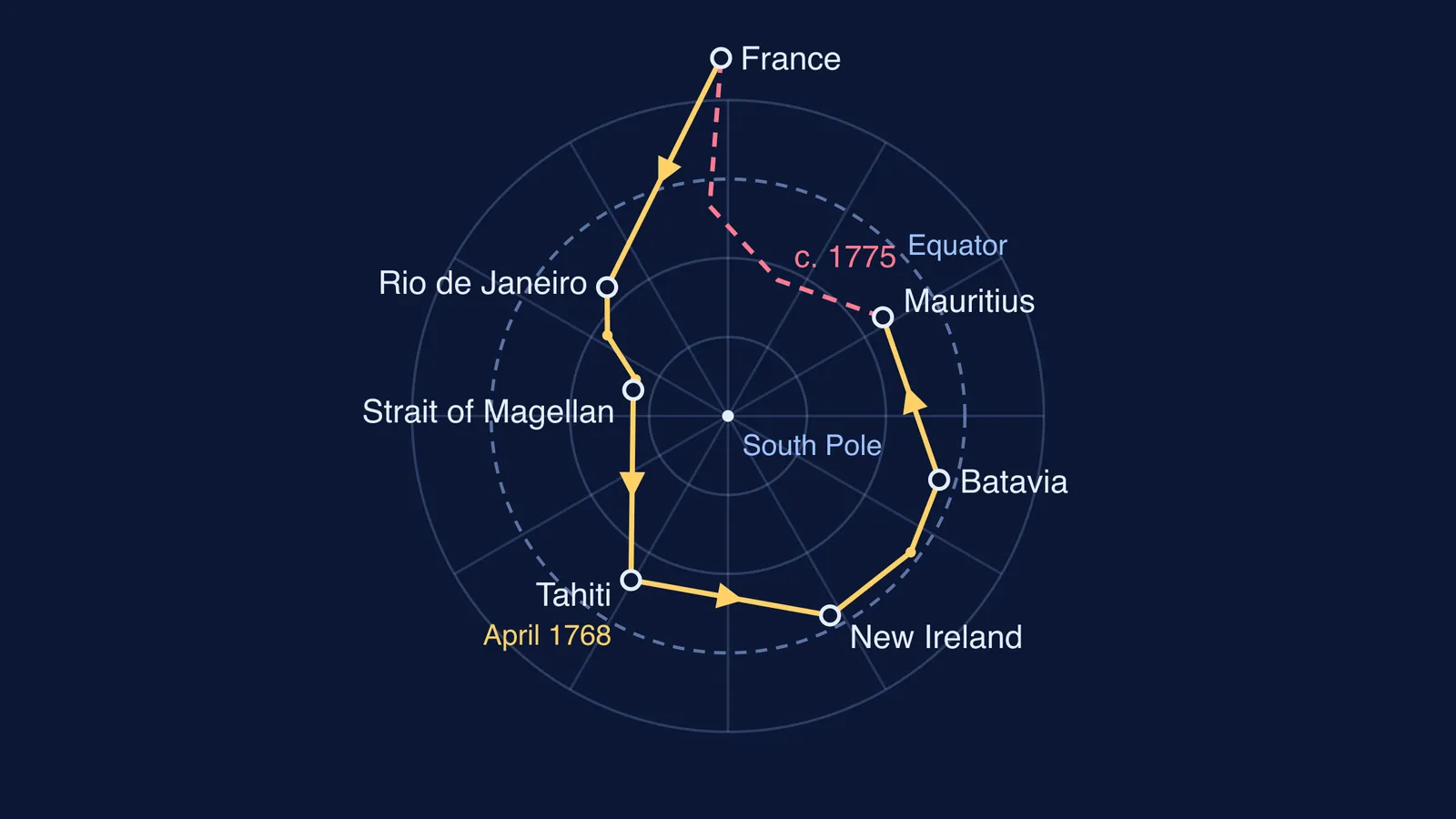
Jeanne Baret was born on 27 July 1740 in Burgundy, France, and died in 1807, according to her Wikipedia biography. Her voyage, led by Louis-Antoine de Bougainville with the frigate Boudeuse and the storeship Étoile, ran from 1766 to 1769, as the title of Bougainville's own account records.
How did Jeanne Baret join the voyage disguised as a man?
French naval rules banned women from the ships, so Baret dressed as a man to get aboard and kept wearing men's clothes for the voyage, explain Eric Tepe, Glynis Ridley and Lynn Bohs in a 2012 paper in PhytoKeys.
The captain's book fills in the rest. In the English translation of Bougainville's account, Baret is "already an expert botanist" who followed Commerson on his botanical walks, even "amidst the snows and frozen mountains" of the Strait of Magellan. She carried "provisions, arms, and herbals" with such courage and strength "that the naturalist had called him his beast of burden".
For some time, rumours went round both ships. Then, at Tahiti in April 1768 (the date comes from her Wikipedia biography), Tahitian men surrounded Baret on the shore and cried out that she was a woman, and an officer had to escort her back to the boat. Later, Bougainville writes, she told him the truth: she had offered to serve Commerson in men's clothes "at the very moment when he was embarking", and she knew the ships were going round the world.
Was Jeanne Baret really the first woman to sail around the world?
She is the first woman known to have done it, and the scientists who named a plant after her call her the first woman to circumnavigate the world in their PhytoKeys paper. "Known" matters: history records only those someone wrote down.
When the ships reached Île de France, today's Mauritius, Commerson chose to stay behind to study the natural history of the islands and Madagascar, as Bougainville's account notes. Baret stayed too. Commerson died there in 1773, Baret married Jean Dubernat in 1774, and she most likely reached France in 1775, closing her circle around the globe, according to her Wikipedia biography.
In 1785 France's Ministry of Marine granted her a pension of 200 livres a year; the grant says she had, "by means of a disguise, circumnavigated the globe" (same source).
What did Jeanne Baret contribute to botany?
Commerson and Baret gathered more than 6,000 specimens, now kept in the French National Herbarium, but Baret was never credited, according to the PhytoKeys paper. Commerson was often too ill to collect, the authors write, and at those times Baret took the part of the expedition's chief botanist.
In Rio de Janeiro, Commerson found the climbing plant later named Bougainvillea after the captain, as Oxford's Plants 400 profile records, and the PhytoKeys authors say evidence suggests Baret made that collection.
Commerson planned to name a genus from Madagascar Baretia, but never published it. In 2012 Tepe, Ridley and Bohs described Solanum baretiae, from the mountains of southern Ecuador and northern Peru, where it grows between 1,900 and 3,000 metres. They chose it partly because its leaves vary so much, from simple to compound, a fitting tribute, they write, to Baret's many-sided life. The name follows the rules for writing scientific names in binomial nomenclature.
How can you study plants the way Baret did?
Baret had no camera, just sharp eyes and a herbal for pressing specimens. Borrow her method for a 20-minute walk near home or school:
Note when and where: date, place, sun or shade.
Describe the whole plant: herb, shrub, climber or tree.
Look at one leaf: simple or compound? If compound, count the leaflets.
Find the flower, and check that what looks like a petal really is one.
Sketch it, labelling only what you actually saw.
Write one question you can't answer yet.
Worked example: the bougainvillea you have probably seen spilling over a wall. The bright pink or purple parts are papery, leaf-like bracts, and the small, tubular real flowers sit among them, as the Oxford profile explains. Your note might read: "Climber on a sunny wall. Simple leaves. Coloured parts are bracts, not petals; small flowers in the centre. Question: why would a plant put its colour into bracts?"
If a term trips you up, such as bract, compound leaf or inflorescence, the Fermi Concept Library covers every concept in biology, each with its own lesson and its place in the map.
Next, read about Maria Sibylla Merian and insect metamorphosis and the plant morphologist Agnes Arber.