

On this page
Mary Agnes Chase learned botany without a college classroom and became one of the people who knew grasses best. She also wrote a book for complete beginners, and its method still works.
Who was Mary Agnes Chase?
Chase was born Mary Agnes Meara in Watseka, Illinois, in 1869, and her formal schooling ended after secondary school, according to the Science History Institute's biography of Chase. She worked as a proofreader and a botanical illustrator before the US Department of Agriculture hired her on 1 November 1903, at $720 a year. Working beside the grass specialist Albert Spear Hitchcock, she moved from drawing grasses to describing them, and from 1936 until she retired in 1939 she was the principal scientist in charge of systematic agrostology, the classification of grasses.
She was also arrested twice while demonstrating for women's suffrage in front of the White House, the same biography records. After retiring she stayed on as custodian of grasses at the US National Herbarium until her death in 1963 (overview of her career).
How many grasses did Mary Agnes Chase collect?
Between 1905 and 1912 she collected specimens in 19 US states, then worked in Puerto Rico in 1913 and Brazil in 1924 and 1929 (Science History Institute). In total she collected 20,000 plant specimens, 5,000 of them grasses, by the institute's count (other accounts give different grass counts).
The institute also credits her with an annotated index of 80,000 grass specimens and more than 70 scientific papers. With Hitchcock she wrote the Manual of the Grasses of the United States, published in 1935 (Popular Science profile).
Grasses mounted on sheets of heavy paper “keep indefinitely,” Chase wrote (First Book of Grasses). For school, see our guide to making a herbarium sheet for your project.
What is in First Book of Grasses?
First Book of Grasses: The Structure of Grasses Explained for Beginners was published by Macmillan in November 1922. Its preface says the kinds of grasses “are known by very few even among botanists,” largely because “they are supposed to be very difficult.”
Her fix was order. The book's 12 lessons are “graded from the simplest to the most complex,” and each ends with a summary, nearly all with review questions too. Everything rests on one idea from the introduction: grass classification is based on “the aggregate of minute flowers and bracts known as the spikelet.”
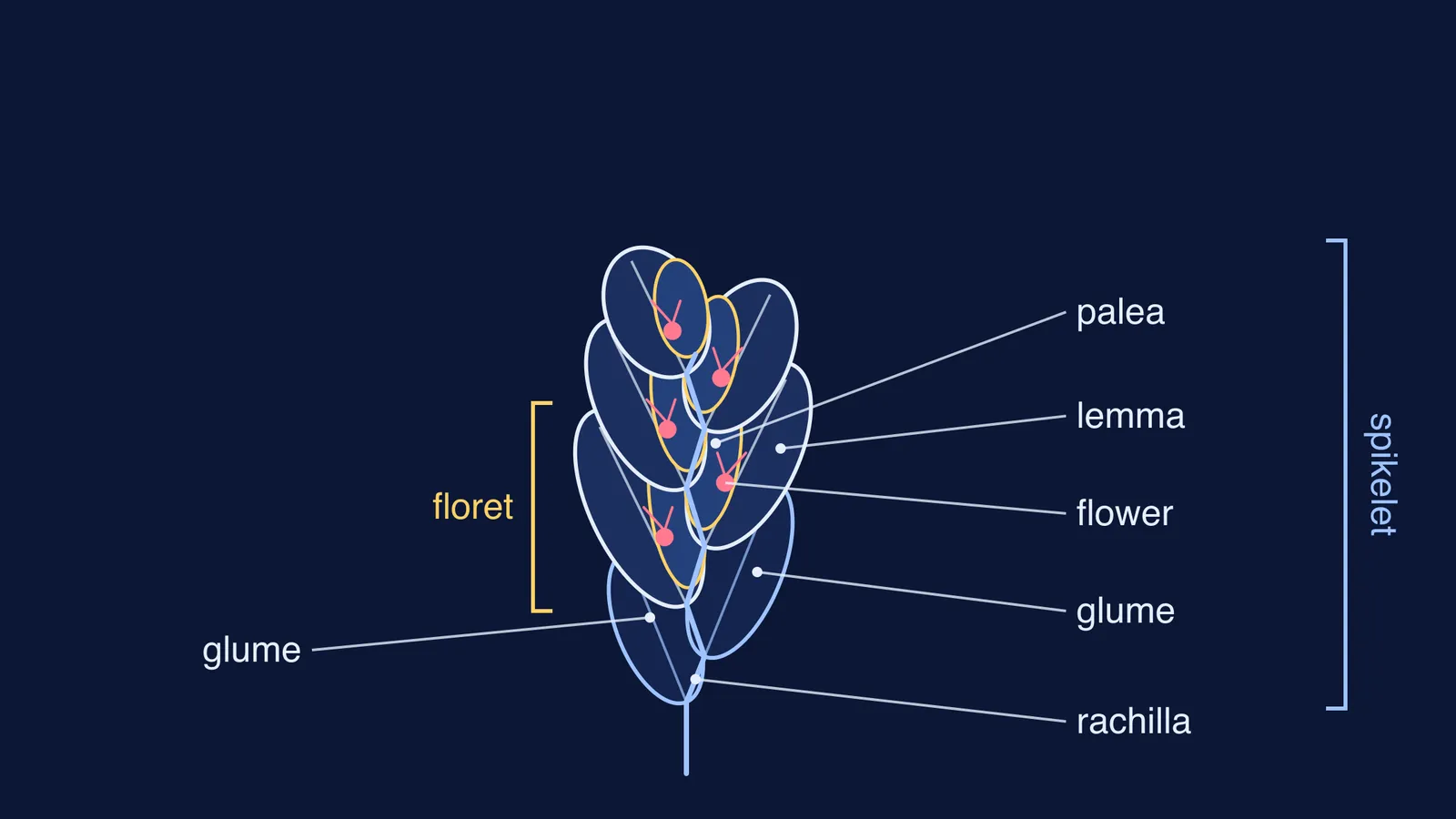
A spikelet is the basic flowering unit of a grass: two bracts without flowers, called glumes, at the base, then one or more florets set alternately on a small axis, the rachilla. A floret is one tiny flower with its two bracts, the lemma and the palea (both definitions from Chase's Lesson I).
Spikelet, glume and lemma, she wrote, are “no more difficult to learn” than the names of harness or car parts, and the scary jargon is only a “harmless necessary cat.” She was equally honest that a guide to knowing grasses “without mental effort” was impossible: “It can not be done.”
A third edition appeared in 1959, and the Venezuelan botanist Zoraida Luces de Febres translated it into Spanish in 1960 (Science History Institute).
How can you study a grass the way Chase taught?
Try her method on doob grass, Cynodon dactylon, the common lawn grass listed with Hindi, Bengali, Tamil and Kannada names by eFlora of India. Chase covers it as Bermuda grass under an older name, Capriola Dactylon, which the same eFlora page lists as a synonym. Pull one flowering stem and follow her book:
Gather her tools: a lens magnifying about ten times, a sewing needle pushed into a pencil-shaped piece of soft wood, and black paper so hairs show up.
Confirm it is a grass: stems round or flattened, never three-angled, solid at the nodes; leaves in two ranks, each with sheath, blade and usually a ligule. Sedges, the usual look-alike, have stems that are commonly three-sided and leaves always in three ranks.
Look at the flowering head. Doob's thin spikes spread from almost one point; Chase likens this arrangement to “a bird's toes.”
Pick off one spikelet. Find the glumes, then the single floret with its lemma and palea.
Sketch it and label each part from memory.
Answer her first review question: “How is a grass distinguished from all other plants?”
Once you can name the parts, you can sort several grasses with a dichotomous key you build yourself.
What can students learn from Chase's method?
Her approach suits any subject thick with new words: learn terms as tools, go from simple to complex, end each session with a summary and review questions, and draw what you study. If a term such as inflorescence still feels foggy, the Fermi Concept Library gives every concept in biology its own lesson and its place in the map, so you can see what it builds on.
For another botanist who read the form of grasses closely, see how Agnes Arber studied monocots and grasses. Then go outside, find a patch of doob, and look at one spikelet.


