

On this page
You have five animals on the bench and one question: what is each one? A dichotomous key answers it with two-choice questions until only one name is left. Writing your own is also a quick test of whether you really know the features you have been memorising.
What is a dichotomous key?
A dichotomous key is an identification tool built from pairs of contrasting choices, which is why it is called dichotomous, as botanist Wendy Applequist explains in an encyclopedia entry on taxonomic keys. The key is written as a series of couplets, and each couplet consists of two opposing descriptions of a feature. Each single statement inside a couplet is usually called a lead.
On 27 March 1689, Richard Waller showed the Royal Society image-based tables for naming English herbs by their shapes, nearly 100 years before the text-based keys in Lamarck's Flora Française (1778), according to Lawrence Griffing's 2011 paper in the American Journal of Botany.
In Class 11 and NEET biology, keys sit among the taxonomical aids; our guide to taxonomic categories and naming in The Living World covers that chapter.
How do you make a dichotomous key step by step?
These steps draw on the key-writing checklist from Stephen Saupe's plant taxonomy course; the final testing step is our own addition.
List every organism you need to separate. For n organisms you will need n − 1 couplets.
Make a list of features you can actually see: number of legs, body covering, leaf type, leaf margin, venation. Skip anything that changes with season or age.
Pick the most distinctive feature that splits the group into two smaller groups.
Write both leads about that same feature, starting with the same noun: "Legs absent" and "Legs present".
Keep splitting each smaller group until every branch ends in one name.
Test the key on someone who has not seen it. Every wrong turn points to a couplet that needs rewriting.
The checklist also says to avoid negatives and vague terms, quantify when possible and keep taxonomic names out of the leads.
Worked example: a key for five common animals
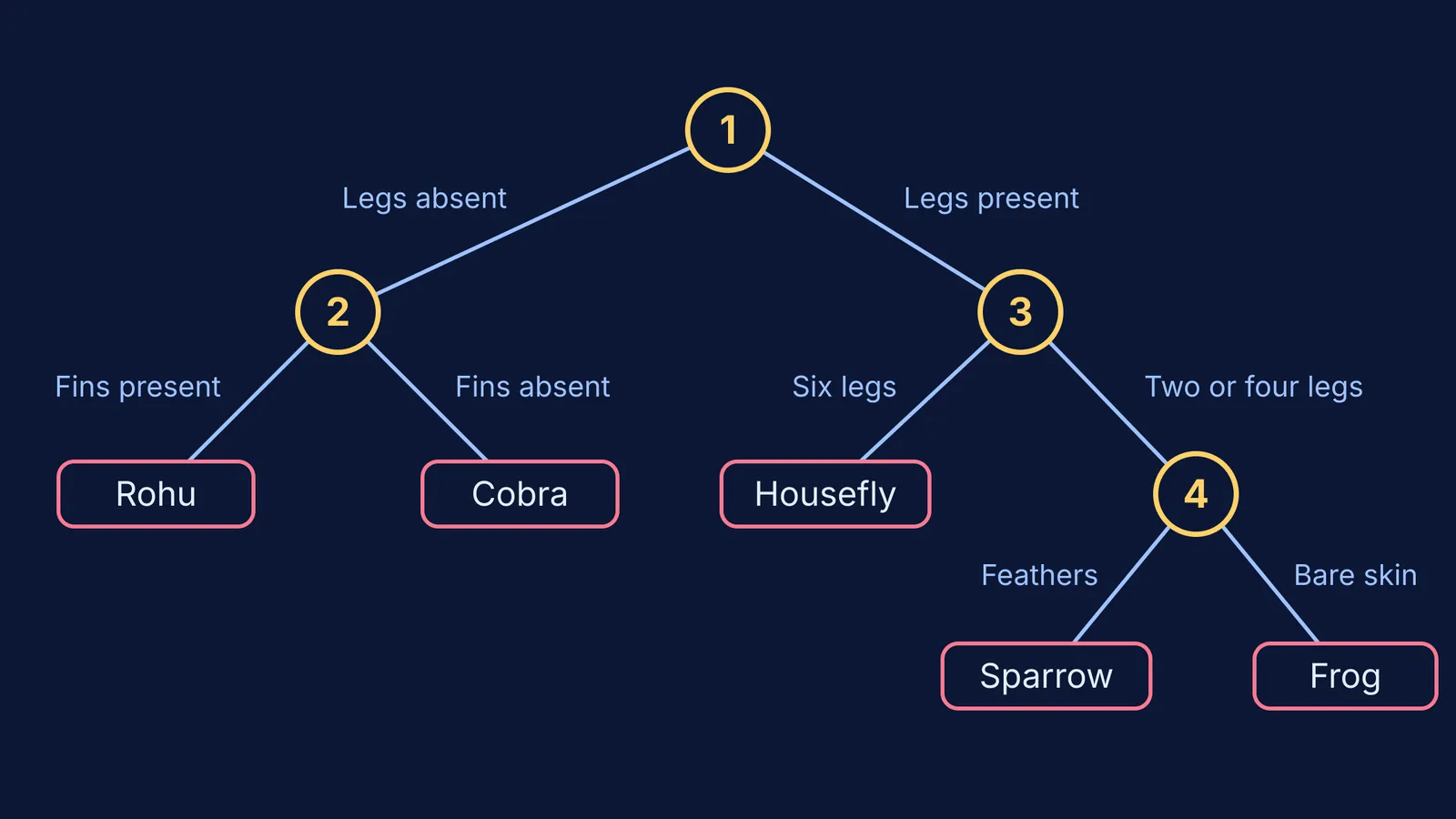
Rohu, cobra, housefly, sparrow and frog: five animals, so four couplets.
1a. Legs absent: go to 2
1b. Legs present: go to 3
2a. Fins present: rohu
2b. Fins absent: cobra
3a. Legs six: housefly
3b. Legs two or four: go to 4
4a. Body covered with feathers: sparrow
4b. Body covered with bare, moist skin: frog
In each couplet, both leads describe the same visible feature and every animal fits exactly one lead. Couplet 4 does not say "Feathers absent", which would be a negative; it names what the frog has instead.
Can you use the same method for plants?
Yes. Leaves are a practical place to start: Saupe's checklist says to rely on features from the same season, and many trees carry leaves for much of the year. Here is a key for four leaves you can collect near most Indian schools: grass, neem, mango and hibiscus (gudhal).
1a. Leaf veins parallel: grass
1b. Leaf veins forming a net: go to 2
2a. Leaf compound, divided into many leaflets: neem
2b. Leaf simple, with a single blade: go to 3
3a. Leaf margin smooth: mango
3b. Leaf margin toothed: hibiscus
A key that needs flowers fails in the months when there are none, so if you use them, say so at the top. To see where these plants sit in the bigger picture, read the five kingdoms compared.
How do you fix vague couplets?
Most keys go wrong in the couplets, not the branching:
"Leaf big / leaf small" depends on who is looking. Give a threshold you measured on your own specimens, such as "Leaf blade longer than 10 cm / leaf blade 10 cm or shorter".
"Has fins / lives on land" compares two different features, so the leads are not mutually exclusive: an animal could have fins and also spend time on land, or have neither. Keep both leads on one feature: "Fins present / fins absent".
"Leaf dark green / leaf light green" changes with age, light and season. Use fixed features such as margin, venation or arrangement.
"Insect / not an insect" uses the answer as the question and adds a negative. Describe what you can see instead, such as "Legs six / legs eight" when separating insects from spiders.
Unsure what a compound leaf or reticulate venation really is? Look the term up in the Fermi Concept Library, which has a lesson for every concept in biology, before you write the lead. And if a practical question gives you a set of drawings to key out, Fermi's AI tutor can work through it with you, deciding whether to explain, ask or show rather than handing you a finished key.
Next time you revise a chapter such as the animal kingdom, try writing a five-organism key from it: the couplets you cannot write are the features you have not learned yet.


