

On this page
It is a common sight in classrooms and families today: twins. While they may share a birthday, their biological origins and genetic blueprints can be remarkably different.
The global twin birth rate has reached an all-time high in recent decades. According to a comprehensive 2021 study published in *Human Reproduction* (Oxford Academic), the worldwide rate rose from 9.1 to 12.0 twin deliveries per 1,000 deliveries between the 1980s and the 2010s. This means approximately 1.6 million twin pairs are born each year. But biologically, twins fall into two distinct categories, driven by completely different reproductive events.
How do identical (monozygotic) twins form?
Identical twins are known scientifically as monozygotic twins. This means they originate from a single zygote.
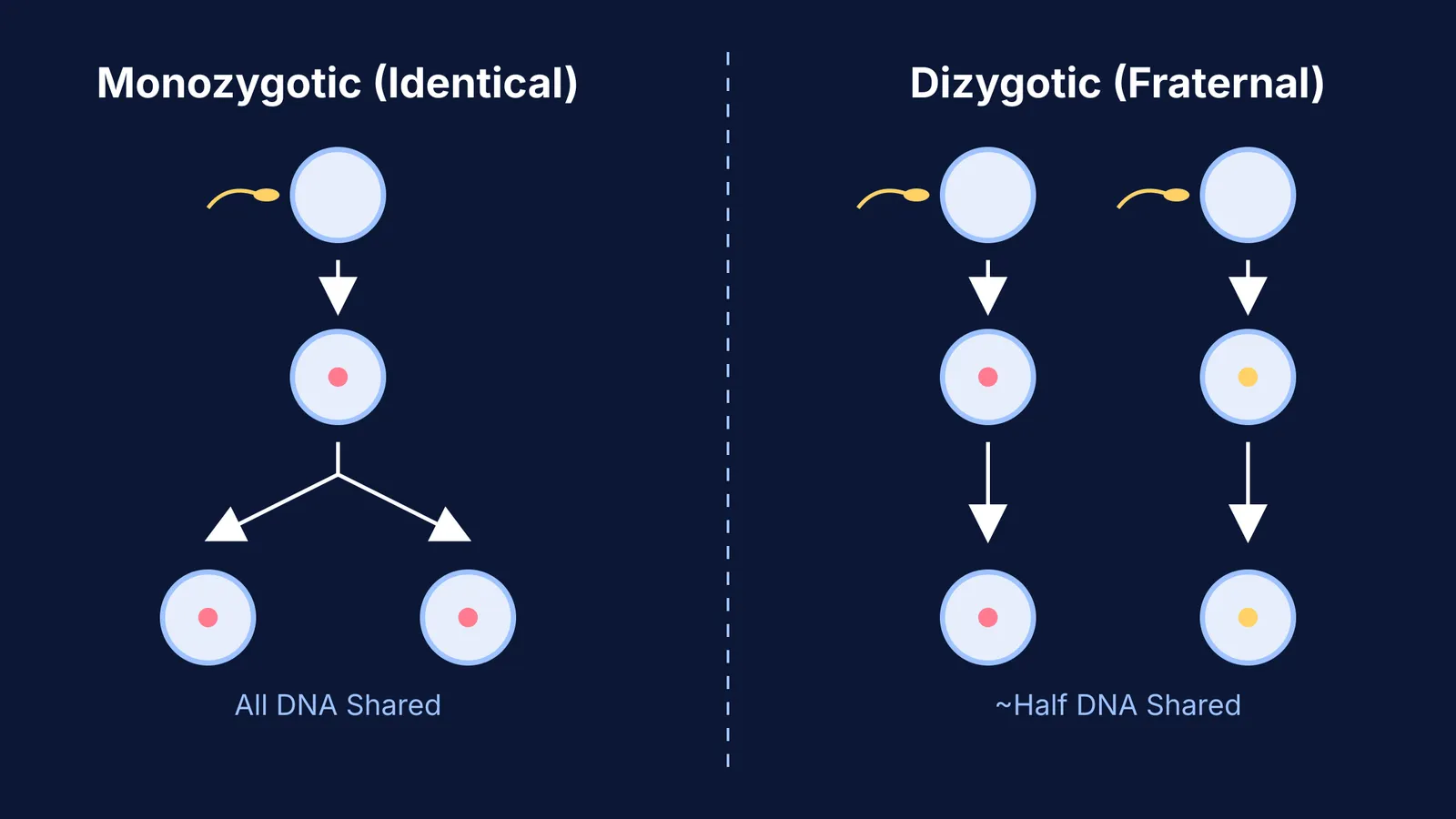
The process begins when a single egg is fertilised by a single sperm cell. During the first two weeks of embryonic development, this single fertilised egg, or zygote, splits into two independent embryos. Because they come from the exact same sperm and egg combination, identical twins share all of their genetic material. This is why they are almost always the same sex, share the same blood type, and look remarkably alike.
Interestingly, this splitting process is a random biological event. It is not generally considered hereditary. According to the 2021 *Human Reproduction* study (Oxford Academic), the rate of identical twins remains surprisingly constant worldwide at about 4 per 1,000 deliveries, regardless of geography or maternal age. In the plant kingdom, a similar concept of one seed yielding multiple embryos without separate fertilisation events is studied as apomixis and polyembryony.
How do fraternal (dizygotic) twins form?
Fraternal, or dizygotic, twins develop when a woman releases two separate eggs during the same menstrual cycle, and each egg is fertilised by a different sperm.
Because they form from two distinct eggs and two distinct sperm cells, fraternal twins share about half of their DNA. Genetically speaking, they are no more alike than any other pair of biological siblings born years apart. They can be the same sex or opposite sexes, and their physical resemblance will be typical of standard siblings.
Almost all of the global increase in twin births is due to a rise in fraternal twins. Factors such as medically assisted reproduction (like IVF) and delayed childbearing—since older mothers are naturally more likely to release multiple eggs—have driven this trend. In the United States, for example, the twin birth rate stands at 30.1 per 1,000 live births, representing over 109,000 individual infants, according to 2024 data from the CDC.
Why does this matter for biology students?
For students preparing for board exams or medical entrances like NEET-UG, understanding the monozygotic versus dizygotic distinction is a foundational genetics concept. It tests your grasp of fertilisation, cleavage, allele sharing, and inheritance patterns.
Twin studies are also a cornerstone of genetic research. Because identical twins share all of their DNA, studying them alongside fraternal twins helps scientists distinguish which traits are inherited and which are shaped by the environment. If you want to strengthen your grasp of inheritance patterns and genetic variation, tracing these pathways interactively can help. You can explore allele sharing and test your understanding of tricky genetics problems in the Fermi Concept Library. Understanding inheritance also helps when studying how populations adapt over time through stabilising, directional and disruptive selection.
A quick checklist for comparison
To keep the biological facts straight for exams and general knowledge, here is how the two types compare:
Origin: Identical twins come from one egg and one sperm; fraternal twins come from two eggs and two sperm.
DNA shared: Identical twins share all of their genetic material; fraternal twins share about half.
Sex: Identical twins are nearly always the same sex; fraternal twins can be the same or opposite sex.
Appearance: Identical twins are nearly indistinguishable; fraternal twins look like ordinary siblings.
Global frequency: Identical twinning is a rare, constant event; fraternal twinning is more common and increasing due to age and medical assistance.
This distinction highlights the incredible variation possible in human development, all starting from microscopic cellular events.


