

On this page
If more of your classmates carry inhalers or food-allergy notes than your parents remember, that is not just a feeling. One widely discussed explanation, that modern children meet too few microbes, has real evidence behind it, but less than the popular version, “kids today are too clean”.
Are allergies really increasing in children?
In many places, yes. The ISAAC Phase Three survey (Lancet, 2006) surveyed 193,404 children aged 6-7 and 304,679 aged 13-14 across dozens of countries, on average 7 years after an earlier round. Across centres, increases in symptoms of asthma, hay fever and eczema were twice as common as decreases. Where asthma was already common, though, symptoms in older children were not rising.
The authors of the LEAP trial (NEJM, 2015) wrote that peanut allergy among children in Western countries had doubled in the previous 10 years and was becoming apparent in Africa and Asia.
What is the hygiene hypothesis?
It began with one observation. D. P. Strachan followed more than 17,000 British children born in 1958 and found that hay fever was less common in those with more older siblings (Strachan, BMJ, 1989, as summarised in a later review). His idea: infections and unhygienic contact, such as with older brothers and sisters, might protect younger children (von Mutius, 2010). Popular retellings turned this into “too much hygiene causes allergies”.
What is the old friends hypothesis?
The old friends hypothesis says the rise in allergies and other inflammatory disorders is partly due to too little exposure to the microbes that evolved an essential role in setting up our immune system (Rook, Clinical and Experimental Immunology, 2010). These “old friends” have been with humans since long before farming; more recent childhood infections are unlikely to play that role. A 2023 update says most come from our mothers, families and the natural environment, including animals.
A 2016 expert review went further: the term hygiene hypothesis is misleading, and there is no good evidence that hygiene as the public understands it caused the change (Bloomfield and colleagues, Perspectives in Public Health). It points instead to rapid urbanisation, altered diet and antibiotic use.
What did the farm-children studies find?
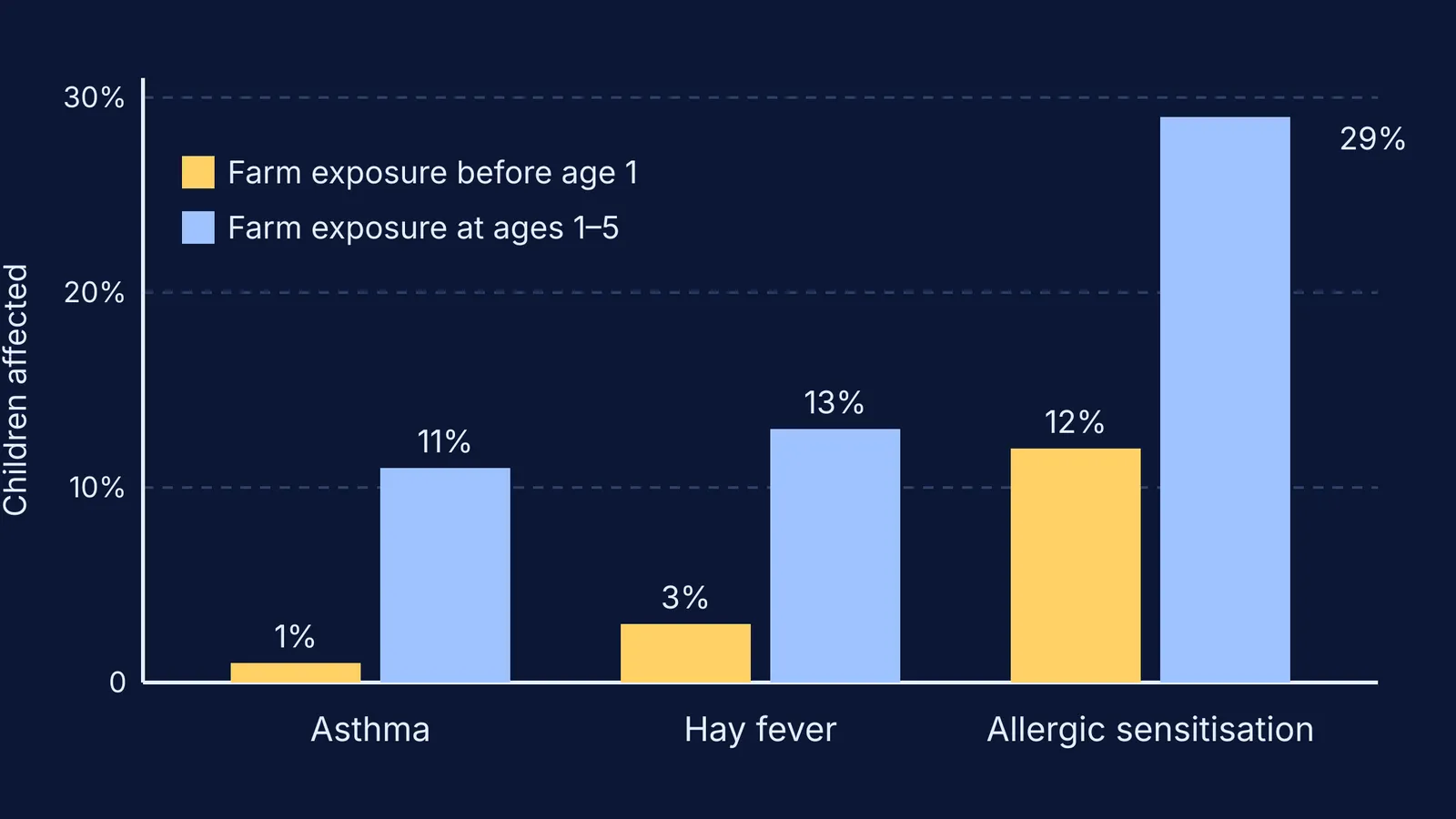
In rural Austria, Germany and Switzerland, 1% of children exposed to stables and farm milk before age 1 had asthma, against 11% of those exposed at ages 1-5 (Riedler and colleagues, Lancet, 2001). Hay fever was 3% against 13%, and allergic sensitisation 12% against 29%.
Two later surveys found that farm children met a wider range of microbes in household dust, and that this diversity was linked to lower asthma risk (Ege and colleagues, NEJM, 2011). In the US, asthma was 4 times less common in Amish children (traditional farming) than in Hutterite children (industrial farming) despite similar ancestry, and median endotoxin in Amish house dust was 6.8 times as high (Stein and colleagues, NEJM, 2016).
Where does the evidence stop?
Most of it is observational. Farm families differ from city families in many ways at once. See our guide to correlation vs causation with everyday examples.
Some counts are small. The 1% asthma figure in the Riedler study is 3 children out of 218; the Amish-Hutterite study had 60 children.
The exact microbes were not pinned down. A 2010 review by Erika von Mutius noted the protective microbial exposures had not been identified.
Farm milk here means raw milk. It can carry Salmonella, E. coli and Listeria, and children under 5 face higher risk of serious illness (CDC). The studies are not a recipe.
Randomised trials give firmer answers, and one large prevention trial is about timing, not dirt. In LEAP, 640 high-risk infants were assigned to eat or avoid peanut; among those who tested negative at the start, 13.7% of avoiders had peanut allergy at age 5, against 1.9% of eaters. Decisions about a baby's diet belong with a paediatrician.
How can you test an allergy claim yourself?
Ask five questions of any headline or forwarded message:
Who was studied, and how many?
Was it a survey, or a trial where researchers assigned the exposure?
What exactly was the exposure: siblings, animals, raw milk, soap?
Does the claim stay within what was measured?
Is there a safety cost to acting on it?
Worked example. Claim: “Allergies are rising because parents are too clean, so stop making kids wash their hands.” (1) Farm children in Europe and the US. (2) Mostly surveys. (3) Stables, animals and farm milk, not unwashed hands. (4) No: the expert review found no good evidence that ordinary hygiene is the cause. (5) Yes, more infections. Verdict: the evidence does not support it.
The 2016 review lists outdoor activity, sport, less time indoors, diet and appropriate antibiotic use among strategies that may help, focused on early life. For a child with symptoms, see a paediatrician or allergist.
For the biology of the reaction, read our explainer on how IgE and mast cells cause an allergy and the basics of probiotics and gut bacteria. If immunology terms are hazy, the Fermi Concept Library gives each biology concept its own lesson and shows its place in the map.


