

On this page
Why does breathing in dust, pollen, or animal dander trigger explosive sneezing, watery eyes, and airway constriction within minutes? In biology, an allergy is defined as an exaggerated immune response to foreign antigens that are otherwise harmless. Rather than defending against an active pathogen, the immune system mistakes an innocuous airborne particle for a dangerous invader. To master this topic for CBSE and competitive exams, you must move beyond symptoms and trace the cellular sequence, connecting back to fundamental principles of innate and acquired immunity in NEET biology.
What makes an environmental substance an allergen?
An allergen is any non-pathogenic antigen capable of inducing hypersensitivity in susceptible individuals. Common triggers include dust mites, pollens, and animal dander. In India, aeroallergens represent a widespread challenge; the 10-city CARAS study (Lopez et al., 2019) documented that 65.2% of surveyed asthma patients had concomitant allergic rhinitis.
When an allergen crosses a mucosal barrier, dendritic cells process it and present peptides to naive CD4+ T helper cells. In individuals with atopy, these cells differentiate into Th2 helper cells. The Th2 cells release interleukin-4 (IL-4) and interleukin-13 (IL-13), directing B lymphocytes to switch classes and secrete Immunoglobulin E (IgE). In 1966, Kimishige Ishizaka, Teruko Ishizaka, and Margaret Hornbrook published their discovery in *The Journal of Immunology* (Ishizaka et al., 1966), identifying IgE as the unique antibody mediating allergic hypersensitivity. Like the antibodies analysed by Rodney Porter and Gerald Edelman, IgE possesses a Y-shaped structure with two variable antigen-binding arms and a constant tail.
How does IgE prime mast cells during sensitisation?
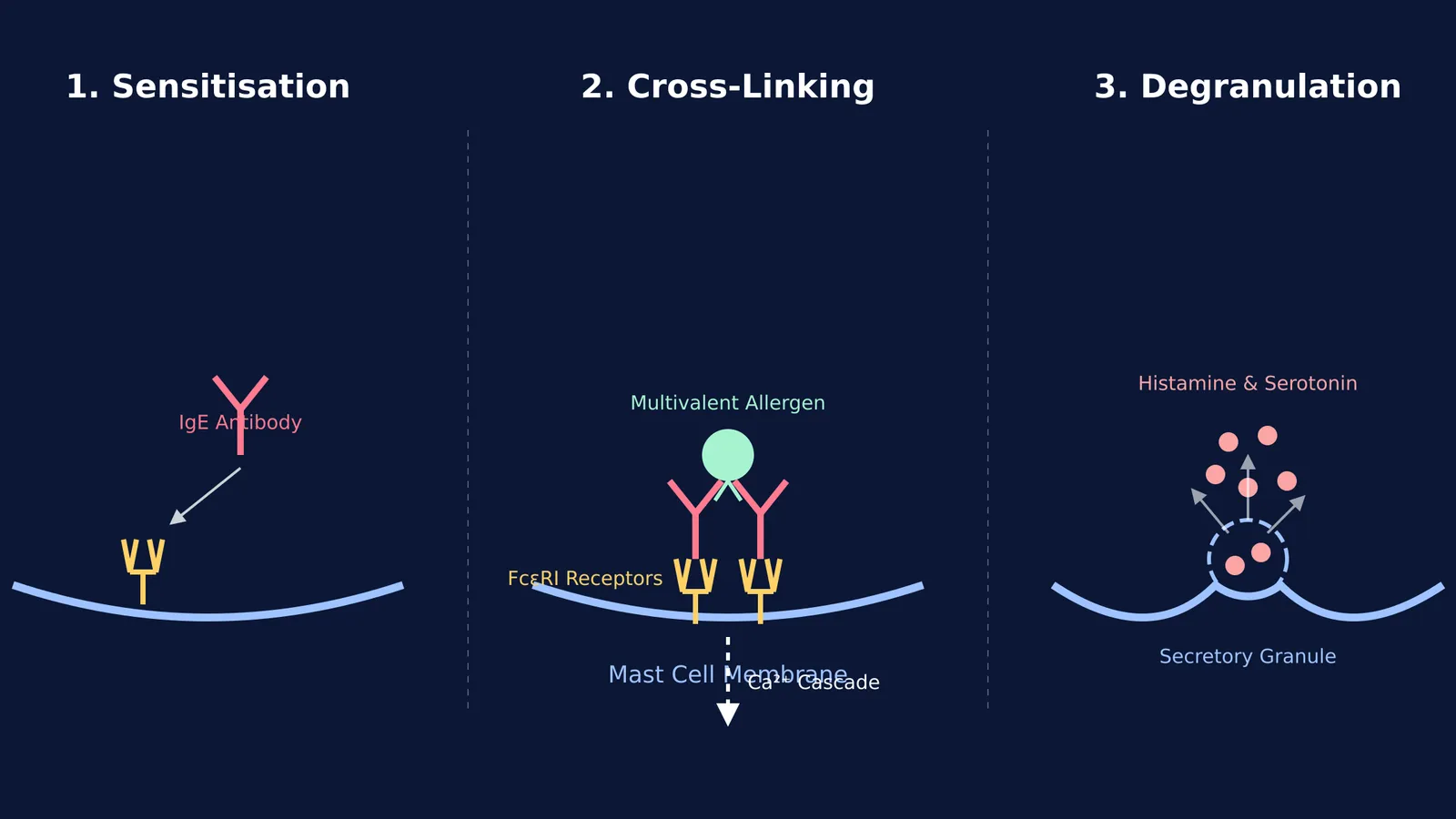
The initial production of IgE produces no outward symptoms; it establishes sensitisation. Plasma cells release IgE antibodies into tissue fluids, where they migrate to tissue-resident mast cells. First identified and named *Mastzellen* by Paul Ehrlich in his 1878 doctoral dissertation (Crivellato et al., 2003) due to their cytoplasm packed with granules, mast cells reside in vascularised connective tissues beneath mucosal surfaces. They are closely related to circulating basophils, one of the leukocyte types covered among the formed elements of blood.
Mast cells express thousands of copies of the high-affinity receptor FcεRI. As detailed by Jean-Pierre Kinet in the *Annual Review of Immunology* (Kinet, 1999), FcεRI is a tetrameric complex (αβγ₂) whose extracellular α-chain binds the constant Fc tail of IgE with an affinity of Kd ≈ 10⁻¹⁰ M. Because of this tight binding, IgE docks onto mast cells and remains anchored for months, arming each mast cell with antigen-specific receptors.
Why does receptor cross-linking trigger mast cell degranulation?
When the same allergen enters the tissue again, it triggers rapid activation. However, activation strictly requires multivalent binding.
When a multivalent allergen bridges adjacent IgE molecules, it clusters their underlying FcεRI receptors. As reviewed by Stephen J. Galli and colleagues in *Nature* (Galli et al., 2008), receptor clustering initiates a rapid intracellular cascade:
Receptor-associated Lyn kinase phosphorylates ITAM motifs on the receptor's β and γ subunits.
Phosphorylated ITAMs recruit Syk kinase, which activates phospholipase C-gamma (PLCγ).
PLCγ cleaves membrane PIP₂ into IP3 and diacylglycerol.
IP3 triggers the rapid release of Ca²⁺ from the endoplasmic reticulum, followed by store-operated calcium entry.
Surging cytoplasmic Ca²⁺ drives SNARE proteins to fuse secretory granules with the cell membrane, expelling their contents within 5 to 15 minutes.
How do histamine and serotonin produce allergic symptoms?
The symptoms of an allergic reaction stem from chemical mediators stored in mast cell granules, principally histamine and serotonin.
In 1910, Henry H. Dale and Patrick P. Laidlaw showed in *The Journal of Physiology* (Dale & Laidlaw, 1910) that histamine reproduces the vascular collapse, capillary leakage, and bronchospasm seen in anaphylaxis. In tissue beds, histamine exerts specific physiological effects:
It binds H1 receptors on vascular endothelial cells, triggering nitric oxide release and relaxation of vascular smooth muscle, causing local vasodilation and redness.
Endothelial cells contract, widening intercellular gaps and allowing plasma fluid to leak into interstitial spaces, producing local swelling, nasal congestion, and watery eyes.
It stimulates sensory nerve endings, causing intense itching and reflex sneezing.
On bronchial smooth muscle, histamine triggers contraction, narrowing airways and causing difficulty in breathing.
Mast cells also synthesize and release serotonin (5-hydroxytryptamine), as verified in human mast cells by Nataliya M. Kushnir-Sukhov and colleagues in the *Journal of Allergy and Clinical Immunology* (Kushnir-Sukhov et al., 2007). Serotonin synergises with histamine in modulating vascular tone and sensory neuron activation, while newly synthesized leukotrienes maintain inflammation over subsequent hours.
How should students break down the allergy pathway for exams?
When preparing for competitive exams like NEET-UG, questions frequently test the sequence and molecular prerequisites of allergic reactions. Use this 4-step framework to analyse any allergy question:
Identify the exposure stage: Distinguish primary sensitisation (silent IgE loading onto FcεRI) from secondary challenge (immediate degranulation).
Check antigen valency: Confirm whether the allergen is multivalent. Monovalent antigens bind without cross-linking and fail to trigger exocytosis.
Trace the signaling chain: Follow the pathway from receptor clustering to Lyn/Syk phosphorylation, IP3 generation, Ca²⁺ influx, and membrane fusion.
Differentiate mediators: Separate preformed granule contents (histamine and serotonin, driving immediate vasodilation and bronchoconstriction) from newly synthesised lipids (leukotrienes and prostaglandins, sustaining late-phase inflammation).
To see how this molecular cascade fits into broader human physiology, the Fermi Concept Library has every concept in biology, each with its own lesson and its place in the map. When practicing multi-step reasoning questions on cell signaling, the Fermi Problem Library provides worked problems with a step-by-step solver that explains the reasoning rather than printing an answer.


