

On this page
Many hydropower stations in the Himalaya take their water through a tunnel several kilometres long before it drops down a steep pipe to the turbines. If the grid trips and the turbine gates shut, all that moving water has to stop. Stopping it in a second would send a damaging pressure wave through the tunnel, so engineers build a tall shaft, open to the air, near the end of the tunnel. This shaft is called a surge tank or surge shaft. Here is why it works, and how to calculate the height and period of the swing that follows with Class 11 physics.
What happens in a tunnel when the turbines shut suddenly?
Moving water has momentum. When a valve closes, the water just behind it stops first, and a pressure wave runs back up the pipe at the speed of sound in the water-filled pipe, a. The pressure jump is given by the Joukowsky equation, Δp = ρaΔv. It is the effect behind why water pipes bang when a tap is shut fast. The equation and its limits are set out in the review by Ghidaoui and co-authors in Applied Mechanics Reviews (2005).
Take a tunnel carrying water at v₀ = 3 m/s, with an illustrative wave speed a = 1,200 m/s:
Δp = 1000 × 1200 × 3 = 3.6 × 10⁶ Pa, or 3.6 MPa.
As a head of water, Δp/ρg = av₀/g = 1200 × 3 / 9.81 ≈ 367 m.
The full Joukowsky jump only happens if the valve closes faster than the time a wave takes to go to the reservoir and back, 2L/a. For a 1 km tunnel that is 2 × 1000 / 1200 ≈ 1.7 s. An instant shutdown is the worst case, so that is what we calculate.
What does a surge tank actually do?
When the gates shut, the tunnel water keeps moving and flows up into the shaft. As the level in the shaft rises above the reservoir level, the extra column of water pushes back on the tunnel water and slows it down. The stop now takes tens of seconds instead of about a second, so the pressure in the tunnel only rises by the height of water in the shaft, a few metres.
The shaft protects only the tunnel. The short steel penstock between the shaft and the turbine still feels water hammer. Because it is short, its 2L/a time is short too, and the gates are made to close slowly compared with it.
It works both ways. When the turbines open up to take more water, the shaft supplies it at first and its level falls. The bottom of the shaft must stay deep enough that the level never drops to the tunnel and lets air in.
Real shafts are large. At Nathpa Jhakri on the Sutlej, a 27.394 km headrace tunnel of 10.15 m diameter ends in a surge shaft 301 m deep and 21.6 m in diameter, open to the sky, according to SJVN's project page.
Why is the surge in the shaft a U-tube oscillation?
Treat the tunnel water as one solid column of length L and area A, moving at speed v. Let z be the height of the shaft water above the reservoir level, and let the shaft have area S. Ignore friction.
Force on the column. The reservoir end is at reservoir pressure. The shaft end has an extra head z. The net force on the column is −ρgzA.
Newton's second law. The column's mass is ρAL, so ρAL (dv/dt) = −ρgzA, which gives dv/dt = −gz/L.
Continuity. With the gates shut, all the tunnel flow goes into the shaft: Av = S(dz/dt).
Combine. Differentiate step 3 and substitute step 2: d²z/dt² = −(gA / LS) z.
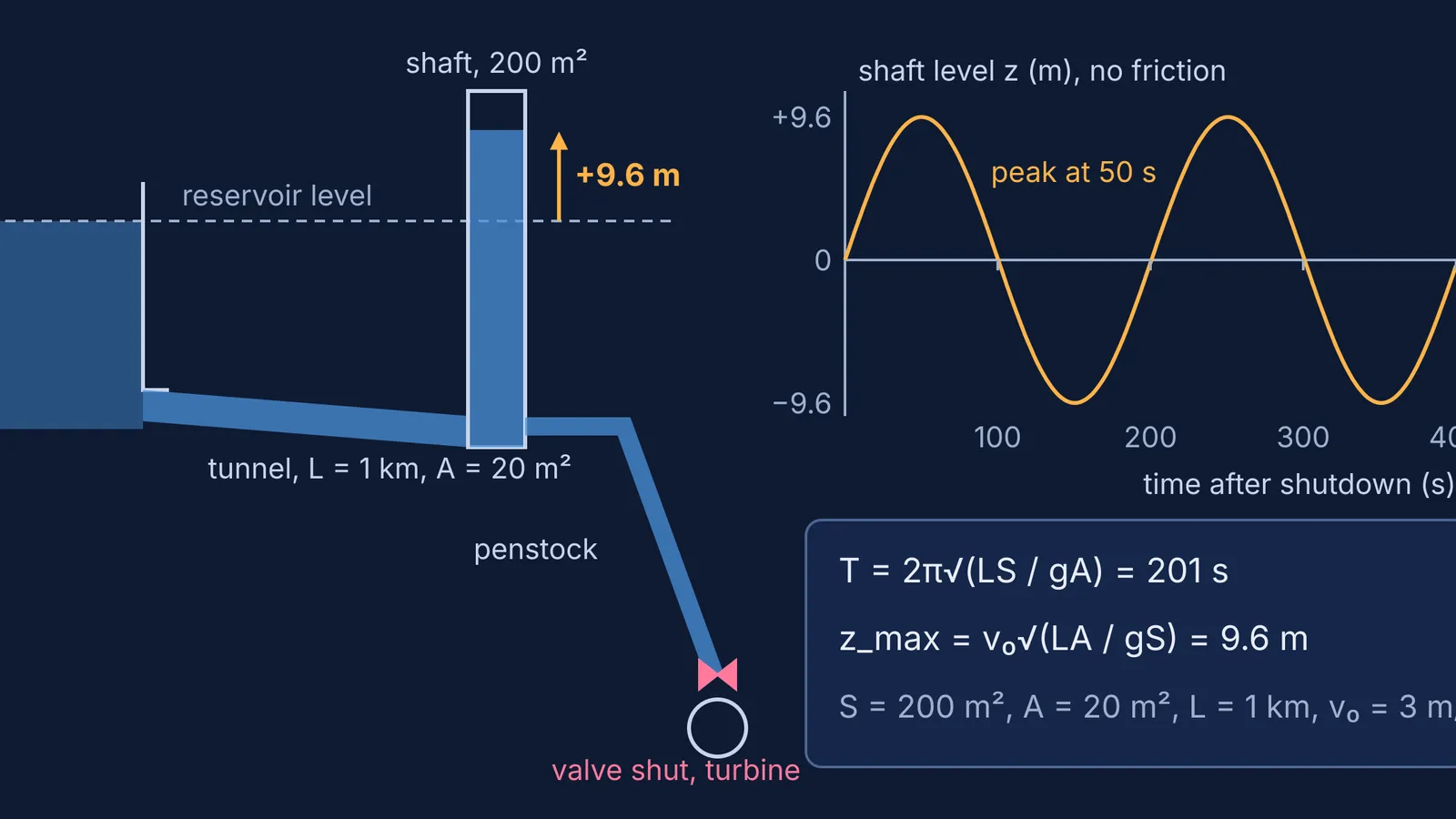
That is simple harmonic motion with ω² = gA / (LS), so T = 2π√(LS / gA). Just after shutdown z = 0 and dz/dt = Av₀/S, so the amplitude is z_max = (Av₀/S)/ω = v₀√(LA / gS).
You have seen the equal-arm version of this in SHM of a floating body and liquid in a U-tube, where T = 2π√(l/2g). Here the two arms are very different. The shaft water's own mass is neglected; the tunnel column is far longer.
Worked example: how high does the water rise, and when?
A tunnel 1 km long with area 20 m² carries 60 m³/s, so v₀ = 60/20 = 3 m/s. It ends in a shaft of area 200 m². The gates shut instantly; ignore friction and take g = 9.81 m/s².
Period. T = 2π√(1000 × 200 / (9.81 × 20)) = 2π√1019.4 = 2π × 31.93 ≈ 201 s.
Time to the top. The level is highest a quarter period after shutdown: 201/4 ≈ 50 s.
Highest rise. z_max = 3 × √(1000 × 20 / (9.81 × 200)) = 3 × √10.19 = 3 × 3.19 ≈ 9.6 m above the reservoir level.
Energy check. The tunnel water's kinetic energy is ½ × (1000 × 20 × 1000) × 3² = 9.0 × 10⁷ J, or 90 MJ. Raising the extra water into the shaft stores ½ρgSz² = ½ × 1000 × 9.81 × 200 × 9.58² ≈ 90 MJ. They match.
Pressure in the tunnel. At the peak the extra pressure at the shaft is ρgz = 1000 × 9.81 × 9.58 ≈ 94 kPa. Without the shaft it would have been 3.6 MPa, about 38 times more.
Now shrink the shaft to 50 m², a quarter of the area. T falls by a factor of 2 to 100 s, and z_max doubles to 19.2 m. A small shaft must be taller; a large one costs more rock to dig.
Why is the real surge smaller than this?
The frictionless answer is an upper bound. In a real tunnel, friction on the walls removes energy on every swing, so the first rise is less than 9.6 m and each later swing is smaller until the level settles back. With modest friction the period stays close to the frictionless value, so 2π√(LS / gA) is a good first estimate. Mass oscillation in surge tanks, first without friction and then with it, is treated in hydraulics texts such as John Pickford's Analysis of Surge, chapter on the theory of mass oscillation.
How the falling water then turns into electrical power, with head and flow, is covered in how a dam makes electricity at Bhakra and Tehri, so it is not repeated here.
If you want to watch a liquid column slosh back and forth as you change the arm areas, try the Simulation Lab, which has interactive simulations for ideas easier to see than read.
Quick checklist
Sudden shutdown in a long tunnel gives a Joukowsky spike Δp = ρaΔv, here 3.6 MPa or 367 m of head.
A surge shaft lets the water climb, so the tunnel sees only a few metres of extra head.
Tunnel plus shaft is a U-tube with unequal arms: T = 2π√(LS / gA).
Highest rise without friction: z_max = v₀√(LA / gS), reached at T/4.
Bigger shaft: longer period, smaller rise; friction lowers the real rise.
The penstock below the shaft is not protected by it.


