

On this page
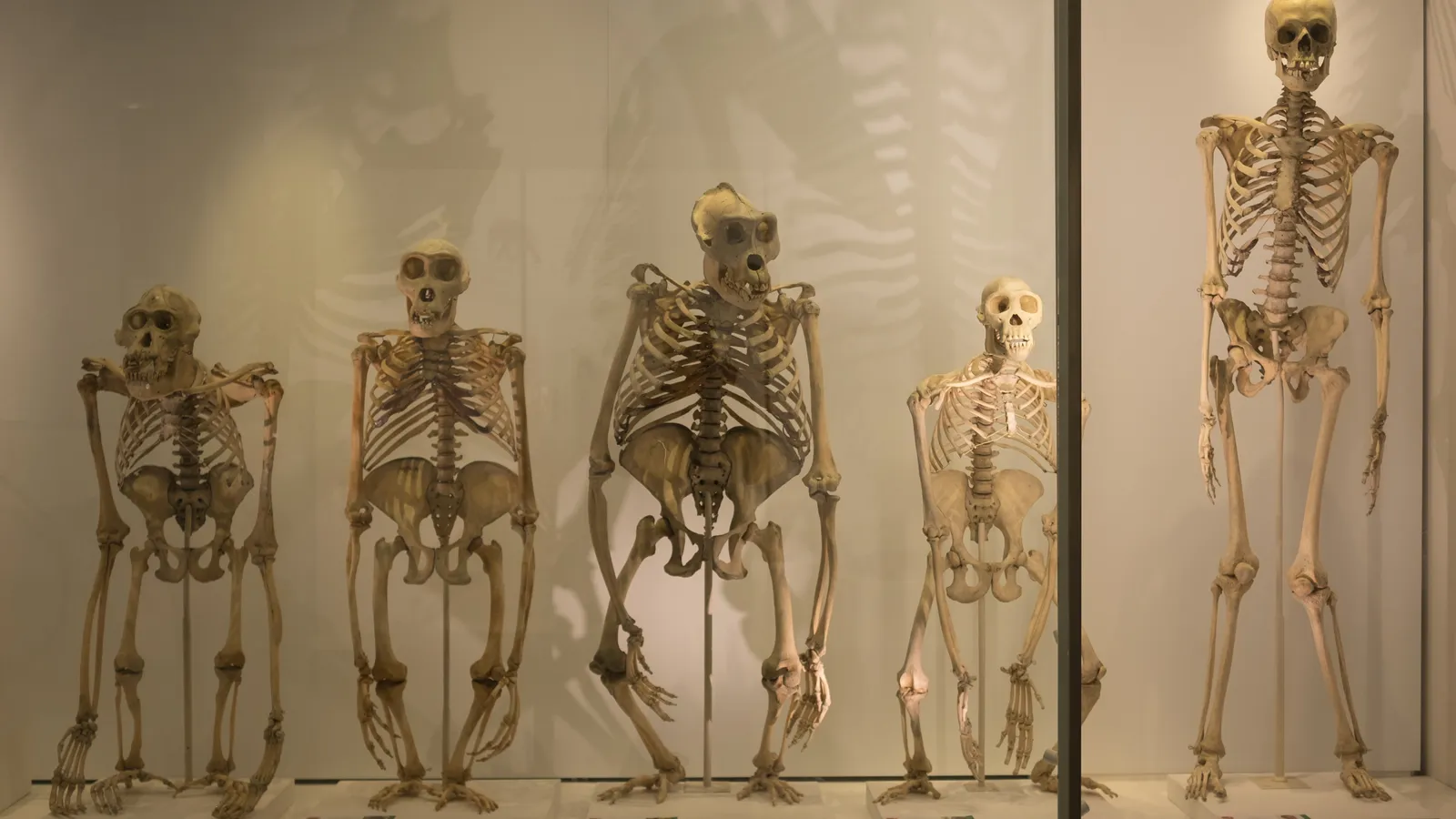
Chimpanzees sometimes walk upright, but the Smithsonian notes that their skeletons are not adapted for regular walking on two legs. Yours is, from the base of your skull to the arch of your foot. Here are the four big changes, what each does, and a side-by-side comparison to revise from.
Why does walking upright need a different skeleton?
For much of every stride, your whole weight sits on one leg, and the skeleton must keep head and trunk balanced over that foot cheaply. A 2007 PNAS study found that human walking is about 75% less costly than chimpanzee walking, on two legs or four, and traced the saving to a more extended hip and a longer hindlimb.
What are the four main skeletal adaptations for bipedalism?
1. An S-shaped spine. The adult spine has four curves; the neck curve forms as a baby begins to hold its head up, and the lumbar curve forms as a child begins to stand and walk. The curves add strength, flexibility and shock absorption. The Smithsonian calls the lower-back curve uniquely human.
That curve, the lumbar lordosis, positions the trunk's centre of mass above the hips, according to Whitcome, Shapiro and Lieberman in Nature. They also found extra curvature and reinforcement in women's lumbar vertebrae, which helps balance the forward load of pregnancy.
The skull changed too: in humans the spine joins it from underneath, near the centre, so the head balances on top; in chimpanzees it joins at the back, holding the head at an angle.
2. A short, bowl-shaped pelvis. The human pelvis is bowl-shaped, with short, wide iliac blades that curve along the sides of the body, says a 2025 Nature study. Compared with the ilia of apes, ours are shorter, wider and turned to the side, and the gluteus medius and minimus attached to them stop the pelvis dropping each time you stand on one leg. The paper's full text notes a short, wide ilium already in Ardipithecus (4.4 million years ago) and Australopithecus (3.85 million years ago).
3. An angled femur. Your thigh bones slope inward from hips to knees. This bicondylar angle brings the knees closer together, so the feet land under the body. A computer-modelling study in the journal Bone found that the loads of two-legged standing and walking can explain how the angle forms in growing children00700-7), and notes that the angle in 3.5-million-year-old Australopithecus afarensis indicates they walked upright.
4. An arched foot. A chimpanzee's foot grasps; ours is a stiff lever for push-off. A 2020 Nature study by Madhusudhan Venkadesan and colleagues found that the transverse arch across the midfoot provides more than 40% of the foot's lengthwise stiffness, while other primates have flat feet that bend in the midfoot. A review by Holowka and Lieberman adds that the springy longitudinal arch is likely partly an adaptation for long-distance running.
How does a human skeleton compare with a chimpanzee's?
Revise this top to bottom, human first, chimpanzee second (sources above).
Skull: spine joins underneath, head balanced on top; spine joins at the back.
Spine: S-shaped with a lumbar curve over the hips; no human-style lower-back curve.
Pelvis: short, wide, bowl-shaped; tall, blade-like ilia.
Hip muscles: gluteus medius and minimus hold the pelvis level on one leg; a short thigh-to-hip connection means they cannot contract effectively to support upright walking.
Femur: angled inward so knees sit under the body; nearly vertical.
Knee: strong, carries the body's weight on one leg at a time; lightly built, so it cannot carry the body on one leg for long walks.
Foot: arched and stiff, big toe in line; flatter midfoot, grasping big toe.
For the longer story, read our timeline of human evolution from Australopithecus to Homo sapiens and how Donald Johanson found Lucy.
How can you remember the adaptations for an exam?
Say it as one line down the body: head on top, back curved, hips a bowl, knees in, foot arched. Then try this two-minute check.
Put a hand on your lower back and feel the inward curve keeping your trunk over your hips.
Press your fingertips on the side of your right hip, just below the bony rim, and lift your left foot. The muscle that tightens is the gluteus medius holding your pelvis level; the same lever explains why a walking stick goes in the opposite hand.
Look at your thighs in a mirror: they slope inward to the knees.
Write the comparison list from memory, check it, and fix any line you missed.
If one link still feels shaky, such as why the hip muscles need a wide pelvis, the Fermi Concept Library gives each biology concept its own lesson and its place in the map.


