

On this page
How did Donald Johanson discover Lucy in Ethiopia?
On the morning of 24 November 1974, American paleoanthropologist Donald Johanson and graduate student Tom Gray surveyed Locality 162 at Hadar in the Afar Triangle of Ethiopia. Walking back toward their vehicle in blistering midday heat, Johanson spotted an arm bone fragment lying exposed on a dusty gully slope. Looking uphill, the pair noticed a fragment of skull, thigh bone, vertebrae, ribs, and a pelvis half.
In their 1976 report in Nature, Johanson and Maurice Taieb detailed the Hadar fossil beds. Monographic studies in the American Journal of Physical Anthropology confirmed that the individual, catalogued as AL 288-1, preserved roughly 40% of a single skeleton—comprising 47 distinct bones out of 207. Single-crystal argon-argon dating of surrounding volcanic ash layers by geologist Robert Walter in Geology022<0006:aolatf>2.3.co;2) established her age at 3.18 million years ago.
Why did Lucy prove that upright walking came before big brains?
Throughout the early twentieth century, anthropology was dominated by the "brain-first" hypothesis. Prevailing theory assumed our ancestors first evolved large, intelligent brains to manufacture tools, and only then stood upright. Even after South African discoveries such as Raymond Dart and the Taung child skull of Africa and East African excavations by Louis and Mary Leakey and fossils of early humans in Africa, many anatomists still viewed australopithecines as aberrant fossil apes rather than direct ancestors.
Lucy overturned that model. In 1978, Johanson, Tim White, and Yves Coppens classified the Hadar and Laetoli hominins into *Australopithecus afarensis*, followed by Johanson and White's systematic phylogenetic assessment in Science. Lucy belonged to a species with an adult cranial capacity typically between 375 and 500 cm³—comparable to a chimpanzee and less than a third of modern humans. Adult crania described in Nature confirmed this modest braincase across the species.
Yet Lucy's pelvis and lower limbs were adapted for upright bipedal walking. This proved that bipedal locomotion evolved more than a million years before brain expansion, establishing walking as the foundational adaptation that freed hominin hands.
What anatomical bones proved that Lucy walked upright?
Paleoanthropologists determine locomotion by examining key weight-bearing joints in the human skeleton. In Lucy's skeleton, three features confirmed upright walking:
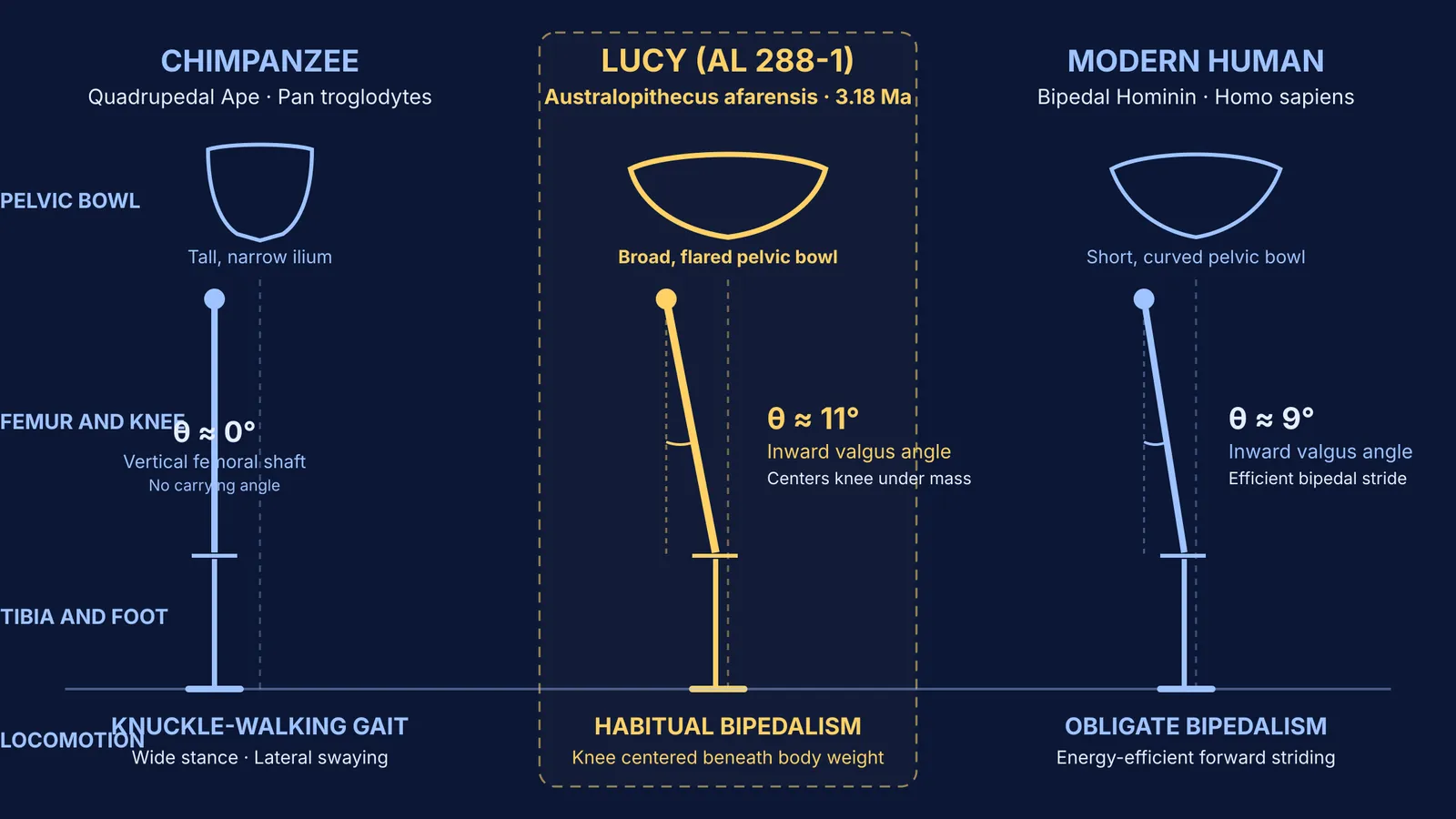
The femoral valgus knee: In quadrupedal apes, the femur drops vertically at nearly 0°. In Lucy, measurements published in the American Journal of Physical Anthropology revealed a bicondylar valgus angle of 9° to 11°. This inward slant mirrors modern humans, centering the knee and foot beneath the body's midline during single-leg stance.
The broad pelvic bowl: Apes have tall, flat iliac blades. Lucy's ilium was short, broad, and laterally curved into a bowl, rotating her gluteal muscles to stabilize the pelvis during each stride.
Mosaic body proportions: Lucy stood 1.1 metres tall and weighed 29 kg, as recorded in the American Journal of Physical Anthropology. Her humero-femoral index was 84.6%, between chimpanzees (97.8%) and humans (71.8%), showing retained climbing ability alongside habitual ground walking.
The diagnostic anatomical contrast:
Cranial capacity: Lucy (375–500 cm³) vs Chimpanzee (~400 cm³) vs Human (~1350–1400 cm³).
Femoral valgus angle: Lucy (9°–11°) vs Chimpanzee (0°–1°) vs Human (8°–11°).
Pelvic ilium: Lucy (short, flared bowl) vs Chimpanzee (tall, flat) vs Human (compact bowl).
Locomotion: Lucy (habitual biped) vs Chimpanzee (knuckle-walker) vs Human (obligate biped).
How can students master human evolution for competitive exams?
In competitive exams like NEET, human evolution questions test timelines and anatomical traits. Students often lose marks by assuming all modern traits evolved simultaneously.
Use this three-step reasoning plan for evolutionary biology:
Separate posture from brain size: Remember that habitual bipedalism evolved in *Australopithecus* more than three million years ago, whereas substantial brain expansion appeared much later with the emergence of early *Homo* species.
Connect bone shapes to physical balance: Relate skeletal features to mechanical function, such as the inward valgus knee centering weight over the foot.
Track mosaic transitions: Recognize that ancestral arboreal traits and derived bipedal traits coexist during transitional evolutionary stages.
If you struggle to picture how pelvic angles and knee alignments alter mechanical forces, the Fermi Simulation Lab provides interactive simulations for ideas that are easier to see than to read. To connect individual fossil milestones into a structured evolutionary timeline, the Fermi Concept Library organizes every concept in biology, giving each topic its own lesson and place in the map. When working through complex comparative anatomy problems, Fermi's AI tutor can work out what you already know, hold a line of reasoning across the session, and check your understanding as you go.


