On this page
NCERT's Class 12 chapter on evolution says that about 3 to 4 million years ago, man-like primates walked upright in eastern Africa, and that a creature called Homo habilis came later. Much of the evidence for those sentences was dug out of one gorge in Tanzania by a husband and wife. This post covers who Louis and Mary Leakey were, their three best-known finds, a worked example that puts the dates on a clock you can picture, and what students can take from how they worked.
Who were Louis and Mary Leakey?
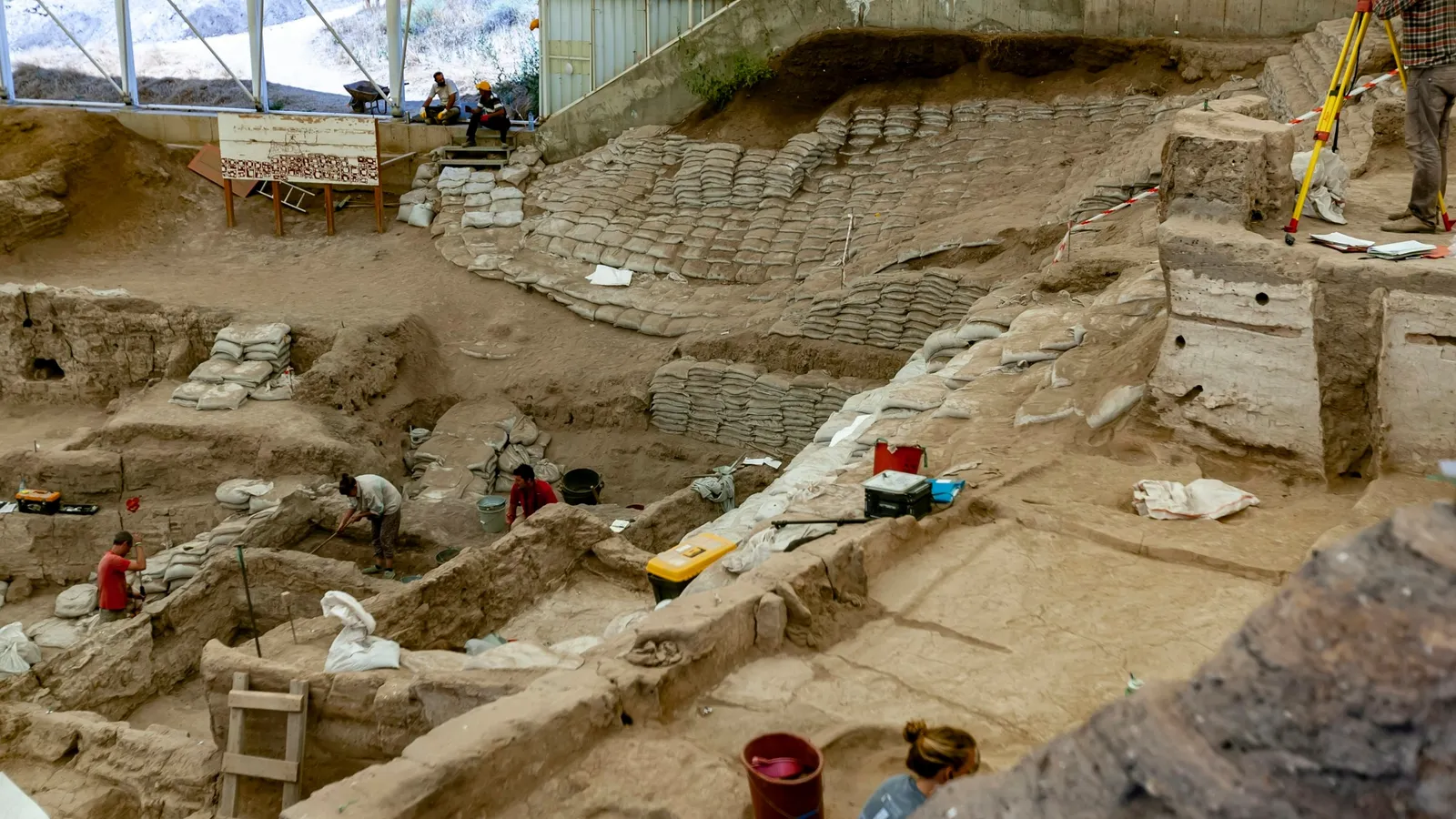
The Oxford Dictionary of National Biography describes both as archaeologists and palaeoanthropologists: Louis Seymour Bazett Leakey (1903-1972) and Mary Douglas Leakey, née Nicol (1913-1996). Their most important site was Olduvai Gorge in northern Tanzania, where thousands of stone tools have been found alongside early human fossils.
What was Zinj?
In 1959 Mary Leakey found a nearly complete skull of an adult male at Olduvai. The Smithsonian's Human Origins Programme records it as OH 5, nicknamed "Nutcracker Man", about 1.8 million years old. Louis described it in Nature that year as a new fossil skull from Olduvai and named it Zinjanthropus boisei. The species is now called Paranthropus boisei, and the skull is still known as "Zinj".
The Smithsonian describes huge cheek teeth, sometimes four times the size of ours, and wide cheekbones that made room for massive chewing muscles. It was the first fossil that showed scientists they had a new species.
Its age mattered as much as its shape. In 1961 Louis Leakey, with Evernden and Curtis, published a measured age of Bed I at Olduvai Gorge in Nature, giving the finds from that part of the gorge a date in years rather than only a place in a sequence of rock layers.
Who was Homo habilis?
Between 1960 and 1963, the Smithsonian's Homo habilis page records, a team led by Louis and Mary Leakey found the remains of a different early human at Olduvai. The type specimen, OH 7, was found by their son Jonathan, and was nicknamed "Jonny's child". In 1964 Louis Leakey, the South African scientist Philip Tobias and the British scientist John Napier named the species Homo habilis, "handy man", because they suspected this slightly larger-brained human made the stone tools found at Olduvai. The Smithsonian adds that this is hard to test, because other early humans lived in the same area at the same time.
NCERT gives the brain capacity of Homo habilis as 650 to 800 cc in its Class 12 chapter on evolution. For exam answers, use NCERT's figures.
What were the Laetoli footprints?
In 1976, team members led by Mary Leakey noticed animal tracks cemented in volcanic ash at Laetoli, Tanzania. In 1978 Paul Abell, working with her team, found a trail of early human prints. The Smithsonian's page on the Laetoli footprint trails says the trail is about 27 m long, holds about 70 footprints and is about 3.6 million years old. The prints show a big toe in line with the other toes, the foot of a creature that walked on two legs. They were most likely left by Australopithecus afarensis, whose fossils lie in the same layer. Mary Leakey and Richard Hay described them in Nature as Pliocene footprints in the Laetolil Beds.
How long ago is 3.6 million years? A worked example
Big numbers blur together, so scale them. Let the 3.6 million years since the Laetoli prints be one 24-hour day, starting at midnight.
One hour of the "day" = 3.6 million / 24 = 150,000 years.
Zinj, 1.8 million years ago, is half way back: 1.8 / 3.6 × 24 = 12 hours before the end. It lived at noon.
Homo sapiens first appeared in Africa about 300,000 years ago, according to the 2022 Nobel press release. That is 0.3 / 3.6 × 24 = 2.0 hours before the end, at 10 pm.
So our species has existed for the last two hours of the Laetoli day.
Common mistakes:
Mixing up millions and thousands. 300,000 years is 0.3 million, not 3 million.
Thinking every fossil is a direct ancestor. The Smithsonian notes that P. boisei fossils turn up in the same layers as early Homo, and that the species went extinct.
Treating ages as exact. "About 1.8 million years" carries an uncertainty, so do not quote more figures than the source gives.
What can a student take from the Leakeys' way of working?
Stay with a hard problem for years. Olduvai gave up its best fossils only after long seasons of searching.
Measure, don't guess. The 1961 paper put a number on the age of the layers, so the finds could be placed on a timeline.
Work as a team. Zinj, OH 7 and Laetoli were each found by a different person in the same family or team.
For the NEET version of this chapter, read our guide to human evolution. For a South African find that came 35 years before Zinj, read about Raymond Dart and the Taung child. If the order of hominins keeps slipping, the Fermi Concept Library covers every concept in biology, each with its own lesson and its place in the map.
Try it now: put Homo erectus, which NCERT dates to about 1.5 million years ago, on the same 24-hour clock.