

On this page
NCERT gives each Human Physiology disorder a line or two across five chapters, and many names look alike. On one page, mix-ups are easier to spot.
Which disorders does the NEET syllabus name in Unit 5?
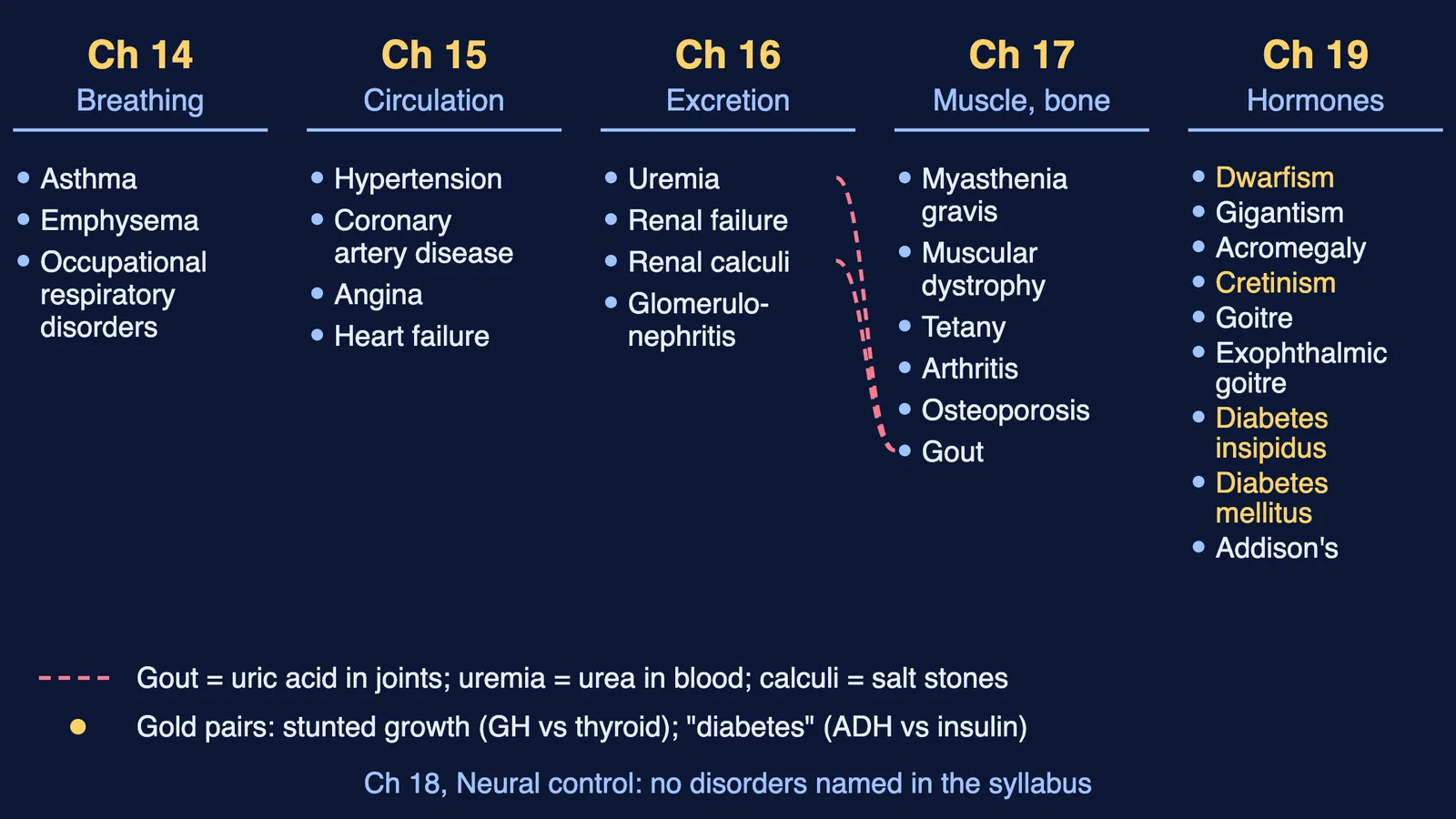
The NMC's NEET (UG) syllabus, posted by NTA, lists 24 disorders in Biology Unit 5, Human Physiology: 3 under breathing, 4 under circulation, 4 under excretion, 6 under the muscular and skeletal system and 7 under hormones. It asks for them to be covered in brief. Diabetes insipidus appears separately, in the line on how the kidney is regulated. The neural control topic names no disorders.
Each group sits in one NCERT Class 11 Biology chapter (14, 15, 16, 17, 19). For the mechanisms, see our Human Physiology for NEET study plan.
What does each disorder mean in NCERT?
Breathing (Chapter 14)
Asthma (NCERT 14.6): bronchi and bronchioles are inflamed, so breathing is hard and wheezy.
Emphysema: alveolar walls are damaged and the respiratory surface shrinks; NCERT names cigarette smoking as a major cause.
Occupational respiratory disorders: dust from grinding or stone-breaking overwhelms the lungs' defences; long exposure brings inflammation, then fibrosis.
Circulation (Chapter 15)
Hypertension (NCERT 15.6): NCERT treats 120/80 mm Hg as normal; readings that stay at 140/90 or higher count as hypertension.
Coronary artery disease (atherosclerosis): the arteries feeding the heart muscle narrow as calcium, fat, cholesterol and fibrous tissue build up.
Angina pectoris: acute chest pain because not enough oxygen reaches the heart muscle.
Heart failure: the heart pumps too weakly to meet the body's demand; lung congestion explains the name congestive heart failure.
Excretion (Chapter 16)
Uremia (NCERT 16.8): urea builds up in the blood when the kidneys malfunction, and it can lead to kidney failure.
Renal failure: NCERT also calls it kidney failure.
Renal calculi: a stone of crystallised salts, such as oxalates, inside the kidney.
Glomerulonephritis (the syllabus says nephritis): the glomeruli are inflamed.
Muscle and bone (Chapter 17)
Myasthenia gravis (NCERT 17.5): an autoimmune disorder at the neuromuscular junction; skeletal muscle tires, weakens and can become paralysed.
Muscular dystrophy: skeletal muscle degenerates step by step, mostly for genetic reasons.
Tetany: fast, wild muscle spasms caused by low Ca++ in body fluid.
Arthritis: inflamed joints.
Osteoporosis: bone mass falls with age and fractures become likelier; lower estrogen is a common cause.
Gout: joints inflamed by a build-up of uric acid crystals.
Hormones (Chapter 19)
Pituitary dwarfism (NCERT 19.2): too little growth hormone (GH), so growth is stunted. Too much GH gives gigantism.
Acromegaly: excess GH in adults, mostly middle-aged, disfiguring the face in particular.
Goitre: lack of dietary iodine leads to hypothyroidism, and the thyroid swells.
Cretinism: hypothyroidism in pregnancy stunts the growing baby's growth and development.
Exophthalmic goitre (Graves' disease): a hyperthyroid state: enlarged thyroid, protruding eyes, raised basal metabolic rate, loss of weight.
Diabetes insipidus: ADH is not made or released properly, so the kidney loses water and the body dehydrates.
Diabetes mellitus: prolonged high blood glucose; glucose is lost in urine and harmful ketone bodies form.
Addison's disease: the adrenal cortex makes too little hormone, altering carbohydrate metabolism and causing acute weakness and fatigue.
Which disorder pairs are easy to swap?
Urea or uric acid? Uremia (Chapter 16) is urea in the blood. Gout (Chapter 17) is uric acid crystals in the joints. Renal calculi are salt crystals in the kidney. More on joints: gout, arthritis and osteoporosis.
Stunted growth, two glands. Pituitary dwarfism comes from low GH; cretinism from thyroid deficiency during pregnancy.
One word, two chapters. The syllabus files diabetes insipidus under kidney regulation (Chapter 16) but lists "diabetes" with the hormone disorders. In Chapter 16, glucose and ketone bodies in urine point to diabetes mellitus, not insipidus.
Vessel, pain or pump? Coronary artery disease narrows the vessel, angina is the chest pain, and heart failure is weak pumping. See angina vs heart attack vs heart failure.
Calcium across chapters. Tetany (Chapter 17) comes from low Ca++ in body fluid; Chapter 19 says parathyroid hormone raises blood Ca2+.
Inflamed where? Inflammation appears in asthma (bronchi), occupational disorders (lungs), glomerulonephritis (glomeruli), arthritis and gout (joints).
How do you revise all of them in one sitting?
Sort by cause, not by chapter, so the map gets a second axis.
Make five piles: inflammation; something builds up (urea, uric acid, salts, deposits); too little hormone; too much hormone; everything else.
Place all 24 names, plus gigantism and diabetes insipidus, from memory.
Check each against the NCERT sections above and move any misfiled name.
Say aloud the organ for every name in the inflammation pile.
Which of the 24 would you mix up first? Fermi's AI tutor works out what you already know and builds a plan for the session.
This is a study summary, not medical advice.


