On this page
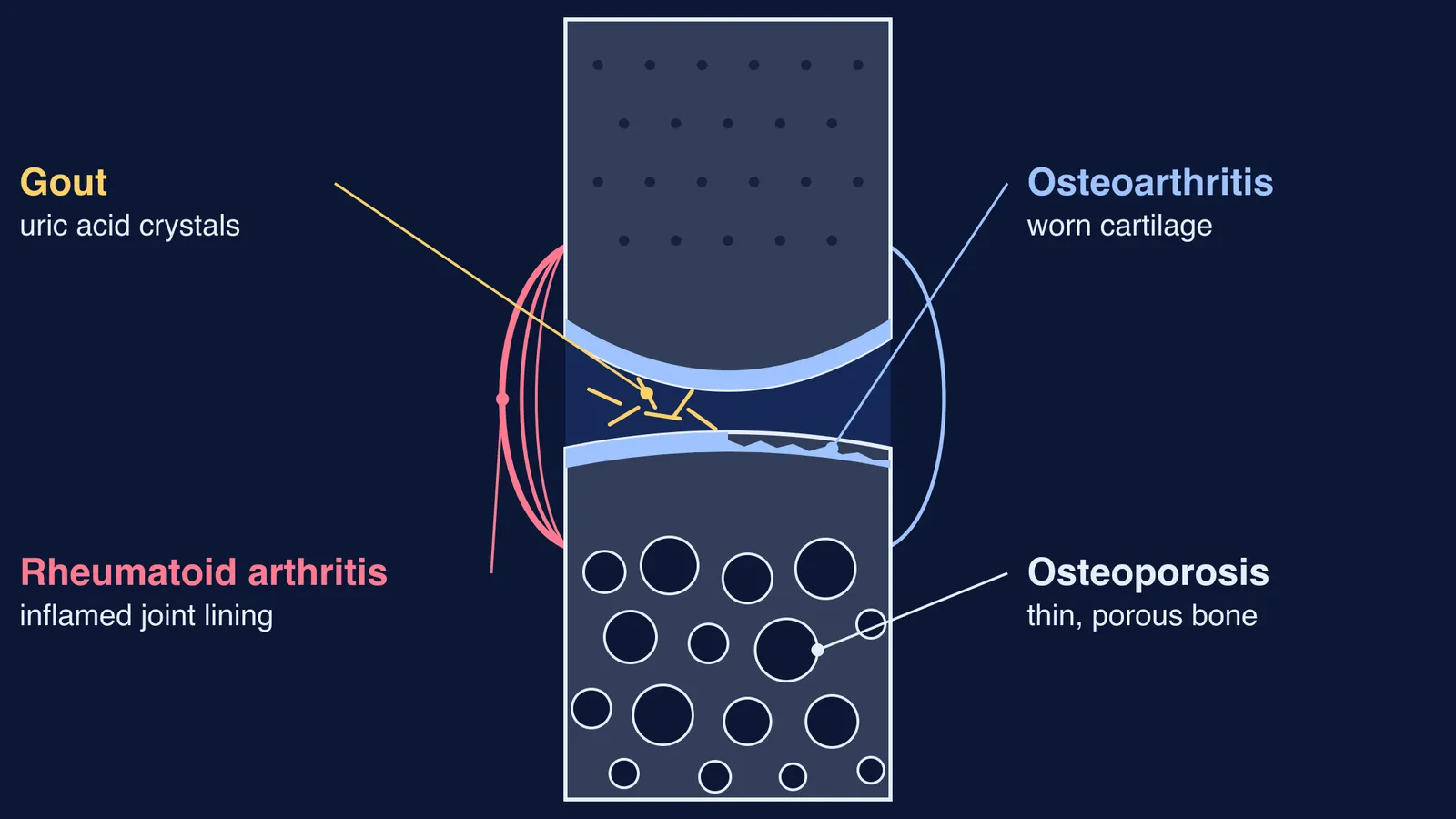
Gout, arthritis and osteoporosis turn up together in the Class 11 chapter on locomotion and movement, and they are easy to mix up because all three involve the skeleton and can cause pain. The way to keep them apart is to ask one question: which part is damaged? In gout it is a crystal problem inside the joint. In arthritis it is inflammation of the joint. In osteoporosis it is the bone itself, not the joint.
What is the difference between gout, arthritis and osteoporosis?
Arthritis is the umbrella term for inflamed, painful joints. Osteoarthritis is a degenerative joint condition that causes pain, swelling and stiffness, according to the WHO osteoarthritis fact sheet.
Gout is a common type of inflammatory arthritis, caused when uric acid builds up and forms needle-like crystals in joints, says MedlinePlus, the US National Library of Medicine's health site.
Osteoporosis is a disease in which bones become weak and are likely to fracture, and it usually causes no symptoms until a bone breaks, according to MedlinePlus.
So gout belongs inside the arthritis family. Osteoporosis does not. It is a problem of bone mass, not joint inflammation.
What causes gout, and why does uric acid matter?
Uric acid is a waste product your body makes when it breaks down purines, substances found in your body's tissues and in many foods (MedlinePlus). When too much of it builds up over a long time, some people form sharp crystals in a joint. Flares often begin in the big toe or a lower limb, and can also affect the ankle and knee.
Gout is common. A Global Burden of Disease analysis in The Lancet Rheumatology00117-6) estimated that 55.8 million people worldwide had gout in 2020. The same study found prevalence was 3.26 times higher in males than in females, and projected 95.8 million cases by 2050, driven mainly by population growth and ageing. High body mass index accounted for 34.3% of the years lived with disability due to gout.
Humans are ureotelic, yet we still make uric acid from purines. Our post on ammonotelic, ureotelic and uricotelic animals explains why some animals excrete uric acid as their main waste.
How is osteoarthritis different from rheumatoid arthritis?
Both are arthritis, but the cause is different.
In osteoarthritis, the cartilage covering the ends of bones breaks down and becomes rough, and sometimes wears away so the bones rub together (MedlinePlus). The WHO reports that about 528 million people were living with osteoarthritis in 2019, and that the knee is the joint most often affected.
Rheumatoid arthritis is an autoimmune disease that affects the lining of the joints, and it usually affects the same joints on both sides of the body (MedlinePlus). The WHO rheumatoid arthritis fact sheet says 18 million people had it in 2019, and about 70% of them were women.
To see where cartilage and the synovial lining sit, read our guide to fibrous, cartilaginous and synovial joints.
Why is osteoporosis called a silent disease?
Because you usually cannot feel bone getting thinner. Many people learn they have osteoporosis only when they break a bone, most often the hip, a vertebra in the spine or the wrist. A bone density scan is one of the tests used to diagnose it (MedlinePlus).
The International Osteoporosis Foundation estimates that 1 in 3 women and 1 in 5 men over 50 will have a fracture caused by osteoporosis.
That is the key contrast: a gout flare announces itself with a painful, swollen joint, while osteoporosis stays quiet.
How do you write the difference in an exam?
Use four questions, in this order, for any skeletal disorder:
Where? Joint or bone?
What goes wrong? Crystals, worn cartilage, immune attack, or loss of bone mass?
What causes it? Uric acid build-up, wear, autoimmunity, or bone weakening with age?
What does the person notice? Sudden painful flare, stiffness, or nothing until a fracture?
Worked example, for a 3-mark "Differentiate between gout and osteoporosis":
Gout is a joint disorder; osteoporosis is a bone disorder.
Gout is caused by uric acid crystals depositing in joints; osteoporosis is a loss of bone mass that makes bones weak.
Gout causes painful, swollen joints, often the big toe; osteoporosis often has no symptoms until a bone breaks.
Three matched pairs, one per mark, each comparing the same feature, rather than two separate paragraphs. The same template works for myasthenia gravis and tetany, covered in our post on muscle disorders.
If a definition still feels shaky, the Fermi Concept Library gives every biology concept its own lesson and shows where it sits in the map, so you can check joints, cartilage and bone in one place. To practise difference questions, the Fermi Problem Library has worked problems with a step-by-step solver that explains the reasoning.
This post is for learning, not diagnosis. If you or a family member has a swollen joint, ongoing joint pain or a bone that broke after a small fall, see a doctor.
Next step: pick one disorder from the chapter tonight and answer the four questions about it from memory.