On this page
If you are revising NCERT Class 11 Biology for NEET-UG or your boards, the last section of Chapter 15 packs four disorders into a few short paragraphs: high blood pressure, coronary artery disease, angina and heart failure. A fifth term, heart attack, appears only in passing, and that is where most mix-ups start. Here is how to tell them apart.
What does NCERT say about disorders of the circulatory system?
Section 15.6 of NCERT Class 11 Biology, Chapter 15, Body Fluids and Circulation gives these definitions, which we paraphrase closely:
Hypertension: blood pressure higher than the normal 120/80 mm Hg, where 120 is the systolic (pumping) pressure and 80 the diastolic (resting) pressure. NCERT says repeated checks of 140/90 or higher show hypertension, and that high blood pressure leads to heart disease and also affects the brain and kidneys.
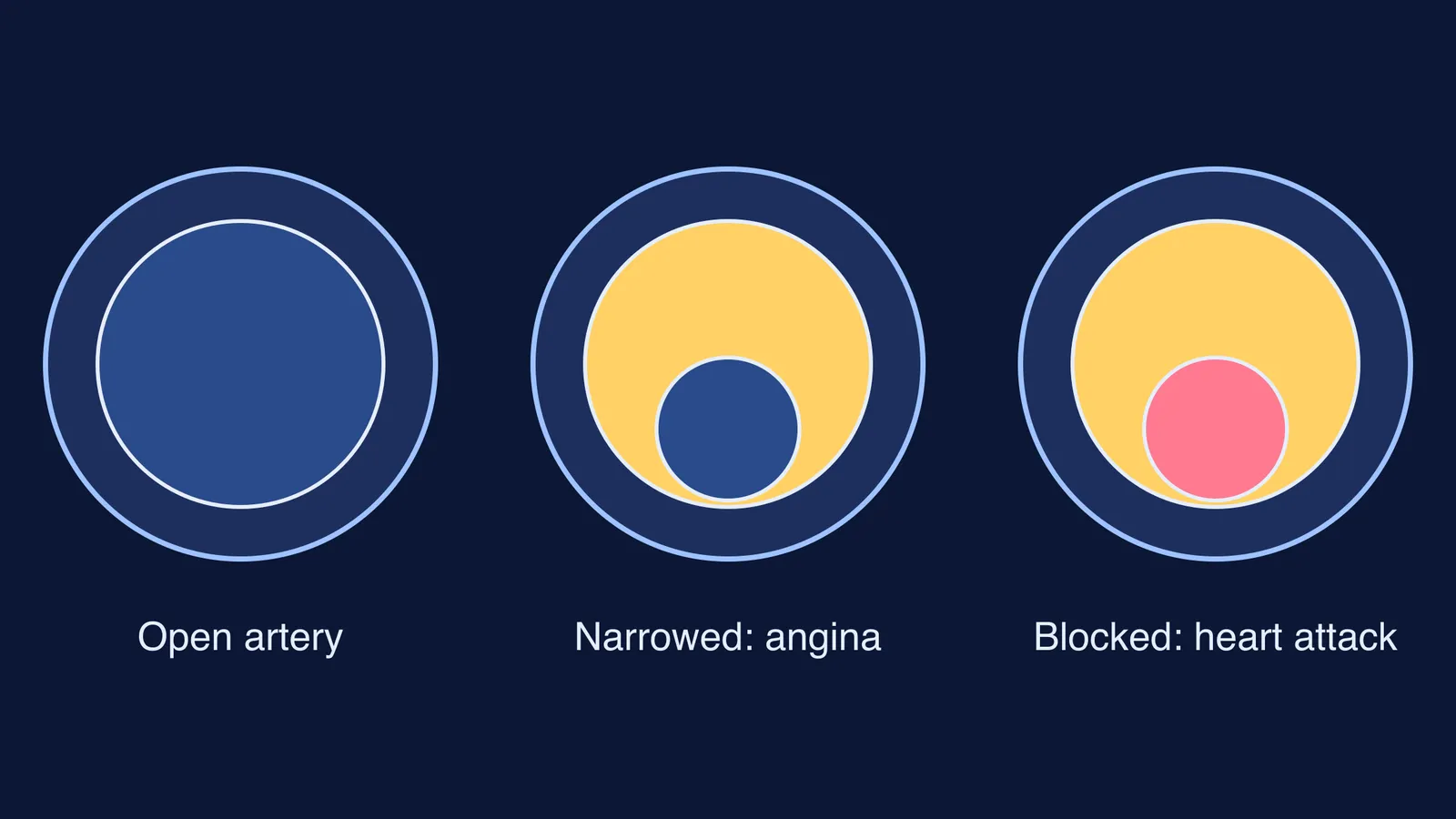
Coronary artery disease (CAD): often referred to as atherosclerosis, it affects the vessels that supply blood to the heart muscle. Deposits of calcium, fat, cholesterol and fibrous tissue make the lumen of these arteries narrower.
Angina (angina pectoris): acute chest pain that appears when not enough oxygen reaches the heart muscle. It can occur at any age but is more common among the middle-aged and elderly.
Heart failure: the heart is not pumping blood well enough to meet the body's needs. It is sometimes called congestive heart failure because congestion of the lungs is one of its main symptoms.
The heart failure entry ends with a line worth memorising: heart failure is not the same as cardiac arrest (the heart stops beating) or a heart attack (the heart muscle is suddenly damaged by an inadequate blood supply).
What is the difference between angina, heart failure and heart attack?
Ask one question: what has gone wrong, the supply line or the pump?
Angina: the supply is too small. The US National Heart, Lung, and Blood Institute (NHLBI) describes angina as chest pain or discomfort when part of the heart muscle does not get enough oxygen-rich blood. NHLBI says it can be a warning sign of a higher risk of a heart attack.
Heart attack: the supply is cut off. NHLBI defines a heart attack, or myocardial infarction, as the flow of oxygen-carrying blood to part of the heart muscle suddenly becoming blocked; if blood flow is not restored quickly, that muscle begins to die.
Heart failure: the pump is weak. NHLBI's heart failure page says the heart does not pump enough blood for the body's needs, and that the term does not mean the heart has stopped. It can develop suddenly or over time.
Angina and a heart attack are problems of the arteries feeding the heart muscle; heart failure is about how well the heart pumps for the body.
How does high blood pressure connect to the rest?
Read the NCERT terms as a chain, not a list. NCERT links high pressure to heart disease. Narrowed coronary arteries (CAD) can starve the heart muscle of oxygen: angina. A sudden block damages the muscle: a heart attack. A heart that grows weaker may, over time, pump too little: heart failure.
High blood pressure is also common. The WHO hypertension fact sheet estimates that 1.4 billion adults aged 30 to 79 had hypertension in 2024, and that about 600 million of them (44%) did not know they had it. WHO uses the same 140/90 threshold as NCERT, measured on two different days.
How do you sort these in a NEET or board question?
Run this three-step check on any statement:
Is it about pressure in the arteries? Then it is hypertension; look for 120/80 and 140/90.
Is it about the coronary arteries? Narrowing is CAD, chest pain from too little oxygen is angina, a sudden block with muscle damage is a heart attack.
Is it about the pump not meeting the body's needs, or the lungs getting congested? That is heart failure.
Now decide true or false before reading each answer:
"Heart failure means the heart has stopped beating." False: that is cardiac arrest.
"Atherosclerosis narrows the lumen of coronary arteries." True: this is CAD.
"Repeated readings of 150/95 show hypertension by NCERT's definition." True: NCERT's line is 140/90 or higher on repeated checks.
If the numbers are fuzzy, start with what 120/80 means for systolic and diastolic pressure, then see how heart rate is controlled in why your heart races when you're scared. For the clotting side of a blocked artery, read William Hewson and blood clotting.
When a definition will not stick, the Fermi Concept Library gives every concept in biology its own lesson and its place in the map, so you can see what each disorder builds on.