On this page
When a cut on your finger stops bleeding, a protein dissolved in your plasma has turned into a solid mesh. William Hewson, a surgeon working in London in the 1760s and 1770s, showed that the clot comes from that pale liquid part of blood rather than from the red cells. A 2006 review in the British Journal of Haematology notes that he "has been called the father of haematology" and says he "showed that it was fibrinogen and not the cells that led to coagulation."
Who was William Hewson?
Hewson was born in Hexham, Northumberland, on 14 November 1739 and died on 1 May 1774, aged 34, of sepsis caught while dissecting a body, according to his Wikipedia biography). He was a student and then an assistant of the anatomist William Hunter, won the Royal Society's Copley Medal in 1769 and was elected a Fellow of the Royal Society in 1770.
Before he studied clotting, Hewson mapped lymph vessels. He published accounts of the lymphatic system in birds in 1768 and in amphibious animals in 1769, both in the Royal Society's Philosophical Transactions.
Why did Hewson call it "coagulable lymph"?
His clotting work appeared as Experiments on the Blood, with Some Remarks on Its Morbid Appearances in volume 60 of Philosophical Transactions. In it he splits a clot, which he calls the crassamentum, into two parts: one "gives it solidity" and is "with more propriety termed the coagulable lymph", and the other "gives the red colour to the blood, and is called the red globules" (full text of the 1770 paper).
So when you search for Hewson and "lymph", you meet two separate stories. One is his anatomy of lymph vessels. The other is coagulable lymph, his name for the clotting substance carried in plasma, which the British Journal of Haematology review identifies as fibrinogen.
How did Hewson show clotting comes from plasma?
Everything below is in the 1770 paper. He starts from two observations he presents as already known, then adds his own salt experiment.
Stir it out. Stirring fresh blood with a stick collects the coagulable lymph on the stick, "in which case the rest of the blood remains fluid." Take out one substance and the red cells do not clot on their own.
Wash the clot. Washing a clot in water dissolves the red particles, "whilst the coagulable lymph remains solid." The solid frame of a clot is not made of red cells.
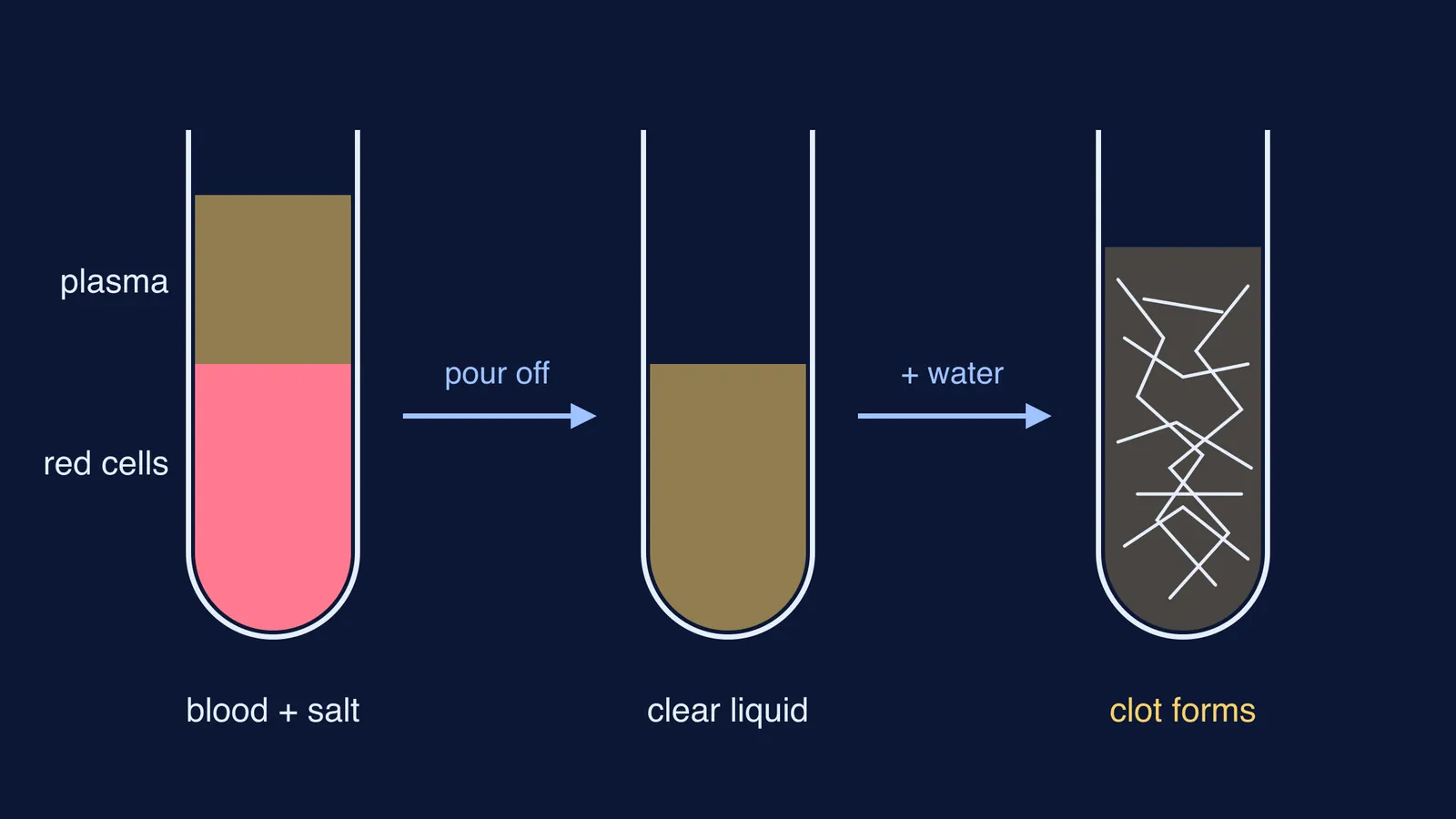
Hold it liquid with salt. Hewson wrote that "six ounces of human blood" received onto "half an ounce of Glauber's salt" will not coagulate. The red particles then sink, the top becomes "clear and colourless", and when poured off it "is found to contain the coagulable lymph, which can be separated by the addition of water." A liquid with no red cells in it still holds the clotting substance.
He also tied off neck veins in living dogs. Blood trapped between the ties was "still entirely fluid" after ten minutes, and at fifteen minutes he found "one, and sometimes two or three small particles" of clot. In a rabbit, blood frozen and thawed inside a vein stayed fluid, which showed that clotting "is not solely owing to cold."
Hewson got one thing wrong. He concluded that "the air is a strong coagulant of the blood." We now know clotting runs through a chain of enzyme reactions that ends with thrombin turning fibrinogen into fibrin; air is not the trigger.
How does Hewson's discovery connect to what you study today?
Fibrinogen (coagulation factor I) is a protein made in the liver that thrombin converts into fibrin during tissue and vessel injury, as Wikipedia's fibrinogen entry summarises. Our explainer on the blood clotting cascade with platelets, thrombin and fibrin walks through the full chain, and plasma vs serum explains what is left once fibrinogen is used up. For the other half of the puzzle, read why blood does not clot inside your blood vessels.
How can you use Hewson's method in an exam answer?
Biology questions often ask how an experiment proves a claim. Hewson's paper gives you a four-step template you can reuse:
State the rival idea. The clot might come from the red cells.
Separate the parts. Salt keeps blood liquid long enough for the red cells to sink.
Test each part alone. The clear liquid still carries the coagulable lymph, which water separates out; washed clots stay solid without red cells.
Give the conclusion and its limit. The clotting substance is in plasma; his idea that air triggers it was wrong.
Try it: cover the list and explain, in three sentences, how Hewson's salted blood showed that the clotting substance is not in the red cells. If the steps from prothrombin to fibrin still feel like a list of names, the Fermi Concept Library covers every concept in biology, and Fermi's AI tutor can draw the figure and check your understanding as it goes.
Next time a scab forms on your knee, part of what holds it together is the substance Hewson called coagulable lymph in 1770.