

On this page
Count the chromosomes in one of your cells and you get 46, in 23 pairs. Do the same for a chimpanzee, gorilla or orangutan and you get 48, as a 2022 genomics study sums it up. That gap of one pair has a clear explanation, and the evidence for it is written into human DNA in two places you can name.
Why do humans have 46 chromosomes but apes have 48?
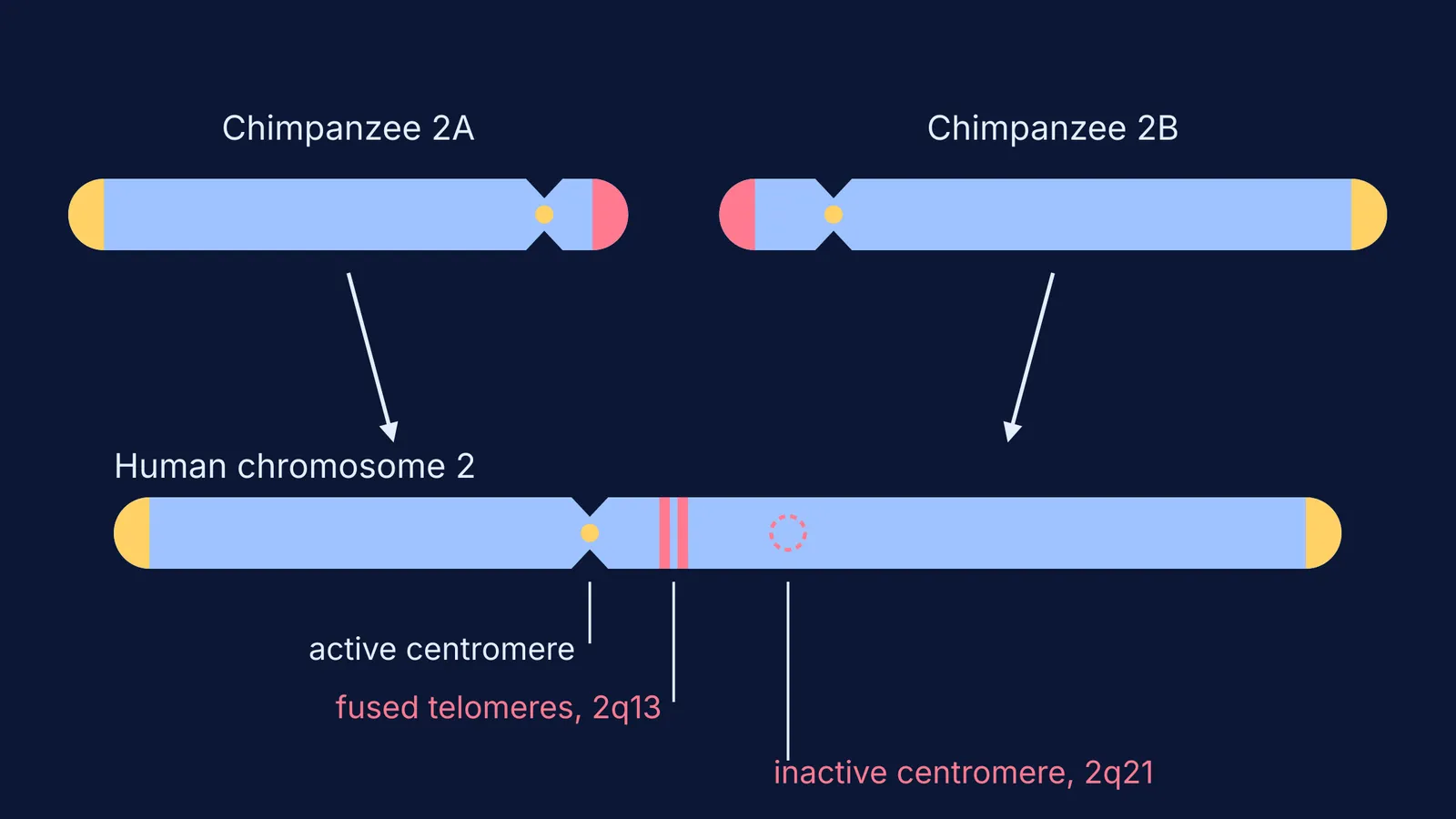
Human chromosome 2 is the product of two ancestral ape chromosomes that joined end to end. A 2022 study in BMC Genomics states it directly: the drop from 48 chromosomes in the great apes to 46 in modern humans is thought to come from the end-to-end fusion of two ancestral chromosomes forming human chromosome 2. In chimpanzees those two chromosomes still exist separately, as chromosomes 2A and 2B.
The team that sequenced human chromosome 2 described it as unique to the human lineage, the product of a head-to-head fusion of two intermediate-sized ancestral chromosomes (Hillier and colleagues, Nature, 2005).
Fusing two chromosomes into one turns 24 pairs into 23. The join was not perfectly clean: a 2016 review notes that a few megabases of mostly repetitive, satellite-rich DNA near the old chromosome tips were lost when the two ends fused.
What is the evidence that chromosome 2 is a fusion?
A fusion predicts two things you should find inside chromosome 2.
Clue 1: telomeres in the middle
Telomeres are the protective caps on chromosome ends, made of a short DNA sequence repeated many times. In vertebrates that repeat is TTAGGG. Normally you only find long runs of it at the two tips of a chromosome.
In 1991, J. W. IJdo and colleagues reported in PNAS that they had found, inside human chromosome 2 at band 2q13, two inverted arrays of the telomere repeat in a head-to-head arrangement: a run of TTAGGG followed by a run of CCCTAA on the same DNA strand. That is what you would expect if two chromosome tips had been joined end to end. The authors concluded this site "marks the point at which two ancestral ape chromosomes fused to give rise to human chromosome 2."
Clue 2: a second, switched-off centromere
Each chromosome normally has one centromere, the pinch point that spindle fibres grab during cell division. Two ape chromosomes would bring two centromeres. A chromosome with two centromeres is inherently unstable, because the two can be pulled towards opposite poles during division, so such chromosomes become stable by inactivating or deleting one centromere.
Human chromosome 2 shows exactly that. A 2017 study in Molecular Biology and Evolution by Chiatante, Ventura and colleagues found that after the fusion, the centromere on the short arm stayed active while the one on the long arm was inactivated, leaving relics of centromeric alpha-satellite DNA. That relic contains four alpha-satellite arrays spanning about 40 kilobases, far smaller than a typical active human centromere, which the authors put at 250 to 5,000 kilobases. A 2016 review places this vestigial centromere at band 2q21.2 on the long arm.
When did the fusion happen?
Estimates vary. The 2022 BMC Genomics study put the fusion at about 0.9 million years ago, with a 95% confidence interval of 0.4 to 1.5 million years. The 2016 review notes the fusion came before our last common ancestor with Neanderthals and Denisovans, with earlier estimates spanning roughly 0.74 to 4.5 million years ago.
How do you write this up in a biology answer?
A strong answer shows the chain of reasoning, not just the conclusion. Use this five-step frame for a long answer or a viva question:
Observation: humans have 46 chromosomes; great apes have 48.
Hypothesis: two ancestral ape chromosomes fused end to end to form human chromosome 2.
Prediction 1: telomere repeats should sit inside the chromosome, facing each other. Found at 2q13 (IJdo, 1991).
Prediction 2: there should be a second, inactive centromere. Found on the long arm, around 2q21.
Conclusion: one fusion turned 24 chromosome pairs into 23.
A common slip is mixing up telomere (chromosome end) and centromere (the attachment point). If those terms still blur together, our list of cell cycle and cell division key terms for Class 11 is a quick refresher. For how this fits into the wider topic, see these evolution mistakes in NEET Biology and how to fix them, and compare other species in our guide to chromosome numbers in humans, onion, pea and other organisms.
When a link between ideas such as telomeres, centromeres and cell division is the part that feels shaky, the Fermi Concept Library gives each biology concept its own lesson and shows where it sits in the map, so you can trace the gap back to where it starts.


