

On this page
The NEET (UG) 2026 syllabus places Evolution under Unit 7 (Genetics and Evolution). We matched each correction below to NCERT Class 12 Biology, Chapter 6, Evolution (Reprint 2026-27), with the section number, and every check question is our own. For the whole chapter method, start with our Evolution for NEET guide.
What does natural selection actually act on?
"The fittest individual is the strongest one, or the one that lives longest."
Why it happens: in everyday English, fit means healthy and strong. What NCERT says (6.2): for Darwin, fitness finally means reproductive fitness alone, so the better fit are the ones that leave more progeny. Check: snail X lives four years and leaves 6 young; snail Y lives one year and leaves 15. Which is fitter in Darwin's sense? (Y, because it leaves more offspring.) Habit: whenever you read "fit", silently swap in "leaves more offspring".
"Any advantage an organism gains during its life can be selected and passed on."
Why it happens: the giraffe story is memorable, and a change gained in one lifetime looks inheritable. What NCERT says (6.5): fitness rests on inherited characteristics, so selection needs a genetic basis; Lamarck's use-and-disuse idea is no longer accepted. Check: two maize plants stand equally tall, one because it grew in well-fed soil, the other because it carries a variant allele. Which tallness can selection carry into the next generation? (Only the allele's.) Habit: before calling a trait selectable, ask "is it inherited?"
"The herbicide made the weeds resistant."
Why it happens: the spray comes first and resistance follows, so the cause looks obvious. What NCERT says (6.3): excess use of herbicides and pesticides has only resulted in the selection of resistant varieties, and it describes evolution as stochastic, driven by chance in nature and chance mutation, rather than directed. In 6.7 NCERT adds that, in microbial experiments, it is pre-existing advantageous mutations that get selected. Check: compare two sentences. (a) "The spray altered the weeds so that they could tolerate it." (b) "Weeds that already carried tolerance outlived the spray and seeded the next crop." Which one fits NCERT's word "selection"? (Sentence b: selection sorts variants that are already there; it does not make them.) Habit: rewrite "X caused resistance" as "X selected resistant variants".
Which look-alike terms get swapped?
"If two organs do the same job, they must be homologous."
Why it happens: "homo" sounds like "same", and the job is the easiest thing to see. What NCERT says (6.3): homologous structures share anatomy even when their functions differ, through divergent evolution; analogous structures share a function without anatomical similarity, through convergent evolution. Check: apply the rule "same job, so homologous" to two vertebrate brains and to the eyes of an octopus and a mammal. Where does it fail, and where is it right for the wrong reason? (It fails on the eyes, which NCERT lists as analogous. The brains are homologous because they share a structural plan, not because they share a job.) Habit: decide on structure first and ignore the job until the end.
"Gene flow and genetic drift are two names for the same thing."
Why it happens: both start with "gene" and sit in the same NCERT paragraph. What NCERT says (6.7): migration that happens many times is gene flow; when allele frequencies shift by chance, that is genetic drift, and a drifted group that starts a new population shows the founder effect. Check: herders move goats between two villages every year and the animals interbreed; in a pond of 12 frogs, a storm happens to kill the four carrying a rare allele. Which is flow and which is drift? (Goats: flow, repeated movement. Frogs: drift, pure chance.) Habit: ask "did something move between populations, again and again?" If not, and luck decided, it is drift.
"Darwin's variations were large and random; de Vries's mutations were small."
Why it happens: both names come with the word variation, so the adjectives get swapped. What NCERT says (6.6): de Vries, working on evening primrose, saw mutations as large, sudden, random and directionless, causing a new species in a single step (saltation); Darwin's variations were small and directional, and for him evolution was gradual. Check: sort four tags, gradual, single step, directionless, small, into two piles. (Darwin: gradual, small. de Vries: single step, directionless.) Habit: tie "saltation" to "single step" and to de Vries every time.
Where do Hardy-Weinberg answers go wrong?
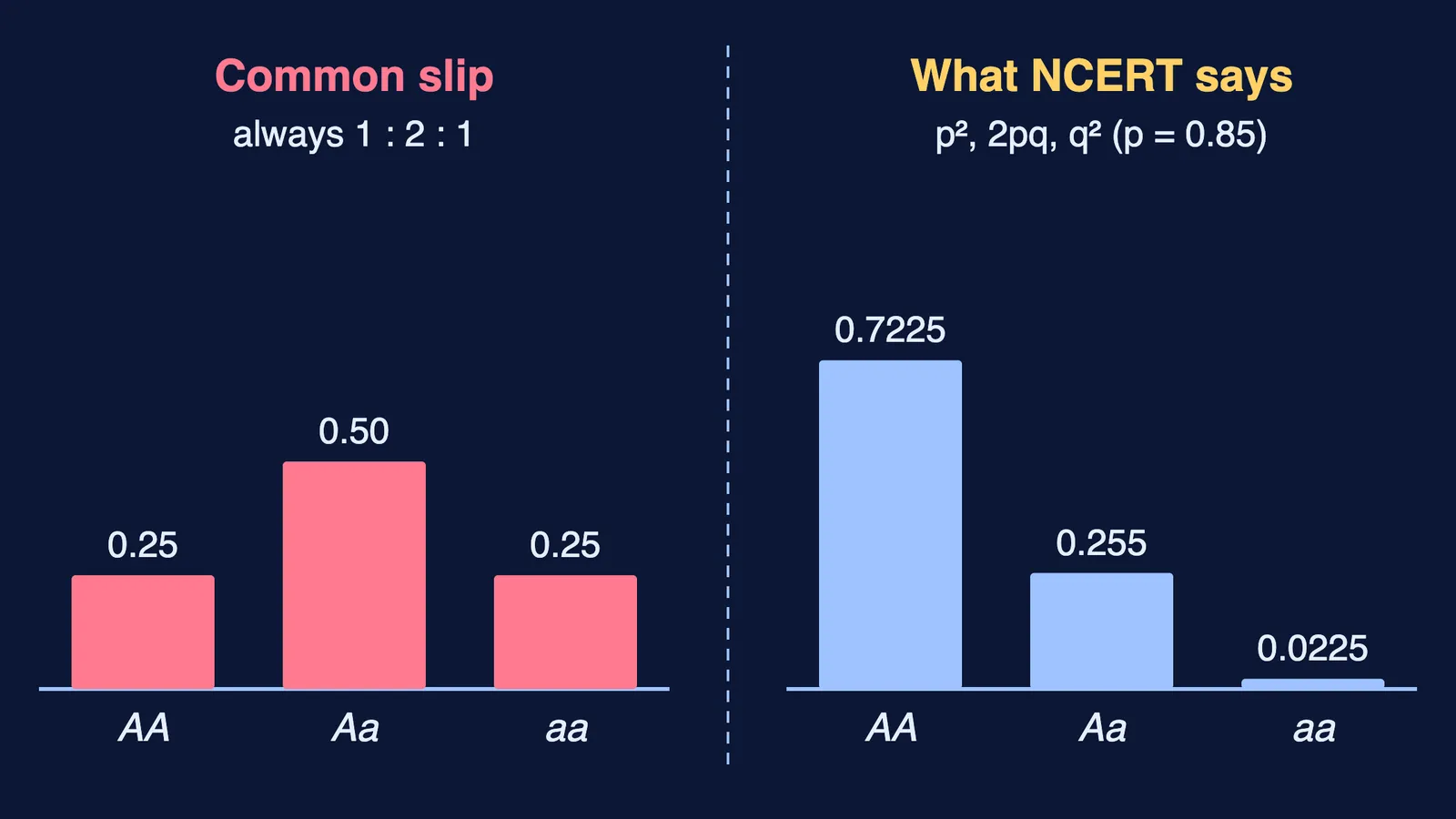
"A population in Hardy-Weinberg equilibrium has its genotypes in a 1:2:1 ratio."
Why it happens: 1:2:1 looks like p², 2pq and q² with the numbers already filled in. What NCERT says (6.7): AA, Aa and aa occur at p², 2pq and q², summing to 1 as the expansion of (p + q)²; equilibrium means allele frequencies stay constant across generations, not that they equal one half. Check: with p = 0.85 and q = 0.15, work out all three. (AA = 0.7225, Aa = 0.255, aa = 0.0225. They sum to 1, nowhere near 1:2:1. Only p = q = 0.5 gives 0.25, 0.5 and 0.25.) Habit: always compute p² and q² from the frequencies you are given; never assume halves. For a full step-by-step method, see how to solve a Hardy-Weinberg numerical.
Which evidence gets misread?
"Embryos replay the adult forms of their ancestors, and NCERT accepts this."
Why it happens: the gill-slit example is vivid, and the rejection is a single sentence that is easy to skip. What NCERT says (6.3): Haeckel (spelt Heckel in NCERT) proposed embryological support from features shared by vertebrate embryos but missing in adults, but Karl Ernst von Baer's careful study rejected it: an embryo does not go through the grown-up forms of other species. Check: a chick embryo shows a row of gill slits behind its head. Is it, at that moment, a small adult fish? (No. It shares an embryonic feature, not an adult stage.) Habit: if an embryology statement says embryos pass through other animals' adult forms, treat it as the rejected idea.
A 60-second self-check before you mark
Then match each idea to its scientist: use and disuse to Lamarck, saltation to de Vries, natural selection to Darwin.
Which of these slips keeps catching you? Fermi's AI tutor works out what you already know and builds a plan for the session.


