

On this page
In 1859 Charles Darwin wrote that the idea of the eye being formed by natural selection "seems, I freely confess, absurd in the highest possible degree" (On the Origin of Species, Chapter VI/Chapter_VI)). In the next sentence he said the difficulty "can hardly be considered real" if many gradations can be shown, "each grade being useful to its possessor". Living molluscs show many of those gradations today.
What is the "half an eye is useless" objection?
The objection: an eye only works with every part in place, so a half-built eye gives no advantage and selection could never favour it.
The flaw is assuming the only useful eye is a camera eye like ours. A simpler eye is a complete tool for a simpler job. Dan-Eric Nilsson's 2013 review in Visual Neuroscience sorts light sensing into four classes: non-directional (monitoring ambient light), directional (detecting light in some directions but not others), low-resolution vision and high-resolution vision. Each supports useful behaviour; see a simple directional eye at work in how planarians use eyespots to move away from light.
How did the eye evolve step by step?
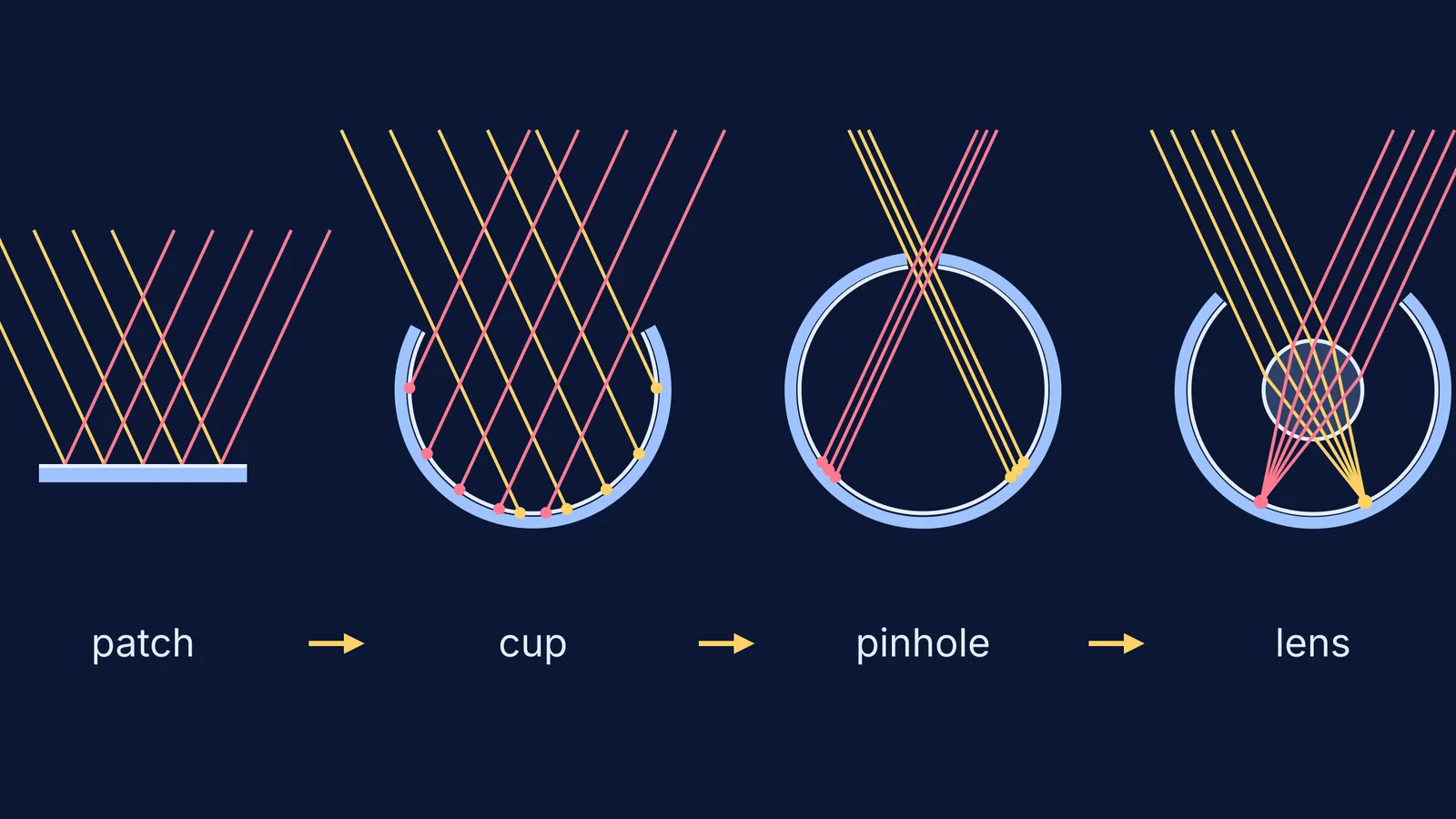
Michael Land and Russell Fernald's review The Evolution of Eyes (Annual Review of Neuroscience, 1992) describes the stages, and molluscs supply living examples.
Flat patch. Light-sensitive cells tell light from dark, but not direction. Nilsson and Pelger's model starts here, with "a light-sensitive patch" (Proceedings of the Royal Society B, 1994).
Cup. Sink the patch into a pigment cup and the walls shade some cells, so direction becomes readable. Land and Fernald report that such pit eyes are typically under 100 µm across, hold 1 to about 100 receptors, and occur in all but five of 33 animal phyla.
Deep cup, narrow opening. In the abalone *Haliotis*, the eye-cup is 1 mm long with a 0.2 mm pupil and perhaps 15,000 receptors.
Pinhole. The nautilus eye is almost 1 cm across, with a pupil that opens from 0.4 to 2.8 mm. A 2021 Nautilus genome study calls it "a unique and simple pinhole eye without lens or cornea", open to seawater.
Lens. The first lenses were probably denser material filling the cup, still seen in some snails; it reduces blur but gives no sharp image. Graded lenses with a focal length of about 2.5 lens radii evolved at least eight times, including in cephalopods such as the octopus and at least four times in snails, periwinkles among them. Fish reached the same design: see why a fish's eye lens is a ball.
Why would a pinhole eye evolve a lens?
Land and Fernald explain that narrowing a pinhole sharpens the image but darkens it; widening does the reverse. Even fully open, the nautilus image is about six times dimmer than an octopus's or a fish's (Annual Review of Neuroscience, 1992).
A worked example with the nautilus numbers: light let in grows with the square of the opening's diameter. Going from 0.4 mm to 2.8 mm is 7 times the diameter, so 7 × 7 = 49 times the light. But the blur spot can be no smaller than the opening, so the picture gets roughly 7 times blurrier. Land and Fernald note that almost any crude lens in the opening would improve sharpness, brightness or both, so selection should favour it. The puzzle is that the nautilus never took that step.
If ray geometry is easier to see than read, the Fermi Simulation Lab has interactive simulations for ideas like this.
How long did it take for the eye to evolve?
Nilsson and Pelger modelled a patch becoming a focused lens eye through small improvements, using deliberately pessimistic assumptions. Their abstract concludes the time needed is "only a few hundred thousand years" (Proc. R. Soc. B, 1994).
Land and Fernald cite work concluding that simple eye-spots evolved independently at least 40 times, and probably as many as 65 times (Annual Review of Neuroscience, 1992). Image-forming optics arose in only six of 33 phyla, but those phyla hold about 96% of known species. For how selection differs from older ideas, see Darwin vs Lamarck on the giraffe's neck.
How do you answer "half an eye" in an exam?
Run any "what use is half an X?" claim through four questions:
What job does the simplest version do? (A patch tells day from night.)
Does a living animal use it today?
Does each next step do the job better? (Cup gives direction, pinhole an image, lens a sharp, bright one.)
Is there a trade-off pushing to the next step? (Dim or blurry.)
A model answer: Darwin argued the eye could evolve if each small stage was useful. Living molluscs show those stages, from cup eyes and the nautilus pinhole to lens eyes in snails and the octopus. Each is a working eye for a simpler task.
If the link between selection and optics still feels loose, the Fermi Concept Library gives each concept in biology and physics its own lesson and its place in the map.
Asked what use half an eye is? Ask which half: the patch, the cup or the pinhole.


