

On this page
Before birth, a baby never breathes air. Its lungs are full of liquid and its oxygen comes from the placenta. Within minutes of birth the lungs must fill with air, the liquid must go, and the heart must send blood through the lungs instead of around them. Here is that sequence, step by step.
What is inside a baby's lungs before birth?
The fetal lung is not collapsed; it is filled with liquid that the lung itself secretes. A review by Hillman, Kallapur and Jobe in Clinics in Perinatology (2012) cites a measured airspace liquid volume of about 50 ml per kilogram of body weight in fetal sheep at term, before labour.
The same review gives the oxygen saturation of fetal blood in the left atrium as about 65%. Most blood from the right side of the heart is diverted through a side channel, the ductus arteriosus, so very little enters the lungs, whose blood vessels stay tight because oxygen there is low.
How does a newborn baby take its first breath?
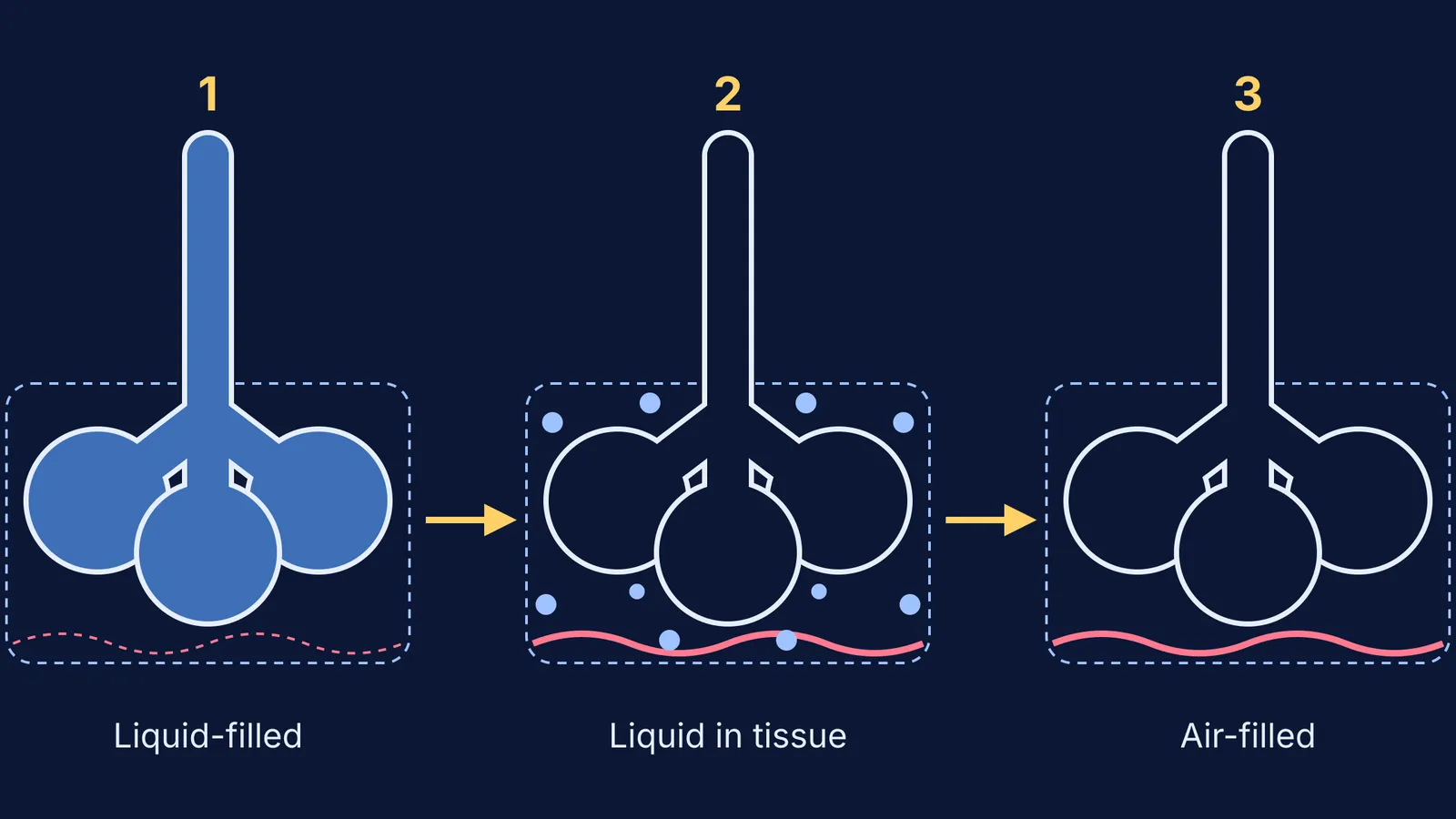
Stuart Hooper, Arjan te Pas and Marcus Kitchen describe the respiratory transition as three overlapping phases in a 2016 paper in Archives of Disease in Childhood. Combined with the Hillman review, the sequence is:
Hormones switch the lungs over. Cortisol, thyroid hormones and catecholamines such as adrenaline rise before birth. They stop the lung secreting liquid and start it pumping sodium out of the air spaces. Water follows the sodium.
The baby pulls hard. Newborns inflate their lungs with large negative-pressure breaths that pull liquid from the airways into the tiny air sacs. In newborn rabbits, most clearance happens while breathing in.
Phase one: liquid in the airways. While the airways are full of liquid, no gas exchange occurs.
Phase two: liquid in the tissue. The air sacs are mostly clear and gas exchange begins. The liquid now sits in the tissue around the sacs, raising pressure there, and some can flow back in.
Phase three: liquid gone. The liquid is cleared from the tissue and the lung works as an air-filled organ.
Some air stays behind. Newborn rabbits breathe in more volume than they breathe out, so air stays in the lungs between breaths. This leftover volume is the functional residual capacity.
What does surfactant do in a newborn's lungs?
Surfactant is a foamy substance (NHLBI) that coats the air sacs and lowers their surface tension, which lets them stay open throughout each breath, according to the Merck Manual. Without enough of it, the air sacs tend to collapse. Our explainer on why tiny alveoli need low surface tension works through the physics.
The lungs begin making the fats and proteins of surfactant from about 22 weeks of gestation (Hillman et al.), and labour releases it into the lung liquid. The Merck Manual says there is enough surfactant to keep the air sacs open by 34 to 36 weeks of pregnancy. Babies born earlier may not have enough, which can cause respiratory distress syndrome, which the NHLBI calls a common breathing disorder in newborns.
How does blood flow switch from the placenta to the lungs?
This happens alongside the first breaths, as the Hillman review and Stanford Medicine Children's Health describe:
The placenta is cut off. Clamping the cord removes the low-resistance placenta from the circuit, and the baby's blood pressure rises.
The lung's blood vessels relax. Air and oxygen raise nitric oxide and prostaglandin I2 in the lung, so resistance in its blood vessels falls quickly. In animal experiments, ventilating the fetal lung without changing oxygen levels increased lung blood flow by 400%.
The foramen ovale closes. Pressure rises in the left atrium and falls in the right, and this shift makes the opening between them close.
The ductus arteriosus starts to close. With lung pressure lower and body pressure higher, the channel is no longer needed, and its functional closure begins shortly after birth.
Our post on double circulation in humans follows the resulting two-loop circulation through the adult heart.
How can you remember the sequence for an exam?
Memorise a six-word chain: hormones, pull, clear, surfactant, relax, close. Then test yourself:
Where does the lung liquid go after the first breaths? (Into the lung tissue, then cleared.)
Why does a very premature baby struggle to keep its air sacs open? (Too little surfactant.)
What makes the foramen ovale close? (Left atrial pressure rising while right falls.)
Shunts and pressure changes are hard to picture from a page, which is what the Fermi Simulation Lab is for: interactive simulations for the ideas that are easier to see than to read. If an idea such as alveoli or the heart's chambers is shaky, the Fermi Concept Library gives each biology concept its own lesson.
Keeping warm is another job a newborn takes on at birth: see how brown fat keeps newborns warm without shivering.


